 By
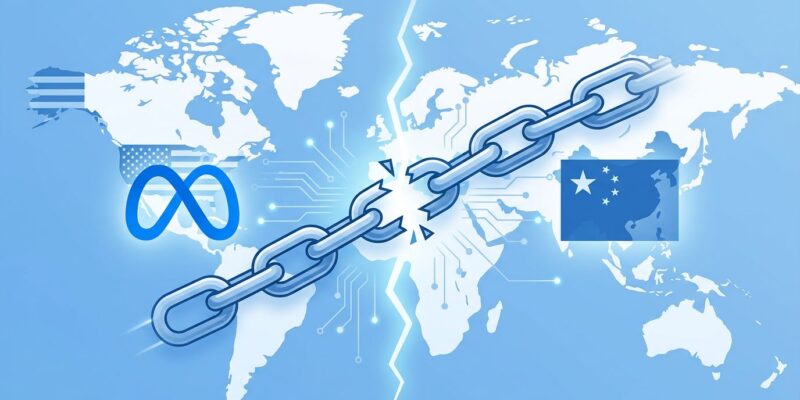
By China ordered Meta to “unwind” its $2 billion acquisition of Manus, an agentic AI startup founded by Chinese engineers. There’s just one problem: the deal closed months ago. Manus employees are already working at Meta’s Singapore offices. Investors like Tencent and HongShan Capital have been paid. The technology is integrated into Meta AI. China’s National Development and Reform Commission wants Meta to reverse all of that—but didn’t explain how.
The Impossible Ask
On April 27, China’s NDRC issued a terse one-line statement: it would “prohibit foreign investment in the Manus project” and require “the parties involved to withdraw the acquisition transaction.” No specific reasons given. No explanation of enforcement mechanisms. Just an order to unwind a deal that closed four months earlier in December 2025.
The practical reality makes this absurd. Manus employees have already integrated into Meta’s AI team. Benchmark, a US venture firm that invested in Manus, has already distributed payouts to its limited partners. The agentic AI technology Manus built—autonomous agents that can execute complex multi-step tasks—is presumably already merged with Meta’s infrastructure. How exactly do you reverse that? Do employees resign en masse? Do investors wire money back to Meta? Does Meta delete code commits?
Adding another layer of complexity: Manus relocated from China to Singapore in mid-2025, precisely to avoid this kind of regulatory entanglement. China is now asserting jurisdiction over a Singaporean company acquired by a US company, with no clear legal mechanism to enforce the order.
Why China Did This
This isn’t random bureaucratic overreach. It’s the latest move in the escalating US-China AI race. The context matters: the US has spent years restricting exports of advanced AI chips to China, trying to slow Chinese AI development. China responded in March 2026 with a massive AI and semiconductor subsidy program aimed at achieving self-sufficiency. Blocking Meta’s acquisition of Manus is part of the same playbook—prevent AI talent and technology from flowing to American companies.
Agentic AI, the technology Manus specializes in, represents a strategic frontier. These aren’t chatbots that answer questions. They’re autonomous systems that can plan, execute, and iterate on complex tasks without human supervision—navigating websites, filling forms, writing reports, analyzing data. Manus uses multiple AI models including Anthropic’s Claude 3.5 Sonnet and Alibaba’s Qwen, orchestrating specialized sub-agents for different functions. It’s the kind of capability nations treat as infrastructure, not just a consumer product.
China isn’t blocking this acquisition because of concerns about data privacy or regulatory compliance. It’s blocking it because three Chinese engineers—Xiao Hong, Ji Yichao, and Zhang Tao—built something valuable, and Beijing wants that value to stay within reach of Chinese interests, even if the company technically operates out of Singapore.
The Chilling Effect
If you’re a venture capitalist looking at a pitch deck from a Chinese-founded AI startup, this creates a new risk category: post-closing regulatory intervention. Even if a company relocates to a “neutral” jurisdiction like Singapore, even if the deal gets signed and closed, even if employees are integrated and investors are paid out, a foreign government might still blow it up months later.
For Chinese AI founders, the message is equally stark. Build something valuable in agentic AI, and China may decide you’re too strategically important to be acquired by a Western company. Your exit options just narrowed significantly. The growing tech rivalry between Washington and Beijing doesn’t care about your term sheet.
This also sets a precedent. If China can order the unwinding of a completed acquisition, what stops other countries from doing the same? The EU already has aggressive tech regulation. What if Brussels decides a US acquisition of a European AI startup threatens European “digital sovereignty” and demands a reversal six months after closing? The Manus block expands the playbook.
What Happens Next
Meta hasn’t publicly outlined its response. The company said in March the acquisition “complied fully with applicable law,” but that was before the block. Now it faces unpalatable options: challenge China’s jurisdiction and risk angering a massive market, negotiate some alternative structure that satisfies Beijing, or just absorb the regulatory headache and move forward with the integrated team.
The most likely outcome? Meta keeps the employees and the technology, pays whatever fines or penalties emerge, and the “unwinding” becomes a symbolic gesture rather than a practical reality. China gets to signal its willingness to intervene in cross-border AI deals. Meta gets to keep the capability it paid $2 billion for. And the global AI ecosystem becomes a little more fragmented.
The real question isn’t whether Meta can reverse this acquisition. It’s whether anyone will try another cross-border AI deal knowing it can be blown up retroactively. The answer to that will shape how AI development proceeds over the next decade—together, or increasingly apart.