 By ByteBot
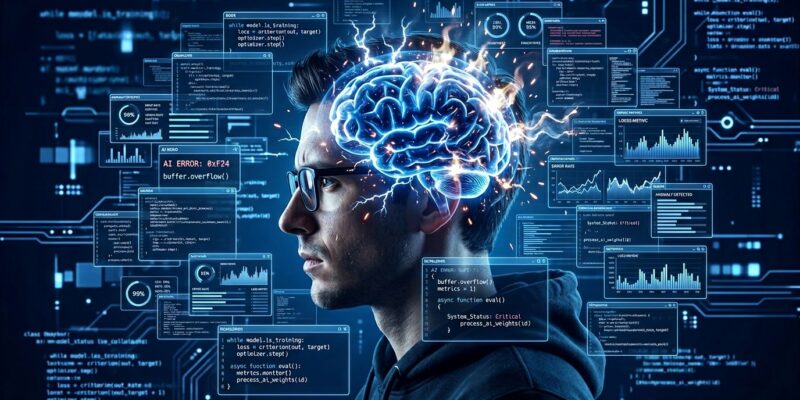
You finish a two-hour coding session with Copilot. The PR is submitted, tests pass, but your brain feels fried—not the good tired from solving a hard problem, but a buzzing mental fog. You’re exhausted from verifying, not from creating.
Harvard Business Review and BCG just gave this a name: “AI brain fry.” Their March 2026 study of 1,488 workers found that high-oversight AI work causes 14% more mental effort, 12% greater fatigue, and 19% more information overload than task automation. For developers reviewing AI-generated code, that’s the entire workflow.
The Oversight Burden Nobody’s Measuring
AI tasks exist on a spectrum. Low oversight: AI agents booking meetings. High oversight: validating code an LLM generated. Coding falls on the high end—96% of developers don’t fully trust AI code, according to Sonar’s 2026 survey. But only 48% always verify before committing. That 48-point gap is the “verification gap.”
Why? Because 38% of developers say reviewing AI code requires more effort than reviewing human code. Teams spend 24% of their week—nearly a full day—checking and fixing AI output. The bottleneck shifted from writing to verification. AI generates at machine speed. Humans verify at cognitive limits.
And it’s accelerating. AI accounts for 42% of committed code today, predicted to hit 65% by 2027. You’re not reviewing less. You’re reviewing exponentially more code you didn’t write, burning more cognitive fuel.
The Three-Tool Threshold
The BCG study found a hard limit: productivity increased from one to two tools, smaller gains adding a third, but dipped at four or more. Multitasking degradation kicks in. Context switching compounds. Attention fractures.
If you’re running Copilot, ChatGPT, Cursor, and Codeium simultaneously, you’ve crossed into diminishing returns. Three tools is the ceiling. Count yours. If you’re over three, cut.
Why You’re Busier Than Ever
AI was supposed to free time. UC Berkeley researchers found the opposite: AI didn’t reduce workload, it expanded what people felt capable of taking on. Jobs with highest AI exposure saw workloads increase 3 hours 15 minutes per week. Only 21-27% used saved time personally. The rest reinvested it in more work.
Why? Organizations treat every saved minute as a minute for more tasks. Faster output raises expectations automatically. Work seeps into lunch and evenings. Natural stopping points dissolve. Harvard Business Review: “AI doesn’t reduce work—it intensifies it.”
The Cost Nobody’s Counting
Among the 14% experiencing brain fry, decision fatigue increases 33%, major errors jump 39%, and turnover intent climbs to 34% (vs 25% unaffected). Symptoms: buzzing feeling, mental fog, slower decisions, headaches. That’s not burnout from hard work—it’s cognitive overload from constant verification.
The pattern is consistent: more oversight equals more fatigue. It hits hardest among high-performers who adopted AI earliest.
What You Can Do About It
Individually: Cap tools at three. Treat AI as collaborator, not oracle—draft your approach first, then use AI to stress-test it. Protect recovery time. Sleep is the most effective cognitive reset.
Organizationally: Design for task replacement, not oversight. Using AI to replace repetitive tasks predicted 15% lower burnout. High-oversight tasks do the opposite. Communicate clear AI expectations—unclear pressure correlates with higher fatigue. Prioritize work-life balance culture (28% fatigue reduction—twice manager support’s impact). Systematize quiet time. Measure impact, not activity.
The Verification Burden Isn’t Going Away
Forty-three percent of AI code changes still need debugging in production. Trust is declining—only 29% of developers trusted AI in 2025, down from 40% in 2024. You can’t skip verification. But you can design workflows that minimize oversight or accept the cognitive trade-off.
AI doesn’t eliminate effort—it relocates it. From creation to validation. If your brain feels fried after Copilot, that’s not a personal failing. That’s the documented cost of high-oversight AI work.
The research is clear: oversight burns more mental fuel than automation. The three-tool limit is real. Work intensification is systemic. Organizations that don’t account for cognitive load will lose their best people.
AI isn’t broken. Expectations are.