 By ByteBot
Anthropic just bought the startup that was quietly maintaining the official SDKs for OpenAI, Google, Perplexity, and Groq — and shut down the product. Stainless, a New York startup founded in 2022, was the invisible plumbing behind nearly every major AI lab’s developer libraries. The deal is valued at over $300 million. For developers, the short answer is: nothing breaks today. The longer answer is more interesting.
The Startup Nobody Knew Was Maintaining Everyone’s AI Libraries
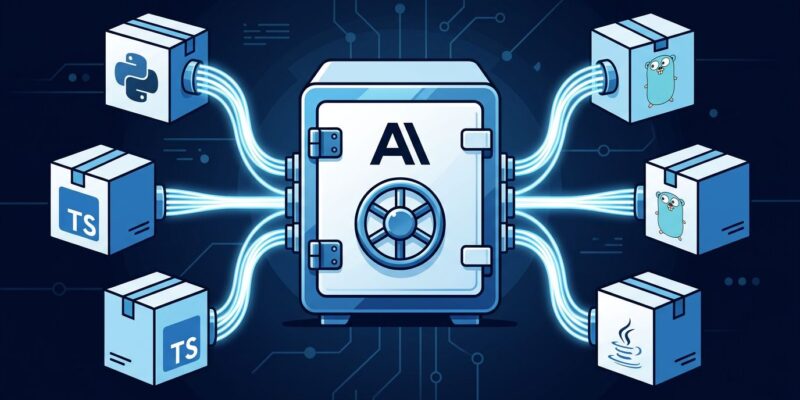
Stainless did one thing extremely well: it took an OpenAPI specification and generated production-ready SDKs across Python, TypeScript, Go, Java, and Kotlin — in under 30 seconds. Not just the stubs. Full libraries with retries, pagination, structured errors, type safety, and automatic updates whenever the API changed. OpenAI had tried maintaining its own SDKs internally and found the burden too high. So did many others. Stainless became the silent vendor powering official developer libraries across the AI industry’s biggest names.
Most developers never thought about it. They ran pip install openai and got a polished library that worked. That library was likely generated and maintained by Stainless.
What’s Actually Shutting Down
Anthropic is winding down all hosted Stainless products, including the SDK generator. No new signups. No new projects. Effective immediately.
Existing customers keep full ownership of the SDKs they’ve already generated. They can modify and extend them however they want. What they lose is the automated pipeline that kept those SDKs current as APIs evolved. That distinction matters: the libraries don’t break today. But when OpenAI ships a new endpoint or deprecates a parameter, updating the SDK is now a manual engineering problem rather than an automated one.
OpenAI switched to Stainless precisely because maintaining SDKs across multiple languages at API release cadence was expensive and slow. That problem doesn’t disappear — it just moves in-house.
This Is Bigger Than SDKs
Here’s where the acquisition becomes strategically significant. Stainless wasn’t just generating language libraries. It was also building MCP servers — the connectors that let AI agents interface with APIs and external data sources. Anthropic created the Model Context Protocol, which grew from 100,000 to 97 million monthly SDK downloads in 16 months. MCP is now the de facto standard for how AI agents communicate with the outside world.
Anthropic now controls the model (Claude), the protocol (MCP), and the toolchain for generating MCP servers and SDK connectors. Katelyn Lesse, Anthropic’s Head of Platform Engineering, was direct about the logic: “Agents are only as useful as what they can connect to.” This acquisition follows Anthropic’s recent move to hire Andrej Karpathy — part of a broader push to own the full AI development stack.
As Forrester analyst Biswajeet Mahapatra noted: “As model performance differences narrow, differentiation is increasingly driven by developer tooling, orchestration layers, and ecosystem connectivity.” Anthropic just acquired a piece of that ecosystem from under its competitors.
What OpenAI and Google Must Do Now
Their existing SDKs continue working. But going forward, both companies need to either rebuild SDK generation tooling in-house or migrate to an alternative. The main contenders are Speakeasy (10 languages, fewer dependencies than Stainless), Fern (acquired by Postman in January 2026), APIMatic, and the open-source OpenAPI Generator.
None of those fully replicates what Stainless did for MCP server generation specifically. That capability is now inside Anthropic.
What Developers Should Watch
If you’re building on Claude, expect your libraries to get better — faster iteration, better MCP tooling, tighter integration. If you’re building on OpenAI or Google APIs, your libraries work today. Watch for a possible lag between API updates and SDK updates over the next few months as those teams rebuild their toolchains.
The broader question is whether OpenAI or Google respond with acquisitions of their own in this space. Speakeasy and Fern are the obvious targets. The consolidation of AI developer infrastructure is accelerating, and the days of a neutral, shared tooling layer are ending.
The AI race has entered a new phase. It’s not just about whose model scores higher on benchmarks. It’s about who controls the pipes developers actually use to build with those models.