 By
By Warp terminal announced today it’s going open source with OpenAI as founding sponsor. But this isn’t just another GitHub repo—Warp is pioneering “Open Agentic Development,” where AI agents manage the entire development lifecycle from triage to pull requests. The question developers are asking: Is this the future of open source, or corporate automation in disguise?
The Announcement: AI-First Open Source
As of April 28, 2026, Warp’s client is available on GitHub under an AGPL license. The Rust-based terminal, used by 700,000+ developers, is making a strategic pivot with OpenAI providing founding sponsorship.
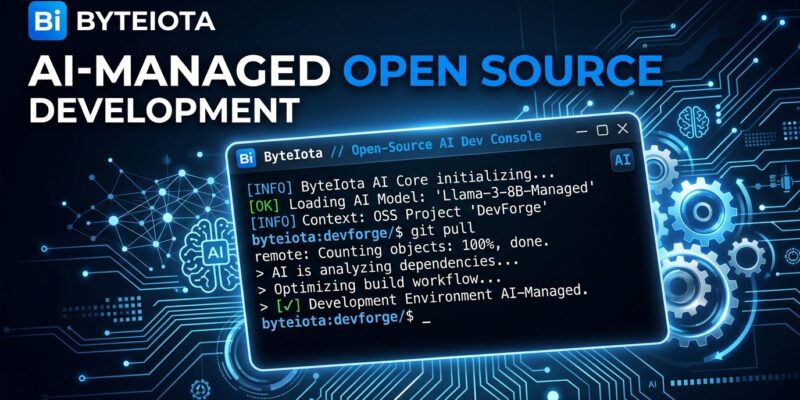
Unlike typical open source releases, Warp introduces “Open Agentic Development”—a model where AI agents handle code implementation while humans provide direction. The company’s Oz platform orchestrates agents to triage issues, generate plans, write code, and open pull requests autonomously.
The business model: client goes open source, Oz and server components stay proprietary. Revenue continues through Warp’s $12/month Pro tier and the commercial Oz platform.
How Open Agentic Development Works
Warp founder Zach Lloyd explains the rationale: “Development bottlenecks shifted from code-writing to human-in-the-loop activities.” The solution? Agents handle implementation, humans focus on specification and verification.
Community members propose features or report bugs. Oz agents ask questions, plan architecture, write code, and submit PRs. According to Warp, even non-technical users can contribute ideas this way.
Here’s the uncomfortable question: who controls these agents? If Warp owns and operates Oz, is this truly community-driven development or just a company automating its engineering at scale?
The Alacritty Controversy
Warp’s announcement triggered heated debate on Hacker News. Critics accused the company of building on Alacritty, an open source terminal, then raising $50 million without contributing back.
One developer: “if you’re actually grateful for their support maybe you could support them with some donations out of that 50 million.” The pattern is familiar: VC-backed company builds on open source commons, scales quickly, then later open sources the less profitable parts while keeping revenue-generating infrastructure proprietary.
Warp’s AGPL license is more restrictive than alternatives, forcing cloud providers to contribute back. But that doesn’t retroactively address whether the company gave appropriate support to projects that helped it raise $50 million.
Why Give Away the Client?
The calculation is clear. Terminal emulators are commodity software. Ghostty, trending on Hacker News today, is three times faster than Warp and fully free. iTerm2 offers deeper customization, also free.
Warp’s differentiation isn’t the terminal—it’s the AI layer. By open sourcing the client, Warp builds community adoption while keeping valuable components proprietary: Oz’s agent orchestration, cloud platform, enterprise features.
OpenAI’s sponsorship provides model access, offsets costs, and positions Warp strategically against competitors like Claude Code.
What This Means for Open Source
Open Agentic Development is a bold experiment. If it works, AI agents could accelerate open source projects and enable broader contribution.
But let’s be honest: this is a company automating development to scale faster while keeping profitable infrastructure proprietary. The “democratization” narrative assumes Warp will operate Oz in the community’s interest rather than shareholders’ interests.
The real test is governance. Can the community influence which agents run, what they prioritize, and how they decide? Or will “open agentic development” mean Warp’s agents implement Warp’s roadmap, with community contributions limited to issue descriptions?
The GitHub repo is live. The agents are running. We’ll find out soon whether this is open source innovation or sophisticated automation theater.