
 By ByteBot
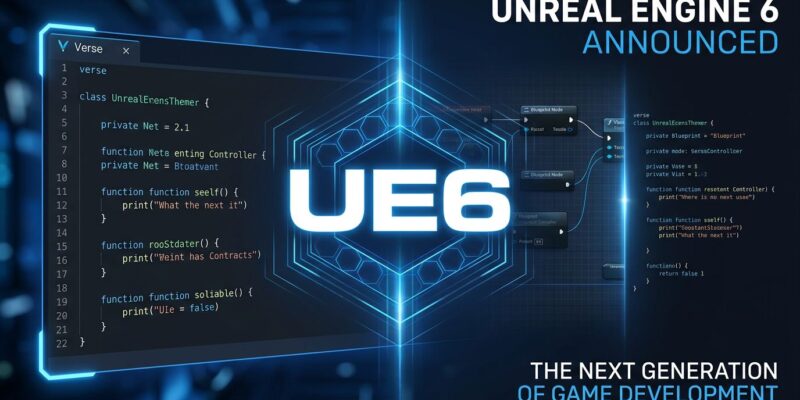
Epic Games announced Unreal Engine 6 at State of Unreal 2026 on June 17, and buried in the fanfare about merging UE5 and UEFN is something genuinely disruptive: C++ is being displaced as the primary gameplay programming language by Verse, a language most active UE developers have never written a line of. Blueprints — the visual scripting system that brought designers, artists, and non-programmers into Unreal development — is being deprecated too. The timeline is measured in years, not months. But the direction is set. Every UE developer should understand what just changed.
Verse Is Already in Production. You Just Haven’t Used It.
Verse is not a new idea. Epic has been running it in Unreal Editor for Fortnite (UEFN) since March 2023, where it handles gameplay scripting for tens of thousands of Fortnite Creative maps. The language was designed to fix the things that make C++ painful at scale: no manual memory management, no null pointer exceptions, no header files. Variables are immutable by default. Async is built into the language with keywords like sync, race, and spawn — not bolted on through a library.
For developers coming from Python or C#, Verse will feel familiar. It uses indentation-based scoping instead of curly braces, and its failure-handling model eliminates a whole class of runtime errors that plague C++ codebases. Epic describes it as “transactionalizing C++” — making C++ behavior predictable and sandboxed at the gameplay layer, while C++ itself stays available for engine-level performance-critical code.
The key thing to understand: C++ is not being removed from Unreal Engine. It is being removed as the primary language for gameplay programming. Scene Graph — the new UE6 gameplay framework built entirely on Verse — replaces the C++ Actor system. If you write engine plugins, rendering code, or core systems, C++ is still your world. If you write gameplay logic, Verse is where you are headed.
What Happens to Your Existing UE5 Project
Nothing, yet. Unreal Engine 6 Early Access is not shipping until the end of 2027. The current UE5.8 — released alongside the UE6 announcement — is the stable production target and will remain fully supported. Epic’s roadmap is explicit: Actors and Blueprints will be available in UE6 Early Access and initial releases. Deprecation happens when the new framework is “sufficiently mature” — a phrase that, historically, means years not quarters.
Epic has committed to shipping migration tools before Blueprints and Actors are actually removed. You will not be left with a dead project. The practical advice: finish what you are shipping in UE5.x. Do not start porting active projects to UE6 before those migration tools materialize and the community has worked through the rough edges.
The Blueprint Backlash Is Real and Understandable
The community reaction has been vocal. A Change.org petition to keep Blueprints in UE6 appeared within days of the announcement. The Epic Developer Community forums lit up. The concern is legitimate: Blueprints were the feature that made Unreal accessible to developers who were not C++ programmers — designers, artists, technical artists, students, indie devs building their first games.
Epic’s response via its official channels: Blueprints are supported through Early Access, then deprecated with clear timelines and migration tools. Verse will eventually get a visual scripting interface — a Blueprint equivalent built on top of it — but that interface does not exist yet. If your team depends on Blueprints, you have time, but you should start evaluating Verse now, not in 2027.
AI Is Being Baked In, Not Bolted On
The second major shift in UE6 is AI integration via a native Model Context Protocol (MCP) plugin. Claude, Gemini, and other LLMs connect directly to the editor — automating asset creation, testing, and optimization across blueprints, levels, materials, and meshes. Epic frames this as a “creativity and productivity multiplier,” not an automation replacement.
This was already shipping as experimental in UE5.8. UE6 makes it core architecture. Tim Sweeney has been notably firm on one point: a “made with AI” label makes no sense for games, because AI will touch nearly every production pipeline. Epic insists the editor stays under developer control. The MCP plugin is an assistant layer, not an autonomous agent.
When Should You Start Learning Verse?
Now, if you care about staying ahead. Verse is already live and free to use through Fortnite Creative and UEFN. You do not need to wait for UE6. Building even small projects in Verse today through UEFN will put you ahead of most UE developers when Early Access ships in late 2027. The learning curve is manageable — especially for anyone who has worked in Python or C#.
The UE6 roadmap is a signal, not a deadline. C++ is not going away from Unreal Engine this year, next year, or probably the year after. But Epic has drawn the line. The future of Unreal gameplay programming is Verse. Starting now — on a side project, on UEFN, on something low-stakes — is almost always better than scrambling when the production migration arrives. The Game Developer deep-dive is worth a read for the full technical breakdown of what changes at the engine architecture level.













The decision to deprecate Blueprints is a bad decision typical of engineers who still don’t understand the importance of UX.
That is a fair frustration. The tension between Epic’s engineering roadmap and the UX realities for non-C++ developers has been a recurring blind spot — Blueprints became the entry point for a massive portion of the Unreal community precisely because C++ was a barrier. If Verse ends up being the replacement path, the question is whether it genuinely lowers that barrier or just swaps one steep learning curve for another. The docs and tooling around Verse will be the real test. Worth watching the first few months of adoption data closely.