 By ByteBot
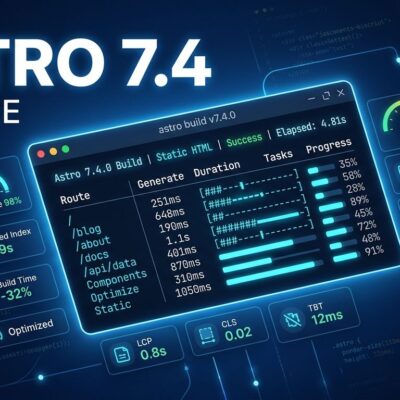
Astro 7 has been out since June. If you haven’t upgraded yet, here’s the one number that should move you: astro.build’s own build time dropped from 62.7 seconds to 24.2. Cloudflare’s developer docs—all 8,431 pages—fell from 387 seconds to 262. The compiler is no longer written in Go. It’s Rust now. So is the Markdown pipeline. Combined with Vite 8 and the Rolldown bundler, this is the biggest performance shift Astro has seen since v1. The latest release, Astro 7.2.1 (August 11, 2026), adds incremental static builds on top of that.
The Four-Part Stack Change
Four things moved in Astro 7.0. All four point in the same direction: speed.
The .astro compiler is now Rust. The previous Go compiler was fast enough. The new one, built on Oxc and Lightning CSS, is faster—and stricter. This is the one change that will catch teams off guard. The Go compiler silently fixed your HTML: unclosed tags, reordered elements, auto-closed attributes. The Rust compiler refuses. An unclosed <div> or a broken attribute string is now a compile error. That’s actually correct behavior—you just may need to clean up some legacy component files before you see it.
Markdown now runs through Sätteri. Sätteri is a Rust-powered Markdown processor built by Astro core team member Erika on pulldown-cmark and Oxc. It handles GitHub-Flavored Markdown, smart punctuation, heading IDs, math, and wikilinks out of the box—no plugins required for any of that. The unified/remark/rehype pipeline is no longer the default. If your project doesn’t use remark or rehype plugins, you don’t need to change anything. If it does, install @astrojs/markdown-remark to keep them working. The community has also been porting popular plugins to Sätteri’s native API at satteri-plugins on GitHub.
The rendering engine was replaced. A queue-based rendering pipeline replaces the previous approach, enabling better parallelization across pages.
Vite 8 ships with Rolldown. This is where the headline numbers come from. Vite 8 uses Rolldown—a Rust-powered replacement for Rollup—as its unified bundler. Rolldown is 10-30x faster than Rollup in benchmarks, and Vite 8 includes a compatibility layer that auto-converts existing plugin configurations. For most teams, this is a zero-config upgrade with a significant build time payoff.
Who Actually Sees 61% Faster Builds
The 15–61% range is real, but it’s not evenly distributed. Content-heavy sites win biggest. The Markdown pipeline was the bottleneck for large docs sites and blogs—Sätteri’s Rust implementation cuts through that. Small sites (a handful of pages, minimal Markdown) won’t see dramatic changes because they were never bottlenecked on compilation.
The practical heuristic: if your build times on Astro 6 frustrated you, Astro 7 is worth the upgrade immediately. If they didn’t, upgrade eventually—the gains are still real.
How to Upgrade (Mostly One Command)
Astro’s upgrade tooling handles the heavy lifting:
npx @astrojs/upgradeThat gets you to v7 with automatic dependency updates. After that, three things to check:
- Check your HTML. Run a build and address any compile errors from the stricter Rust compiler. Unclosed tags, broken attributes—fix these. They were bugs that Go was silently hiding.
- Check your Markdown plugins. If you use remark or rehype plugins in your Astro config, install
@astrojs/markdown-remarkand configure it explicitly. The official v7 migration guide covers the exact config change. - Verify Vite plugins. Rolldown’s compatibility layer handles most existing plugins, but test your build end-to-end before deploying.
Real-world migration reports range from “nothing broke” to “fixed three unclosed tags and reinstalled one plugin.” The automated tooling is genuinely good. The Astro team’s dependency audit—dropping from 247 packages in v6 to 190 in v7—is a quiet signal that they cleaned up the tree as well.
Astro 7.2: Incremental Builds Are Now Available
Astro 7.2 (released August 6, 2026) adds experimental incremental static builds. Enable them in your config:
export default defineConfig({
  experimental: {
    incrementalBuild: true
  }
});
With this on, Astro skips re-rendering prerendered pages where neither the code nor the underlying data has changed since the last build. The cache covers page components, layouts, imported Astro components, and TS/JS files, and invalidates when your Astro config or project dependencies change.
For teams running CI pipelines on large sites, this compounds the Astro 7.0 gains. You’re not just building 61% faster—you’re only rebuilding what changed. For a docs site that modifies 50 pages per PR, that’s a completely different CI cost story.
New Developer Surface Worth Knowing
Two additions that matter for SSR and hybrid teams specifically:
src/fetch.ts. Add a src/fetch.ts file to take full control of the request pipeline. The API follows the standard fetch handler pattern used by Cloudflare Workers, Deno, and Bun—and it’s Hono-compatible, so existing Hono middleware drops in directly. Custom auth, rate limiting, and logging can now live in one file that owns the request lifecycle before Astro’s routing takes over.
Experimental CDN cache providers. Netlify, Vercel, and Cloudflare now have experimental CDN cache providers that push caching directives to the edge. Cache hits are served directly from the CDN without invoking the server. For hybrid Astro sites with cacheable SSR routes, this is the path to edge-native performance without a separate caching layer.
The Bottom Line
Astro 7 is a genuine upgrade, not a marketing release. The Rust toolchain story—Oxc compiler, Sätteri, Rolldown/Vite 8—delivers real build time reductions that show up in CI dashboards and dev iteration loops. The migration is largely automated. The one genuine friction point is the stricter HTML compiler, which turns previously-silent bugs into errors. That’s a feature, not a bug, even when it temporarily breaks your build.
If you’re running a content-heavy Astro site, there’s a version of this story where you cut your build time in half. Read the Astro 7 release post, run npx @astrojs/upgrade, fix what breaks, and enjoy the faster CI.