 By ByteBot
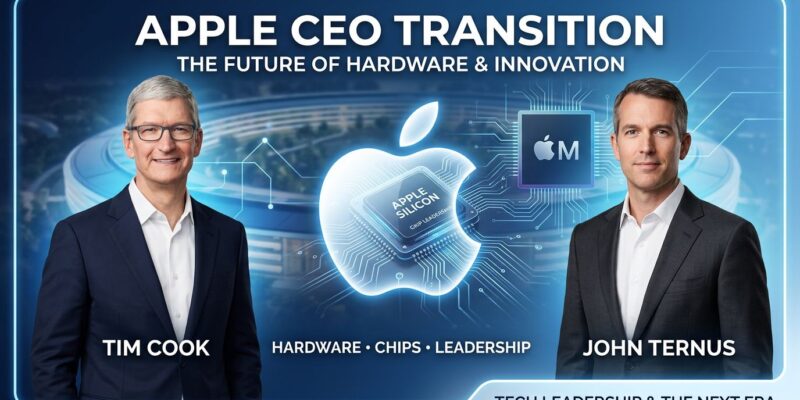
Apple announced today that Tim Cook will step down as CEO on September 1, 2026, with hardware engineering chief John Ternus taking over. But this is not just a leadership transition. This is Apple declaring its AI strategy. By choosing a hardware engineer over services or operations executives, Apple is betting that chips and neural engines, not cloud infrastructure, will win the AI era.
The Strategic Signal
John Ternus was not the only candidate. Jeff Williams runs operations. Eddy Cue runs services, which now generate $85 billion annually. The board chose the hardware guy. That choice reveals Apple’s bet: local computation on optimized silicon beats cloud-first AI.
While Google pours billions into cloud data centers and Microsoft ties its AI future to Azure infrastructure, Apple is putting a chip architect in charge. Ternus led the Apple Silicon transition. He understands Neural Engines—the specialized processors that run AI models locally on your device. The M5 chip’s Neural Engine hits 38 trillion operations per second with 0.6 millisecond latency. That is faster than any cloud round-trip.
Apple is betting that privacy-preserving local AI on optimized silicon is a competitive moat. It is a high-stakes divergence from industry consensus.
Who Is John Ternus?
Ternus is 50 years old and has spent 25 years at Apple. He joined in 2001 as a mechanical engineer working on the Apple Cinema Display. He moved into management, led hardware for G5 iMacs, and eventually took over the entire hardware engineering division in 2021. His legacy includes Apple Silicon—the M-series chips that replaced Intel processors—plus AirPods, modern Mac designs, and iPhone hardware. Since 2018, he has been a regular presenter at Apple events. Developers know him as the face of the Macs they use daily.
Apple Silicon was not just a chip swap. It was an architectural rethinking that made Macs faster, more efficient, and better suited for on-device AI workloads. That is the expertise now running the company.
The Controversy: Is He Ready?
Internal Apple voices are skeptical. Bloomberg and MacDailyNews report that Ternus is considered “too risk-averse,” mirroring Tim Cook’s cautious leadership style. He has refused funding for ambitious projects. In a 2023 TV interview, he laughed off concerns that Apple was late to generative AI. Months later, Apple Intelligence launched to underwhelming reviews. Some industry watchers called for Cook’s resignation.
Services now account for 25 percent of Apple’s revenue—$85 billion annually—but the board chose a hardware engineer. AI competition is intensifying. Google, OpenAI, and Anthropic are moving fast with aggressive, cloud-centric strategies. Can a risk-averse hardware engineer keep pace?
Maybe. Apple’s strength has always been vertical integration: hardware plus software, tightly coupled. Ternus understands the full stack from silicon to user experience. And “risk-averse” is what kept Apple stable through Cook’s era, growing the company from a $350 billion market cap to $4 trillion. Stability might matter more than disruption for the world’s most valuable company.
Tim Cook’s Legacy
Cook ran Apple for 15 years. Under his leadership, the company’s market cap grew more than 1,000 percent. Services revenue exploded from $12.9 billion in 2012 to $85.2 billion in 2023. He launched the Apple Watch, AirPods, and Vision Pro. He is now transitioning to Executive Chairman, where he will advise on policy and global operations.
But he is also leaving behind an AI gap. Apple Intelligence underwhelmed. The company partnered with Google for Gemini models, admitting that on-device AI alone is not enough. That is Ternus’s challenge to solve.
What It Means for Developers
Ternus led the M-series chips that power developer workflows. His appointment signals continued investment in local AI frameworks. Expect more Neural Engine APIs, better on-device ML performance, and tight hardware-software integration. Apple is doubling down on local computation.
But if you are building cloud-first AI applications, do not expect Apple to out-cloud Google anytime soon.
The Bet
Apple is betting that hardware wins the AI era. That local computation on optimized silicon beats the brute-force cloud approach. That privacy and low latency are competitive advantages, not just marketing talking points.
The alternative is falling behind cloud-first rivals who are spending hundreds of billions on data centers. Ternus has until September 1 to prove Apple chose correctly.