 By ByteBot
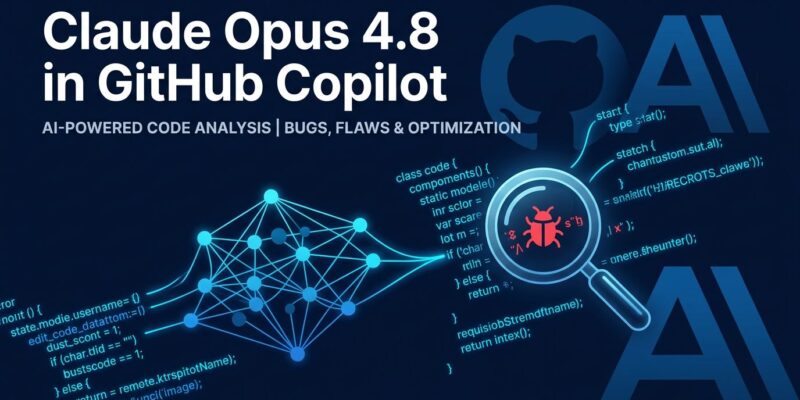
Claude Opus 4.8 is generally available in GitHub Copilot as of May 28, 2026. Copilot Pro+, Business, and Enterprise users can select it from the model picker right now. The headline numbers: a 4x improvement in catching code flaws, a meaningful step forward on agentic coding benchmarks, and no price change at the API level. There is a default configuration change that will bite teams upgrading existing pipelines, and a billing transition landing June 1. Here is what actually matters.
The Number That Should Drive Your Decision
Forget SWE-Bench for a moment. The most operationally significant improvement in Opus 4.8 is that it is four times less likely than 4.7 to miss flaws in code it produces. In practice, that means overlooking coding failures only 3.7% of the time. For teams using Copilot in agentic review pipelines or treating AI output as near-production code, this is a direct reduction in bugs that ship. That is the upgrade argument, and it is a good one.
Benchmark Reality Check
The broader numbers hold up. SWE-Bench Pro jumps from 64.3% to 69.2%, a 4.9-point gain that reflects genuine improvement on multi-step coding tasks. On GDPval-AA, the agentic evaluation Elo, Opus 4.8 sits at 1,890 — up 137 points over 4.7 and roughly 121 points clear of the next-best model. That implies about a 67% win rate against GPT-5.5 on agentic tasks. Long-context reasoning also took a notable leap: performance at the 1M-token context window improved from 40.3% to 68.1%, which matters for large codebase work.
The honest caveat: GPT-5.5 still leads on Terminal-Bench 2.1 (78.2% vs. 74.6%). If your workflow is terminal-heavy automation, Opus 4.8 does not close that gap. Also worth noting is a slight regression in prompt injection resilience — 7% versus 2.3% for 4.7 without safeguards. Not a dealbreaker, but relevant for security-conscious deployments.
How to Enable It
Individual users on eligible plans can select Claude Opus 4.8 directly from the model picker in VS Code (all modes: chat, ask, edit, and agent), Visual Studio, JetBrains, Xcode, Eclipse, the Copilot CLI, GitHub Mobile, and the Copilot App. That is essentially full IDE coverage.
Organization admins have an extra step: the Claude Opus 4.8 policy must be enabled in Copilot settings before users can access it. If you are on Business or Enterprise and wondering why the model is not appearing, check the admin console first.
Pricing: What “Same Price” Actually Means
At the API level, Opus 4.8 is priced identically to 4.7: $5 per million input tokens, $25 per million output tokens. Same cost, better performance — that is a clean value proposition. A new Fast Mode option runs at $10/$50 per million for 2.5x throughput, which makes sense for latency-sensitive interactive tooling.
Inside GitHub Copilot, the picture is messier until June 1. Opus 4.8 launches with a 15X premium request multiplier, which burns through monthly request quotas quickly under the current billing model. On June 1, GitHub transitions Copilot to usage-based billing (GitHub AI Credits tied to token consumption), which should bring more predictable pricing clarity. Evaluating Opus 4.8’s Copilot cost after that transition is a better baseline than the pre-June-1 multiplier situation.
The Gotcha: Default Effort Just Changed
This one will catch teams off guard. With Opus 4.8, the default effort parameter shifts from “medium” to “high.” That means any existing pipeline upgraded from 4.7 without an explicit effort setting will consume more thinking tokens than before. If you are watching token costs on agentic workflows, set effort: "medium" explicitly before assuming cost parity.
There is also a breaking change for teams using the extended thinking API. Code relying on thinking: {type: "enabled", budget_tokens: N} will need to migrate to the adaptive thinking API. Anthropic has documented the migration path, but it is not automatic. Check your integration code before upgrading production deployments. For a full benchmark breakdown, Artificial Analysis has an independent deep-dive worth reading.
Bottom Line
Opus 4.8 is the rare AI model upgrade where Anthropic’s own characterization — “modest but tangible” — is exactly right and also understates the practical value. A 4x reduction in self-missed code flaws is not modest for anyone shipping production software. The benchmark gains on agentic tasks are real. The price is unchanged at the API level. Switch to it if you are on Copilot, but read the effort default change and check your extended thinking integrations before flipping the switch on automated pipelines.