 By ByteBot
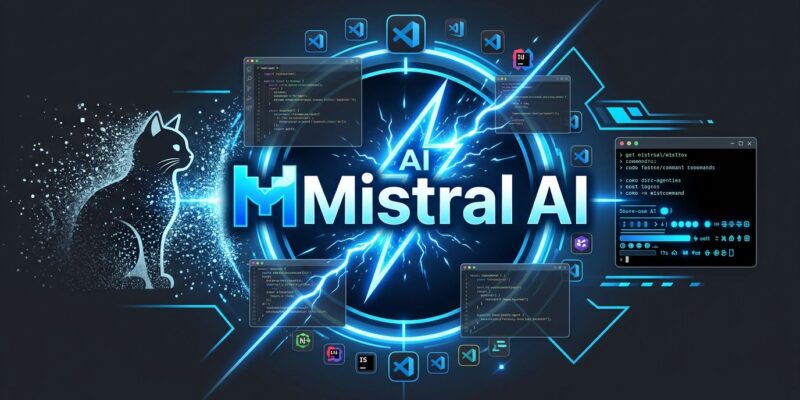
Mistral AI renamed Le Chat to Vibe on May 28 and relaunched it as a full AI coding agent — complete with a VS Code extension, remote cloud agents, and pull request generation out of the box. If Claude Code or Codex is already in your workflow, Mistral Vibe coding agent is now competing directly for that slot. Here is what shipped, what the benchmarks actually show, and whether it is worth a look.
What Shipped
Vibe is a single product and license that covers both productivity work and coding. If you were on Le Chat, your plan, history, and settings migrated automatically — nothing to do on your end. The platform splits into two modes: Work Mode for calendar, inbox, and long-running research tasks, and Code Mode for the developer use case that matters here.
Code Mode gives you three ways in:
- VS Code extension: mistralai.mistral-vibe-code, available now on the VS Code Marketplace. It lives in a side panel, attaches open files automatically, and lets you @ mention other files or directories for broader context.
- CLI: Open source under Apache 2.0, installable via
pip install mistral-vibe. The GitHub repo has 2,000+ stars and runs on Pydantic, Rich, and Textual — meaning it is hackable if you want to modify the agent loop. - Web: code.mistral.ai runs remote sessions in isolated cloud sandboxes, useful if you do not want a local install or want to offload tasks to background agents that keep working while you are doing something else.
The agent integrates with GitHub, GitLab, Jira, and Linear out of the box and can generate pull requests directly. JetBrains and Zed support is available via ACP. Slack integration is arriving in June 2026.
The Benchmark Reality Check
Mistral powers Vibe’s complex coding tasks with Mistral Medium 3.5, which scores 77.6% on SWE-Bench Verified — the benchmark that tests whether a model can resolve real GitHub issues from open-source repositories. That is a meaningful number. It is not, however, the best number.
Claude Sonnet 4.6 sits at 79.6% on the same benchmark. Claude Opus 4.7 hits 87.6%. GPT-5.5 leads the field at 88.7%. According to the SWE-Bench leaderboard, Mistral Medium 3.5 trails Claude Sonnet by 2 percentage points and GPT-5.5 by 11. For routine coding work — writing tests, refactoring files, fixing clear bugs — that gap likely will not matter. For complex, multi-file architectural changes, the frontier models still have an edge, and the community has noticed: “Vibe handles routine coding tasks well, but trails frontier closed models on complex multi-step refactors.”
The honest framing is that Mistral Medium 3.5 is a solid mid-tier coding model, not a benchmark leader. However, benchmarks are not the full story here.
What Actually Differentiates the Mistral Vibe Coding Agent
Three things separate Vibe from Codex and Claude Code in ways that matter to a specific set of developers:
The CLI is open source. Apache 2.0 means you can fork it, modify the agent loop, swap in a different model, or build tooling on top. Claude Code and Codex are proprietary products. If you need to customize your coding agent or audit what it is doing, this is a meaningful difference. ByteIota has been tracking the broader AI coding agent space, and open-source infrastructure remains a real differentiator.
It is model agnostic. Community feedback confirms you can use Vibe’s harness with Claude Sonnet 4 or other models — you are not locked to Mistral models. This is unusual for a vendor-built tool and reduces the cost of trying it without commitment.
On-premises and VPC deployment. Claude Code runs in Anthropic’s infrastructure. Codex runs in OpenAI’s. Vibe supports on-prem, VPC, and cloud provider deployments, which is a genuine differentiator for enterprise teams in regulated industries or European organizations with data residency requirements.
Moreover, pricing is worth noting: Pro runs $14.99 per month, undercutting GitHub Copilot Pro at $19 per month and landing well below Claude Max tier pricing.
The Bigger Picture
Mistral rebranding Le Chat is not just a product decision — it is a signal about where the company is heading. With 1,000 employees, a new 10 MW inference data center outside Paris opening in Q3 2026, and industrial customers including Airbus and BMW, Mistral is transitioning from model vendor to full-stack AI company. Vibe is the consumer and developer face of that bet.
For European developers or teams that want a credible alternative to US-headquartered AI tooling, Mistral now has a real coding product — not just a competitive model. That matters, and it is why the Hacker News discussion of the AI Now Summit pulled 411 points.
How to Try It Today
If you want to test Vibe without commitment, the free tier covers basic usage:
# Install the CLI
pip install mistral-vibe

# Start the agent
mistral-vibe

# Use plan mode for read-only exploration before making changes
mistral-vibe --profile plan
Alternatively, install the VS Code extension directly from the Marketplace and connect via your Mistral account. Remote agents at code.mistral.ai require no local setup and run in isolated cloud sandboxes.
If Codex or Claude Code already handles everything you need, Vibe’s benchmarks do not make the switch obvious. But if open-source flexibility, on-prem deployment, or European data residency is a real requirement — Mistral just made a case worth taking seriously.