 By ByteBot
Researchers at the University of Minnesota have built a living cell from scratch — assembled entirely from non-living chemicals — and watched it grow, copy its genome, and split into daughter cells. For the first time in history, the complete engineering blueprint for a functional cell cycle exists, and it works.
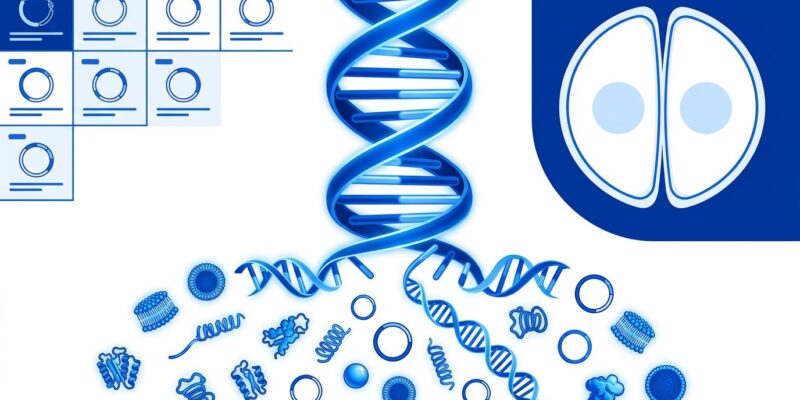
The cell, nicknamed SpudCell, was created by associate professors Kate Adamala and Aaron Engelhart. It contains between 150 and 200 molecular components packed into a lipid membrane. Its genome is 90 kilobase pairs split across seven separate DNA plasmids — smaller than the 113 kbp previously theorized as the minimum viable genome size. Published as a preprint on July 1, the work has not yet been peer-reviewed, but the achievement is already the top story on Hacker News and across synthetic biology circles.
How It Works
The engineering details are worth slowing down for. SpudCell’s seven-plasmid genome structure isn’t incidental — it means different cellular functions can be programmed and swapped independently, like separate software libraries. When a plasmid is modified, only that function changes. This modularity is one of the most significant engineering insights in the research.
Division happens through a mechanism that bypasses one of synthetic biology’s longstanding bottlenecks. Natural cells divide using a cytoskeleton — an internal scaffolding system that pinches the cell in half. SpudCell doesn’t have one. Instead, fusion proteins crowd together on the membrane surface, and the mechanical stress from that crowding causes the membrane to split on its own. The team demonstrated five generations of replication, with faster-growing variants outcompeting slower ones — a rudimentary form of selection.
The limitation is real: SpudCell cannot produce its own ribosomes. It requires external “feeder liposomes” delivering ribosomes and transfer RNA to keep running. Each generation takes about 12 hours at 30°C. It is not self-sustaining. Adamala describes it plainly: “an incredibly wimpy organism that right now basically does nothing other than to eat and occasionally make a daughter cell.”
The Wright Flyer Moment
Adamala’s own framing is the most useful. She called SpudCell “a Wright Flyer — the first bike frame with wings that flies 100 feet.” That’s the right way to hold this. The Wright Flyer was impractical, fragile, and dependent on specific conditions. It also changed everything, because it proved the underlying physics worked.
SpudCell proves the underlying biology works. The complete ingredient list — every chemical, every molecule, every concentration — is now known for a functional cell cycle. No natural cell offers that. Natural cells still have unknown components. SpudCell’s chemical definition is total. Adamala: “I know the full ingredient list of the cell, I know exactly what chemicals, what molecules at what concentrations.”
That completeness is what makes it a milestone, not the five generations or the 12-hour cycle time. The engineering question — can we assemble a cell cycle from non-living parts? — has been answered.
What It Unlocks
The applications Adamala and Engelhart describe operate on a decades timeline, and that’s appropriate. SpudCell in its current form produces nothing commercially useful. But the research enables work that will:
- Produce drugs with novel amino acids that current pharmaceutical synthesis cannot achieve
- Grow materials at biological temperatures, replacing energy-intensive industrial manufacturing
- Generate fuels without petrochemicals
- Enable living sensors — cells engineered to detect and respond to specific environmental conditions
The team launched Biotic, a public-benefit institution with roughly 0 million in seed funding, co-founded by Adamala, Stanford’s Drew Endy, Jan Jedryszek, and entrepreneur Chris Raggio. The goal: release all data and methods openly, establish shared protocols, and let researchers globally build on this foundation.
Is It Alive? (Wrong Question)
The debate over whether SpudCell qualifies as “life” is already running hot in academic circles. Endy — who co-founded Biotic with Adamala — drew a clear line: “I would say Kate has constructed a cell. I don’t think she’s created life.” His argument is that the cell cannot evolve via natural selection; the genetic changes are engineered, not selected. Nobel laureate Jack Szostak adds that a truly comparable cell would need to produce its own ribosomes.
These are fair points. They’re also the wrong frame for anyone thinking about what this means for engineering and technology.
Whether SpudCell meets a philosophical definition of life is a question for biologists and ethicists. The engineering question — can we build a functional cell cycle from known components? — has been answered. The next engineering question — can we make it self-sustaining? — is now the work. Synthetic biology doesn’t need SpudCell to be “alive.” It needs the blueprint. It has one.
Why Developers Should Pay Attention
Synthetic biology is increasingly framed as programming for living systems. The SpudCell architecture makes that framing concrete: seven modular plasmids, each controlling a separate function, each independently programmable. That’s a cell that looks like a software architecture, not an organism.
The convergence with AI is already underway. Machine learning models predict protein folding, optimize genetic sequences, and model cell behavior — the same tools developers use for data pipelines are being applied to biological design. DNA data storage, living environmental sensors, and programmable therapeutics are all real research directions that intersect directly with software engineering disciplines.
SpudCell is not an immediate product. It is a proof of concept for a field that is about to get very interesting, very fast. The biological engineering community now has what the aviation world had in 1903: a working demonstration that the fundamental goal is achievable. Everything that follows is iteration.