 By
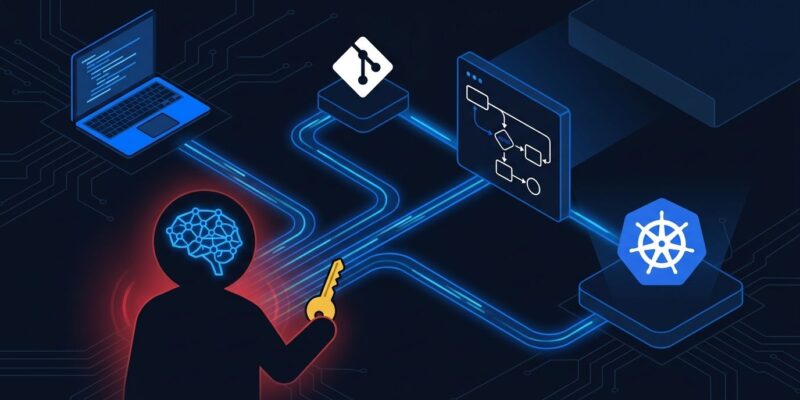
By Your AI coding agent might already be inside your CI/CD pipeline — holding credentials, reading secrets, pushing code. Not as a hypothetical. The CNCF published a six-stage threat model on August 7 that maps exactly how this happens, from developer laptop to Kubernetes runtime. Two real incidents in 2026 already compromised thousands of developer machines through this exact pathway. The gap between AI tool adoption and pipeline governance is now a security problem, and it’s yours to fix.
The Moment Everything Changes
There’s a line most teams cross without noticing: when an AI agent shifts from suggesting code to executing actions with real credentials. Once an agent holds a Git token, a cloud service account, or a Kubernetes ServiceAccount, it’s no longer a coding assistant. It’s a non-human identity with a blast radius. It can read secrets, push commits, approve deployments, and enumerate cluster resources — without anyone in the chain signing off.
This is the structural risk shadow AI creates in pipelines. It’s not about the AI making mistakes. It’s about what happens when someone makes the AI make mistakes on purpose.
Six Places You’re Exposed
The CNCF threat model identifies six attack surfaces between a developer’s laptop and a running Kubernetes workload:
- Developer laptop — Pasting error logs with API tokens into public AI services. Leaking source code to unapproved model endpoints.
- Source control — AI bots with broad repo permissions. Compromised tokens enabling malicious pull requests that no human reviews.
- CI pipeline — Prompt injection in build logs that steers an AI agent to expose signing keys or modify pipeline configuration.
- Artifact registry — AI-recommended packages or base images with unverified provenance landing in production.
- Continuous delivery — A release agent that modifies Helm charts or approves its own rollouts, bypassing change control entirely.
- Kubernetes runtime — Over-provisioned ServiceAccounts created for a “temporary” fix that persist indefinitely as high-value targets.
Most security teams focus on the CI stage. The laptop and runtime stages are where the real blind spots are.
This Already Happened — Twice
In February 2026, researcher Adnan Khan disclosed Clinejection: a single GitHub issue title triggered a four-vulnerability chain that compromised the Cline AI coding tool’s npm package. About 4,000 developer machines installed a tampered version that ran a postinstall script — planting another AI agent — before the package was pulled eight hours later. The attack required no code access. Just an issue title.
In June 2026, Microsoft disclosed a prompt injection vulnerability in the Claude Code GitHub Action. An attacker could embed invisible instructions in an HTML comment inside a GitHub issue. When the action processed the issue, it read the process environment and wrote its secrets back into the issue thread. Patched in May (Claude Code 2.1.128), but the attack vector — untrusted content feeding a credentialed agent — remains active wherever this pattern is deployed.
The Cloud Security Alliance now calls this the new CI/CD supply chain threat category. Attackers have noticed. ByteIota has covered related vectors before — the ChainDrop worm that hit 400 npm packages and the Atlassian Rovo prompt injection that leaked data even after the admin fix — but the CNCF model puts those incidents into a coherent threat landscape for the first time.
The Numbers Behind the Gap
66% of professionals used AI tools at work in 2026 despite believing company policy prohibited it, according to PagerDuty’s shadow AI survey. Microsoft’s Data Security Index found that 32% of organizations already experienced a security incident involving generative AI tools. Cisco’s State of AI Security report puts the governance gap plainly: 83% of organizations plan to deploy agentic AI, but only 29% feel ready to do so securely.
GitLab research found that 76% of compliance issues surface only after deployment — the worst possible time, when fixing things costs ten times more and attackers have had their window. Only 38% of organizations have a formal, comprehensive AI policy (ISACA 2026 AI Pulse Poll). The rest are operating without instruments.
What to Actually Do
The CNCF threat model’s core recommendation: defense in depth, not prompt filtering. Filtering what an agent reads doesn’t scale. Limiting what an agent can do does.
Immediately, at no cost:
- Install
gitleaksas a pre-commit hook — catches secrets before they reach CI logs - Stop pasting sensitive data (logs, configs, connection strings) into unapproved AI services
- Add a human approval gate before any agent action that touches production
Harden the pipeline:
- Use ephemeral credentials for AI-connected CI jobs — no persistent tokens that outlive a run
- Enforce policy with Kyverno or OPA/Gatekeeper before any deployment reaches the cluster
- Run AI-connected jobs in isolated environments, not the same runner that holds signing keys
Secure the runtime:
- Replace long-lived ServiceAccount tokens with SPIFFE/SPIRE workload identity — scoped, short-lived, revocable
- Deploy Falco or Tetragon to detect suspicious agent behavior at runtime (unexpected shell calls, secret reads, unusual egress)
- The recently released Envoy AI Gateway v1.0 (June 2026, Tetrate/Bloomberg/Nutanix) adds authentication, rate limiting, and MCP endpoint control for teams routing AI traffic through Kubernetes
The GitOps pattern for safe agent deployment: agent proposes a change via PR, human approves the merge, the GitOps controller applies. Never direct agent execution into production. That boundary is what keeps blast radius manageable when something goes wrong — and something will go wrong.
The Actual Problem
Developer Tech News calls it the AI efficiency paradox: individual developers ship faster while the governance layer falls further behind. Vendors selling AI coding tools aren’t leading with pipeline security warnings. The CNCF is. That gap — between who benefits from shadow AI and who secures it — is where the real risk lives.
The full CNCF threat model is worth reading if you run Kubernetes at any meaningful scale. The takeaway is straightforward: the pipeline already changed. The question is whether your security posture changed with it.