 By
By Your AI coding agent is quietly rotting. Connect a handful of MCP tools, start a session, and by minute 30 roughly 40% of your context window is gone — swallowed by raw tool output you never asked to keep. Playwright snapshots cost 56 KB. Twenty GitHub issues cost 59 KB. One access log costs 45 KB. The agent does not warn you. It just gets progressively less coherent until you restart and wonder what happened. context-mode, an MCP server with 25,000 GitHub stars trending number one this week, is the community’s answer.
The Context Window Is the New Memory Leak
The problem is architectural, not accidental. MCP tool calls dump their raw output directly into your conversation transcript — every call, every time. Connecting seven MCP servers to Claude Code burns 67,300 tokens before you type a single character. Standard setups consume up to 72% of an agent’s context with tool definitions before any actual work begins. Then each tool call adds to the pile.
Most developers do not notice until the agent starts making mistakes it would not make in a fresh session. By then, the damage is done. Running ctx_stats after installing context-mode tends to be a moment of clarity — the kind that makes you rethink every long session you thought was going well.
What context-mode Does
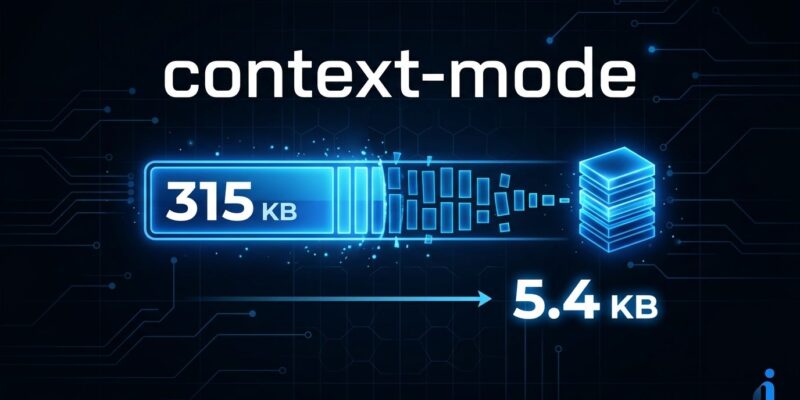
context-mode is an MCP server that intercepts tool output before it reaches the context window. The headline claim: 315 KB of tool output becomes 5.4 KB — a 98% reduction. A typical 200K-token Claude Code session drops to under 10K tokens active with it running. It works across four mechanisms.
Output Sandboxing
Raw tool results go into SQLite, not the transcript. The agent gets a reference and searches for what it actually needs via BM25 full-text search. A 10,000-line log file that would cost roughly 15,000 tokens now costs around 50. The knowledge base uses Porter stemming and trigram substring matching, so queries like “useEff” correctly surface “useEffect” calls buried in a file.
Session Continuity
Five hooks work together to preserve task state across context compactions: PreToolUse, PostToolUse, UserPromptSubmit, PreCompact, and SessionStart. When a session compacts, context-mode builds a priority-tiered snapshot of under 2 KB — last request, active tasks, files modified, decisions made, errors encountered — and restores it at the next context window start. The agent picks up exactly where it left off.
Code-First Analysis
Instead of reading 50 files into context to count functions, the agent writes a short script via ctx_execute and captures only the result. One sandboxed call replaces ten file reads. The reduction on analytics-style queries runs 10x to 100x.
Platform Routing
Hooks enforce sandboxing programmatically on platforms that support them. Platforms without hook support get manual routing instruction files, which the context-mode repo estimates gives roughly 60% compliance. Not ideal, but functional for the majority of workflows.
How to Install context-mode
On Claude Code, this is two commands:
/plugin marketplace add mksglu/context-mode
/plugin install context-mode@context-mode
Hooks register automatically. No JSON config files, no manual setup.
For Cursor, VS Code Copilot, Gemini CLI, Codex CLI, and the 13 other supported platforms, the path is npm install -g context-mode followed by platform-specific MCP config and hooks JSON files. The README covers each platform individually — it is thorough even if the setup is not fast.
What to Watch Out For
License: context-mode runs under Elastic License v2 (ELv2), not MIT or Apache. For personal use and internal tooling this is fine. If you are building a commercial product on top of it, read the ELv2 terms first.
Node version: Requires Node 22.5+, which uses the built-in node:sqlite module. Linux environments on CentOS, RHEL, or Alpine with older Node may need a C++20 compiler to build the better-sqlite3 fallback.
Cursor gets partial support only. Session restore does not work because Cursor’s validator rejects the SessionStart hook. Output sandboxing works fine; you lose only the compaction recovery feature. That trade is still worth making.
Latency overhead of 50 to 250 milliseconds per tool call is real but negligible against LLM inference times.
The enterprise adoption list in the README — Microsoft, Google, Meta, Stripe, and others — is unverified. Treat it as a signal of momentum, not a guarantee.
Why This Matters
For individual developers, context-mode extends useful session length and prevents the agent degradation that makes long autonomous tasks unreliable. For teams running production agentic workflows, the math is direct: fewer tokens billed, fewer session restarts, more consistent output. The context window is already the most expensive surface in your AI stack. It deserves the same attention you give memory management in any other system.
context-mode hit 25,000 stars because the problem it solves is one every developer using MCP tools is quietly experiencing. The fact that it took a community project to fix what is fundamentally an architectural gap in MCP says something about how fast this space is moving — and how much critical infrastructure is still being built in the open. The MCP context overload problem has been documented since early 2026; context-mode is the most comprehensive answer yet.
Install it, run ctx_stats after your first session, and see what your agent has been burning through. The GitHub repo is at mksglu/context-mode.