 By ByteBot
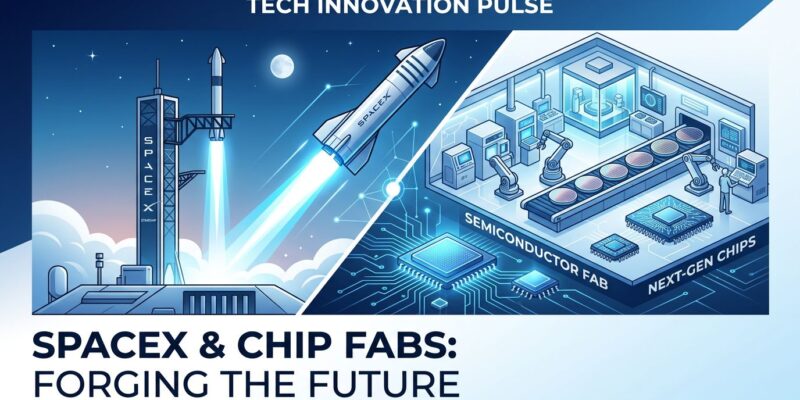
SpaceX filed plans this week for a $55 billion semiconductor manufacturing facility in Texas. The total investment could hit $119 billion. Elon Musk calls it “Terafab” – targeting one terawatt of AI compute capacity annually through complete vertical integration from chip design to testing. The developer community’s reaction on Hacker News? “Reeks of desperation.”
The $119B Gamble
The scope is staggering. SpaceX’s May 6 filing outlines a Grimes County, Texas facility using Intel’s 14A manufacturing process. Tesla builds the prototype line – a $3 billion R&D facility processing a few thousand wafers monthly. SpaceX handles volume manufacturing. Applications span Tesla’s Full Self-Driving chips, Optimus humanoid robots, and xAI’s data centers.
Context matters: $119 billion represents roughly 15 percent of Big Tech’s $725 billion AI infrastructure spending in 2026. TSMC’s Arizona fab cost $40 billion for a single facility. SpaceX is betting hyperscaler-level capital on complete vertical integration.
The filing includes an unusual hedge: “There is no guarantee the company will meet its Terafab goals within expected timelines, or at all.” Even SpaceX admits the execution risks.
The Skepticism is Brutal
Developer forums lit up with doubt. The Hacker News thread titled “Tesla and SpaceX announce $25B ‘Terafab’ chip factory – it reeks of desperation” captures the mood. Three criticisms dominate.
Track record: “Full Self-Driving software, the Cybercab robotaxi program, and Optimus humanoid robot line have all been ‘sold and promised for more than a decade’ yet ‘don’t exist yet,'” one commenter notes. Musk’s announcements often slip years or vanish entirely. FSD has been “next year” since 2016. Why believe Terafab is different?
Funding math: “$25B does not seem anywhere near enough for this.” Samsung’s Texas fab cost $17 billion. Intel’s Ohio facility runs $20 billion. SpaceX targeting a vertically-integrated ecosystem for $55-119 billion looks 2-3x underfunded.
Equipment reality: “You can’t just call and order up certain sophisticated equipment like an EUV machine.” ASML is the sole supplier of extreme ultraviolet lithography tools required for advanced chips. Lead times run 2-3 years. TSMC, Samsung, and Intel already occupy multi-year backlogs. How does SpaceX with zero fab experience jump the queue?
Why Vertical Integration?
The trend is real even if SpaceX’s execution is questionable. Amazon, Microsoft, Alphabet, and Meta are collectively spending $725 billion on AI infrastructure in 2026 – up 77 percent year-over-year. Every hyperscaler is building custom chips.
Google deployed over 100,000 Trillium TPU v6e chips this year. Meta announced four MTIA chip generations in 2026 on a six-month cadence, achieving 25x compute gains across the lineup. Apple’s M5 delivers 4x AI performance versus M4. The pattern is clear: vertical integration reduces costs, secures supply, and optimizes for specific workloads.
SpaceX’s filing reveals the motivation: “Still depends heavily on outside suppliers and lacks long-term agreements with many of them.” Translation: they can’t secure enough chips through normal channels. Terafab is a supply security play.
Nvidia H100 GPUs cost $30,000-40,000 each and remain backordered. Custom chips can hit $15,000-20,000 with better performance for targeted workloads. The economics work – if you can execute.
The Intel Wildcard
Intel’s 14A process technology provides expertise SpaceX lacks. Musk acknowledges this: “14A is state-of-the-art and in fact not yet totally complete. By the time TeraFab scales up, 14A will be probably fairly mature or ready for prime time.”
They’re betting on immature technology from a company with its own execution challenges. Intel 18A, the predecessor to 14A, has slipped multiple times. If Intel’s roadmap shifts, Terafab shifts.
What Happens Next
“Later this decade” puts volume production in the 2027-2030 window. Grimes County officials are reviewing property tax abatements. SpaceX’s June 2026 IPO targets a $1.75 trillion valuation – context that makes $119 billion look less insane but doesn’t reduce execution risk.
Three outcomes seem possible. Optimistic: Prototype operational by 2028, volume production by 2030, Terafab chips powering Tesla and xAI at scale. Pessimistic: EUV delays, low yields, $20-40 billion write-down, another entry in the vaporware ledger. Most likely: Partial success, limited production by 2029-2030 covering some internal needs while still buying Nvidia, reducing dependency 30-50 percent without eliminating it.
For developers, the stakes are clear. Success reshapes chip supply – more competition, lower costs, less Nvidia lock-in. Failure strengthens Nvidia’s 90 percent market share and validates the moat.
SpaceX calls this strategic. Developers call it desperation. The compute shortage is real. The vertical integration trend is proven. But manufacturing isn’t software – you can’t iterate with pull requests. Chip fabs demand execution, not promises. Watch what happens in 2027-2028. That’s when vision separates from vaporware.