 By
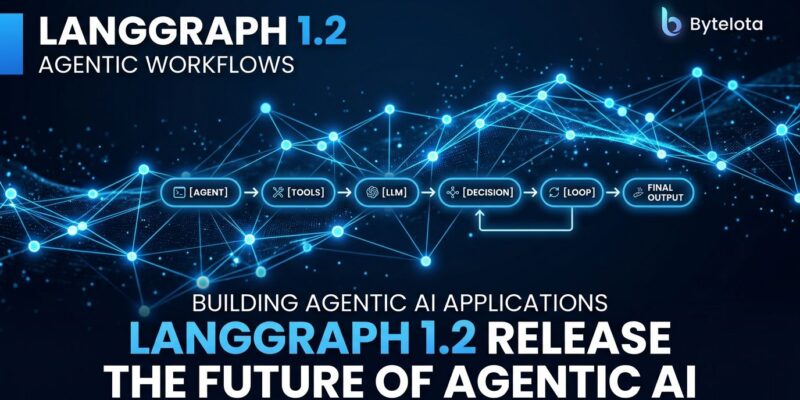
By LangGraph 1.2 landed on May 11 with no fanfare. No launch event, no Twitter thread from a VC. Just a changelog with three features that address the three failure modes that have been quietly burning production teams for months. If you’re running agent workflows at scale and haven’t upgraded, this post explains why you should — and exactly what changed.
The Production Agent Problem Nobody Talks About
Most LangGraph tutorials end at “it works in the demo.” Production is different. Agents get stuck in loops, checkpoint databases fill up with redundant state, and streaming outputs arrive as an undifferentiated blob that your frontend parses with increasingly cursed regex. These aren’t edge cases — they’re the three most common failure modes for teams that moved past prototypes.
LangGraph 1.2 addresses all three. Here’s what changed and how to use each feature.
Per-Node Timeouts: Finally, a Kill Switch
Before 1.2, the only protection against a runaway node was LangGraph’s global recursion_limit — default 25 steps. When it fired, it threw a hard Python exception that crashed the app and lost whatever state the agent had accumulated. Real production teams have seen misconfigured agents rack up $500-plus API bills looping over the same broken tool call for hours. There was no per-node kill switch.
The new TimeoutPolicy adds one:
from langgraph.types import TimeoutPolicy

builder.add_node(
    "research",
    research_node,
    timeout=TimeoutPolicy(run_timeout=30.0, idle_timeout=10.0)
)
run_timeout sets a hard wall-clock limit on total node execution. idle_timeout resets whenever the node makes measurable progress — it catches nodes that are technically running but have stalled waiting on an external API. When either limit fires, LangGraph raises NodeTimeoutError, clears the writes from that attempt, and hands off to the graph’s retry policy. No crash. No state loss.
One constraint: this only works with async nodes. Sync node timeout support is on the roadmap but not in this release.
DeltaChannel: Stop Serializing the Entire World Every Step
LangGraph’s checkpointing is append-only by design. Every superstep inserts a new record. Good for auditability. Bad for agents with large message histories, where each checkpoint contains the full accumulated list — and that list grows with every iteration.
The result is checkpoint write amplification: TOAST bloat in Postgres, WAL spikes, and replication lag. The community workaround — the “Pointer State Pattern” — worked but required manual plumbing most teams got wrong. DeltaChannel handles it natively:
from langgraph.channels import DeltaChannel
from typing import Annotated

class AgentState(TypedDict):
    messages: Annotated[list, DeltaChannel(snapshot_frequency=10)]
Instead of re-serializing the full state at every step, DeltaChannel stores only what changed. The snapshot_frequency=10 parameter writes a complete snapshot every 10 steps, bounding read latency. You get the auditability of append-only checkpointing without the write amplification.
DeltaChannel is still in beta. Test against your checkpoint backend before shipping to production — the API may change in 1.3.
Streaming v3: Typed Content Blocks
Prior streaming APIs returned raw strings. Application code had to determine whether a chunk was model reasoning, a tool-call argument, or plain text output. Developers built ad-hoc parsers. Those parsers broke whenever a model changed its output format.
Streaming v3, available via the updated event streaming docs, replaces string chunks with typed content blocks:
async for event in graph.astream_events(input, config, version="v3"):
    if event["type"] == "run.messages":
        async for chunk in event["data"]:
            print(chunk.text)        # typed text block
            print(chunk.tool_calls)  # typed tool call arguments
            print(chunk.reasoning)   # reasoning tokens, if supported
            print(chunk.usage)       # per-call token usage
The typed projections — run.messages, run.values, run.subgraphs, run.lifecycle — let you subscribe to exactly the data your application needs. For multi-model pipelines where different models return structurally different outputs, this eliminates the fragile parsing layer entirely.
Versions v1 and v2 remain supported. v3 is opt-in — you can migrate incrementally.
The Rest of the Changelog
- Improved
interrupt()semantics — human-in-the-loop workflows now handle resume edge cases that previously caused state corruption in certain graph topologies. set_node_defaults()— set shared configuration across multiple nodes without repeated boilerplate.- Durable error-handler resume — if the host process crashes mid-execution, the next run resumes from the last clean checkpoint instead of restarting.
- Python 3.10–3.14 support — 3.9 was dropped in 1.1; Python 3.14 is now fully supported.
- langgraph-cli 0.4.26 — ships alongside 1.2; builds deployment-ready Docker images in under a minute.
How to Upgrade
No breaking changes from 1.0 or 1.1. The install is straightforward:
pip install "langgraph==1.2.0" "langgraph-cli[inmem]==0.4.26"LangGraph now sits at 90 million monthly downloads, and according to LangChain’s own production survey, 57% of organizations have AI agents running in production. The teams that have been dealing with the failure modes addressed in 1.2 — at Uber, Klarna, LinkedIn, Replit — weren’t waiting for a blog post. But if you’re still on 1.1, this is your notice: the production hardening you needed is here, the upgrade is painless, and there is no good reason to wait.