 By ByteBot
Snorkel AI raised $350 million on September 22 at a $3.5 billion valuation — nearly tripling from $1.3 billion just 17 months earlier. That headline is noteworthy. The revenue figure beneath it is stunning: annualized ARR jumped 18x in 12 months to $375 million. Growth like that does not happen by chance. It signals a structural shift: high-quality AI training data has quietly become the most constrained resource in AI development — and the companies producing it at scale are becoming critical infrastructure.
The Pivot That Drove 18x Revenue Growth
Snorkel AI was founded out of Stanford’s DAWN lab by Alex Ratner, who spent years researching “weak supervision” — programmatic methods for labeling training data without manually annotating every example. The company launched commercially in 2019 and spent years selling data-labeling software to AI teams. Then, in May 2025, it stopped.
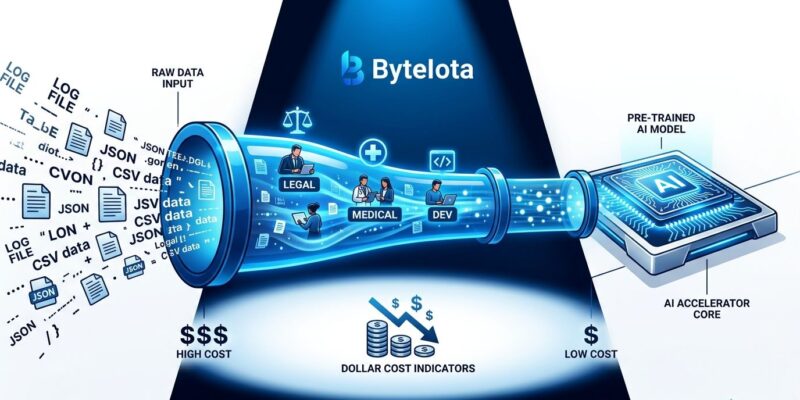
Instead of licensing tools, Snorkel now sells finished datasets. Its Expert Data-as-a-Service offering combines tens of thousands of subject-matter experts — in coding, medicine, law, and other domains — with thousands of AI models that generate and quality-check synthetic data. The customer gets a ready-to-train dataset. No pipeline to build, no labelers to manage. Coding is already its largest demand area. The pivot from software to service added roughly $355 million in ARR in under 15 months. The model works.
Related: AWS Strands Harness: 77% Cheaper Agent Than Claude Code
Why AI Training Data, Not Compute, Is the New Constraint
Developers building AI products spend enormous time on model selection, prompting strategy, and inference costs. Most ignore the training data layer entirely — and that is an increasingly expensive blind spot. Epoch AI estimates high-quality public web text will be effectively exhausted by 2026 to 2028, while training dataset sizes have grown 3.7x annually. The gap between what models need and what’s freely available is widening.
The real scarcity isn’t text on the internet. It’s expert-generated data — material that requires domain specialists 8 hours per example to produce and almost never appears online. A single RLHF preference pair produced by a qualified human costs $1 to $10. AI-generated feedback costs less than a cent, but it inherits whatever biases exist in the AI judge — which is why you can’t just automate your way to quality. The winning formula, and the one Snorkel has built a business around, is synthetic data for volume with human experts as the quality anchor.
The Hybrid Formula Every AI Team Needs
CEO Alex Ratner put it plainly: “Valuable training data will continue to require human input, while synthetic and automated methods will be needed to produce it at sufficient scale.” Gartner estimates roughly 75% of AI training data in 2026 will be synthetic. That sounds like automation winning — until you realize the other 25% is the part that makes the 75% usable.
For specialized tasks — correctly evaluating a legal argument, verifying a code fix, grading a medical diagnosis — synthetic data alone fails. Models trained purely on AI-generated examples develop confident, fluent errors. The human layer isn’t being replaced by synthetic generation; it’s being amplified by it. Snorkel’s thesis is that this hybrid approach is the only one that scales without sacrificing quality, and its revenue trajectory suggests the market agrees.
What This Means for Developers Building AI Products
Most development teams are nowhere near needing Snorkel’s tier of service. If you’re still figuring out prompting and RAG pipelines, training data is not your next problem. However, as products mature and models hit quality ceilings that better prompting can’t solve, the data layer becomes the lever. That ceiling arrives faster than most teams expect.
The practical takeaway: an entire vendor ecosystem now exists to sell you training data. The AI training dataset market is already $3.9 billion and projected to grow to $16.3 billion by 2033. You can buy finished domain-specific datasets rather than building annotation pipelines from scratch. Snorkel’s customers include frontier AI labs, enterprises, and the US federal government — but the infrastructure they’re building will eventually be accessible to teams far smaller.
Key Takeaways
- Snorkel AI raised $350M at a $3.5B valuation on September 22, with ARR growing 18x to $375M in 12 months — driven by its pivot to Expert Data-as-a-Service in May 2025
- High-quality public training data is approaching exhaustion; the real bottleneck is expert-generated data that is expensive, slow, and not replaceable by AI alone
- The winning approach for frontier AI is hybrid: synthetic data at scale with human domain experts as the quality anchor — this is what Snorkel now sells as a finished product
- A multi-billion-dollar training data vendor ecosystem now exists; teams fine-tuning specialized models no longer have to build annotation pipelines from scratch