 By ByteBot
ServiceNow made Build Agent generally available across Cursor, Windsurf, Claude Code, and GitHub Copilot at Knowledge 2026, positioning itself as the governance layer for AI coding while enterprises grapple with 98% unsanctioned AI tool use and 56 CVEs from AI-generated code in Q1 2026 alone. The move comes after a healthcare company paid $3.5 million in HIPAA fines and a manufacturer lost $54 million to coding assistant data leaks. Shadow development isn’t theoretical anymore.
The Shadow Development Problem Got Real
Organizations know they have a problem. 98% report unsanctioned AI use, yet only 49% expect incidents within the next year. That gap between awareness and urgency closed fast in early 2026.
October 2025 security scans of 5,600 vibe-coded applications revealed 2,000+ high-impact vulnerabilities. Every vulnerability was discoverable within hours. Then Q1 2026 brought 56 CVEs attributed to AI-generated code, with March alone accounting for 35 cases – more than all of 2025 combined.
The financial damage is documented. A healthcare company paid $3.5 million in HIPAA fines for feeding patient notes into ChatGPT. A manufacturer lost $54 million after a coding assistant leaked proprietary data. February’s Moltbook breach exposed 1.5 million API keys and 35,000 user emails, allowing attackers to hijack AI agents and access AWS and OpenAI services.
ServiceNow’s Strategic Play
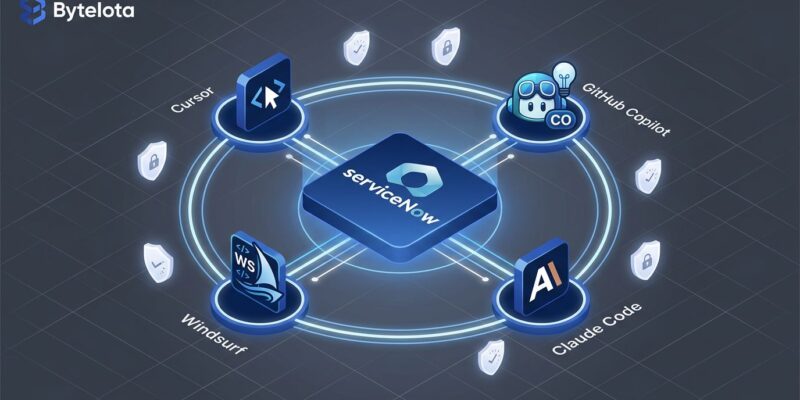
ServiceNow announced at Knowledge 2026 that Build Agent is now generally available in ServiceNow Studio and extended into Cursor, Windsurf, Claude Code, and GitHub Copilot. Developers can use their preferred coding tool while ServiceNow provides platform context, audit trails, security checks, and compliance infrastructure.
The strategic angle is sharp. ServiceNow isn’t competing with Cursor on multi-file editing intelligence or Claude on reasoning depth. Instead, ServiceNow is positioning itself as the governance layer that works with every tool, letting developers choose based on capabilities while enterprises get the audit trails and compliance controls they demand.
Build Agent is powered by Anthropic models, enabling longer context sessions where developers work through entire application builds without losing continuity. It understands live ServiceNow instances including data models, configurations, and policies. It pulls design specs from Figma, requirements from Miro, and code context from GitHub. Then it generates complete applications with workflows, catalog items, and UI components while automatically inheriting enterprise-grade governance.
The Four Tools ServiceNow Just Integrated
The four tools represent the dominant AI coding ecosystem. GitHub Copilot leads with 20 million users, SOC 2 compliance, and seamless Microsoft stack integration at $10/month. Cursor costs $20/month but delivers best-in-class multi-file intelligence that developers fight procurement teams to access. Windsurf offers serious agentic IDE capabilities at $15/month with the best free tier in the market, backed by OpenAI. Claude Code runs usage-based pricing with terminal-native autonomy and the highest SWE-bench scores for hard problems.
These aren’t competitors anymore. They’re integration points for the governance layer ServiceNow wants to own. The timing matters. It comes after Q1’s CVE surge, after Moltbook, after documented eight-figure losses. Enterprises are panicking about shadow AI, and ServiceNow is offering infrastructure to regain control without forcing developers to abandon their chosen tools.
What Doesn’t Get Solved
ServiceNow’s governance layer doesn’t patch vulnerabilities in the tools themselves. Claude Code’s CVE-2025-59536 (CVSS 8.7) lets attackers inject malicious Hooks into .claude/settings.json for remote code execution when a developer opens a project. GitHub Copilot’s CVE-2025-64660 involves prompt injection to edit workspace configuration files. OpenAI Codex CLI’s CVE-2025-61260 allows command injection through .env file tampering. Those flaws exist regardless of whether ServiceNow adds governance on top.
The broader pattern is concerning. AI-assisted developers produce commits at 3-4x the rate of their peers but introduce security findings at 10x the rate. Security debt accumulates faster than teams can remediate it. 62% of AI-generated code contains design flaws or known vulnerabilities. ServiceNow’s audit trails and compliance checks can track what happened, but they don’t prevent vulnerable code from being written.
The Real Question
The debate isn’t whether governance is necessary. The financial losses and CVE counts settled that. The question is whether ServiceNow’s integration solves shadow development or just shifts it to a different platform. If developers bypass the governance layer because it adds friction without delivering security improvements beyond compliance theater, this becomes another tool that security teams mandate and developers route around.
Success depends on execution. Can ServiceNow provide governance without killing velocity? Will enterprises actually enforce the integration or just check a compliance box? Do the audit trails and security checks catch real issues or generate false positive noise?
The pattern emerging across enterprise platforms is clear. Salesforce announced its agent-first Headless 360 restructure the same month, making every workflow and business logic accessible through APIs. Oracle and SAP will follow. Platform vendors are shifting from “use our development tools” to “use any tools, we’ll provide the governance layer.” ServiceNow’s Build Agent launch is that strategy executed first.
Whether it works depends less on the technology and more on whether the compliance layer it provides actually prevents the breaches that triggered this shift in the first place.