 By ByteBot
While the tech industry pours 50 gigawatt-hours into training GPT-4—enough electricity to power San Francisco for three days—a counter-movement is asking a radical question: Do we need this much computing at all? On May 7, 2026, “Permacomputing Principles” hit Hacker News front page with 197 points, reigniting debate about a philosophy that applies permaculture to computing. Maximize hardware lifespans. Minimize energy use. Embrace slowness over speed. It’s the anti-AI: while everyone races toward AGI, permacomputing runs on 30-watt solar panels aboard sailboats.
Permaculture Principles Applied to Computing
Permacomputing, coined by Ville-Matias Heikkilä in 2020, asks whether computing can have a meaningful place in a civilization that contributes to the biosphere rather than destroys it. The movement builds on 10 principles: reduce wastefulness, adapt to energy availability, maximize hardware longevity, favor simplicity. Computers aren’t fast, disposable servants replaced every three years. They’re long-living, repairable, frugal companions.
The philosophy challenges a core assumption of modern tech: that computing should demand more energy. Permacomputing flips it. Adapt computation to energy availability. Run intensive tasks when solar peaks. Scale down when cloudy. Low-tech Magazine‘s website goes offline during cloudy weather in Barcelona—that’s not a bug, it’s the philosophy in action.
The cultural stance values slowness, care, and resilience over automation and speed. Instead of one dominant technology and linear progress, permacomputing aims at a diversity of approaches developing at all levels. It’s not just environmental—it’s a fundamental rethinking of computing’s relationship to resources.
50 Gigawatt-Hours vs 30 Watts
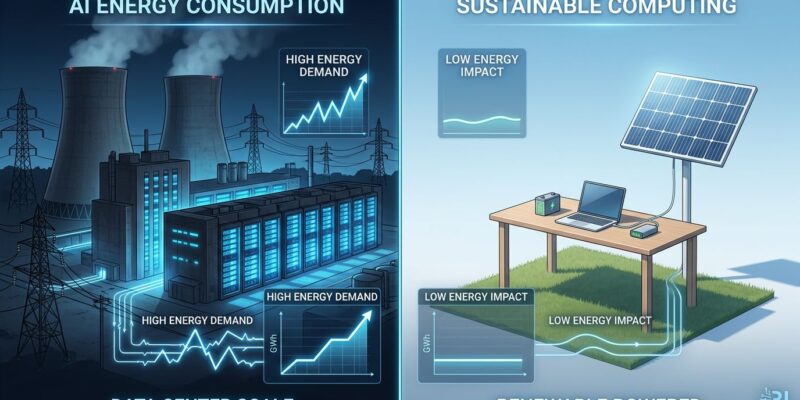
Training GPT-4 consumed 50 gigawatt-hours of energy and cost over $100 million. It emitted 12,456 to 14,994 metric tons of CO2e—roughly equivalent to the annual emissions from 2,700 cars. A single high-end GPU uses over 400 watts, several times a standard home computer. Data centers doubled electricity consumption by 2023. Generating a 100-word ChatGPT-4 email consumes 519 milliliters of water—one Evian bottle.
Meanwhile, Low-tech Magazine runs its entire website on a 30-watt solar panel and 168 Wh battery. That’s a 1.67 million-to-1 energy ratio compared to GPT-4 training. The website sometimes goes offline in cloudy weather. That’s not failure—it’s proof that computing can adapt to available energy instead of demanding unlimited power.
Hundred Rabbits, a two-person art collective, creates software from a 10-meter sailboat in the northern Pacific Ocean. Their Uxn virtual machine runs on everything from Game Boy Advance to Raspberry Pi Pico. Off-grid, solar-powered, proving that meaningful software doesn’t require data centers.
Related: AI Developer Productivity: 30% Faster, Hidden Costs
From Sailboats to EU Regulation
Hundred Rabbits’ Uxn stack isn’t theoretical. It ships software written in Uxntal assembly language that works like video game ROMs—portable across decades of hardware. Programs designed in 2020 run on hardware from 2001. That’s longevity.
Framework Laptop offers fully modular, repairable design with 50% recycled aluminum and an 8-year lifespan. Almost every component—display, battery, keyboard, bezels—is user-replaceable. If you use a laptop for 8 years instead of 4, you cut your per-year environmental impact in half. Manufacturing accounts for 70-80% of a device’s total environmental footprint, so using it longer matters more than marginal efficiency gains.
Fairphone 5, released in 2023, features 10 replaceable modules including battery, camera, USB-C port, and speaker. The company sources conflict-free minerals, pays fair wages to factory workers, and designs for an 8-year lifespan with software updates to match. The EU Right to Repair directive, taking effect July 2026, will force tech giants to adopt the exact supply chain mechanics—accessible components, extended software lifecycles, Design for Repair—that Framework and Fairphone pioneered.
Low-tech Magazine’s solar-powered website reduced its size by a factor of five through optimization. It runs on a Barcelona balcony’s 30W solar panel. When the sun isn’t shining, it goes offline. Visitors see the battery level displayed on the homepage. Transparency about energy constraints is part of the design.
Political Baggage and Practical Limits
The Hacker News discussion (197 points, 103 comments) revealed deep splits. Critics argue that permacomputing’s explicit anti-capitalist framing—anarchism, decoloniality, intersectional feminism, degrowth—alienates potential supporters. “The more topics political factions gobble up, the worse this becomes,” one user wrote. Combining environmental goals with revolutionary politics creates an “intersection that already agrees with you,” leaving the movement “tiny, powerless.”
There’s a real risk of permacomputing becoming luxury craft for the wealthy. Academic analysis warns of “romanticism close to the failure of the arts and crafts movement”—permacomputing aesthetics as bourgeois, elitist products accessible only to those with resources to choose simplicity. That’s a failure mode to watch.
The manufacturing reality is blunt: “Until computers can be grown on trees, the whole electronic industry is based on highly artificial materials firmly tied to complex, extractive and exploitative manufacturing processes.” Semiconductor production remains highly polluting, resource-intensive, and tied to geopolitical supply chains. Permacomputing can’t escape that—it can only minimize harm by maximizing device lifespans.
Supporters counter that computing is inherently political. Climate impacts hit marginalized groups disproportionately. The question isn’t whether permacomputing should address systemic issues—it’s whether effective environmental sustainability is possible without addressing them. The debate isn’t settled.
What This Means for Developers
Not everyone will adopt permacomputing, but it challenges assumptions worth questioning. Do you need the latest GPU, or can you repair and upgrade existing hardware? Can your application run on modest hardware instead of demanding cutting-edge specs? Should your service scale down during low-energy times, or must it maintain constant performance regardless of environmental cost?
Manufacturing accounts for 70-80% of a device’s environmental impact. Doubling lifespan from 4 to 8 years cuts per-year impact in half. That’s not idealism—it’s math. Framework and Fairphone prove 8-year lifespans are commercially viable. The EU Right to Repair directive makes repairability mandatory starting July 2026. The industry is moving whether incumbents like it or not.
Permacomputing won’t replace cloud computing. AI workloads won’t run on solar-powered sailboats. High-performance computing will always exist. But the movement asks a question the industry needs to answer: If we can build meaningful software on 30 watts instead of 50 gigawatt-hours, should we?
Key Takeaways
- Permacomputing applies permaculture to computing: maximize hardware lifespans, minimize energy use, adapt computation to available energy instead of demanding unlimited power.
- Real projects prove it works: Hundred Rabbits creates software on a sailboat with Uxn VM, Framework and Fairphone ship 8-year-lifespan modular hardware, Low-tech Magazine runs on 30W solar panels.
- AI’s 50 GWh training runs vs permacomputing’s 30W solar panels represent a 1.67 million-to-1 energy ratio—forcing a question about computing’s relationship to resources.
- Political framing (anti-capitalism, degrowth) splits the community, risking alienation and elitist luxury craft associations, while supporters argue computing is inherently political.
- EU Right to Repair (July 2026) mandates repairability and extended lifecycles, validating permacomputing principles and forcing mainstream adoption of sustainable design practices.