 By
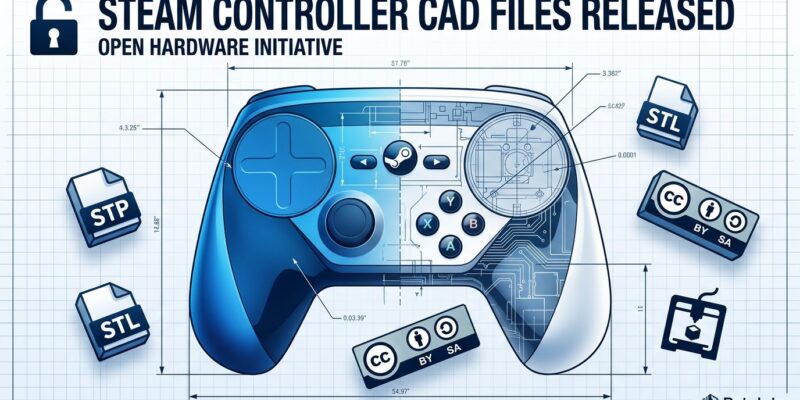
By Gaming hardware companies guard their CAD designs like nuclear codes. Sony sued third-party makers over PS5 faceplates. Nintendo fires DMCAs at fan projects. Microsoft locks down hardware with ironclad control. Then on May 6, 2026, Valve released the complete CAD files for its Steam Controller and charging Puck under a Creative Commons license—for free. The community can now design accessories, 3D print replacement parts, and create modifications using Valve’s official engineering files. This doesn’t happen in gaming hardware. Ever.
The timing matters. The Controller 2 launched May 4 and sold out in 30 minutes. Valve released the CAD files two days later while everyone waits for restock. Meanwhile, Hacker News pushed the story to the front page with 1,533 upvotes. The message is clear: your hardware, your rules—if the manufacturer allows it. Valve does. Its competitors don’t.
No Other Gaming Company Releases CAD Files
Valve released STP models, STL files, and engineering drawings under Creative Commons (CC BY-NC-SA 4.0). That means external shell geometry, critical dimensions, keep-out zones—everything you need to design accessories or 3D print replacement shells. No major gaming hardware manufacturer has ever done this. Not Sony. Not Nintendo. Not Microsoft.
The contrast is sharp. When custom PS5 faceplates appeared before Sony’s official skins, Sony sued the makers out of existence. Nintendo has earned a reputation for being “particularly litigious” with community creations, issuing DMCA takedowns like clockwork. Microsoft maintains strict hardware control and offers no CAD files. The gaming industry actively lobbies against right-to-repair legislation—93 percent of repair shops report manufacturer restrictions blocking console repairs.
Valve has been releasing hardware CAD files consistently since 2016: the original Steam Controller, Valve Index VR headset in 2019, Steam Deck in 2022, and now Controller 2 in 2026. This isn’t a one-off PR stunt. It’s a pattern. No competitor matches it.
What You Can and Can’t Do With the CAD Files
The CAD files cover the external shell only. You can design perfect-fit accessories (wall mounts, charging docks, grips), 3D print replacement shells if yours cracks, and create ergonomic modifications for accessibility needs. What you cannot do: 3D print a fully functional controller (internal electronics aren’t included) or sell products commercially without Valve’s approval.
The Creative Commons license requires attribution, limits use to non-commercial projects, and mandates that derivatives share the same license. However, Valve includes an addendum: commercial products are possible if you contact them first. That email: SteamDeckExternal@valvesoftware.com. The door is open for makers who want to sell accessories—they just need permission.
For repairs and customization, the implications are significant. If Valve discontinues this controller like they did the original in 2019, users can fabricate replacement shells indefinitely. Accessibility wins: gamers can customize ergonomics for larger hands, create left-handed variants, or design modified grip surfaces. This is hardware sovereignty—the community takes over where manufacturers stop.
The Business Model Difference: Platform vs Hardware Revenue
Valve can afford open hardware because the Steam Store generates revenue, not controller margins. Valve takes a 30 percent cut of game sales on its platform. The Controller 2 sold out at $99, but hardware sales aren’t the profit center—they’re platform access. Sony, Nintendo, and Microsoft depend on hardware profits and ecosystem lock-in. They can’t release CAD files without commoditizing their hardware business.
The incentives diverge completely. Valve doesn’t need proprietary control because controllers work with any PC. Sony, Nintendo, and Microsoft sell hardware to lock users into exclusive ecosystems—games, subscriptions, digital stores. Their business models don’t support open hardware. It’s not about ethics. It’s economics.
This explains why competitors won’t follow. The gaming industry lobbied successfully to exclude consoles from California’s right-to-repair law and most state legislation. When your hardware margins matter, repair restrictions protect profits. Valve proves open hardware works when the platform generates revenue instead. Different incentives produce different outcomes.
Community Response and What’s Next
The CAD release hit Hacker News’ front page May 7 as the number one story with 1,533 points. Valve also partnered with iFixit to provide official replacement parts. Combined with CAD files, this creates a complete repair ecosystem: official electronics from iFixit, community-fabricated shells and accessories from makers. This is what repairability looks like when a company commits to it.
Expect a flood of 3D printed designs on Thingiverse and Printables within weeks. Community makers can now create accessories with perfect fit using official dimensions—no guesswork, no trial and error. The precedent is Steam Deck: when Valve released those CAD files in 2022, hundreds of community accessories appeared within months. Controller 2 will follow the same trajectory.
For the industry, this sets a benchmark. Right-to-repair advocates now have proof: successful gaming hardware can be open. Valve’s hardware sells out in 30 minutes despite—or because of—releasing CAD files. The question shifts from “Is open hardware viable?” to “Why don’t others do this?” The answer: they could. They won’t. Hardware margins matter more than goodwill.
Key Takeaways
- Valve released complete CAD files for Steam Controller and Puck on May 6, 2026, under Creative Commons (CC BY-NC-SA 4.0), enabling community accessories, repairs, and modifications
- No other major gaming hardware manufacturer does this—Sony sues third-party makers, Nintendo issues DMCAs, Microsoft maintains strict control, all actively oppose right-to-repair laws
- Business models explain the difference: Valve profits from Steam Store (platform revenue), not hardware margins, while Sony/Nintendo/Microsoft depend on hardware profits and ecosystem lock-in
- Timing shows commitment: Controller 2 sold out May 4 in 30 minutes, CAD files dropped May 6, iFixit partnership provides official parts—this creates a complete repair ecosystem
- Community will build accessories (grips, mounts, cases) on Thingiverse/Printables, just like Steam Deck’s hundreds of community designs after its 2022 CAD release
The CAD files prove hardware sovereignty is possible. Valve demonstrates that successful gaming hardware doesn’t require proprietary lock-in when the business model centers on software. The community now controls repairs, customization, and accessory creation. That’s how it should be—but rarely is.