 By ByteBot
A trending Hacker News discussion hit 514 points and 103 comments on May 13, 2026, revealing a critical skill gap in software development: developers excel at coding but struggle to learn software architecture. System design now comprises 40-50% of senior engineering interviews, yet even experienced engineers frequently fail these assessments. The problem isn’t intelligence or effort—it’s that traditional education teaches implementation while industry demands high-level design thinking. In 2026, the shift to AI-native, serverless, and distributed systems has made architectural skills a professional necessity rather than optional specialization.
The Thinking Gap: Why Coding Skills Don’t Translate
The transition from coding to architecture requires fundamentally different thinking. Coding focuses on implementation—how do I make this work now? Architecture requires strategic thinking—how do I make this work for millions of users over five years? The challenge isn’t technical knowledge. Consequently, it’s structured thinking, trade-off evaluation, and communication under pressure.
Expert analysis puts it bluntly: “Success in these interviews has less to do with experience and more to do with structured thinking, communication, and understanding trade-offs at scale. Moreover, strong coders often struggle the moment the system design interview begins because they don’t have a clear way to approach system design under pressure.”
Understanding that the gap is structural—a different skill type rather than individual failure—helps developers approach learning differently. It’s not about memorizing patterns. Therefore, it’s about building new thinking frameworks that shift from tactical problem-solving to strategic system design.
AI-Native Architecture: The 2026 Game Changer
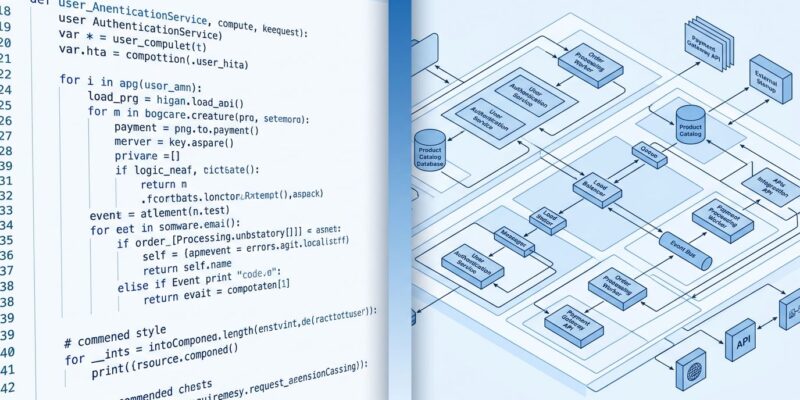
In 2026, systems are no longer designed as applications that might use AI features. They’re designed as AI-native systems where intelligence is a core structural constraint from the initial sketch. The API Gateway evolves into an Agent Orchestrator that routes requests to autonomous agents or domain-specific language models before hitting traditional services. Furthermore, this represents a fundamental paradigm shift requiring new design approaches.
From 2026 architecture guides: “Applications are becoming AI-native, globally distributed, and continuously evolving. The initial architectural sketch must incorporate the AI-Native layer, with the API Gateway/Agent Orchestrator serving as a single entry point that is less about simple routing and more about orchestrating calls to autonomous agents.”
Additionally, Data Mesh architecture—distributed data ownership by domain teams—is replacing centralized warehouses. Serverless has grown over 100% year-over-year with AWS Lambda leading the charge. For developers learning software architecture in 2026, understanding AI orchestration is mandatory, not optional. The skills needed have evolved beyond what’s taught in older courses and books.
System Design Interviews: The 40-50% Career Gatekeeper
System design interviews have evolved from a small component to comprising 40-50% of mid-to-senior level technical interviews in 2026. This has created a paradox: developers learn architecture primarily to pass interviews rather than for job skills, yet the interviews test real capabilities—structured thinking, trade-off evaluation, communication—that matter in practice.
The challenge is intentional ambiguity. System design problems deliberately lack clear requirements to test if candidates can handle unknowns. Common failure modes include jumping to solutions without clarifying requirements, theoretical knowledge without practice applying it under time pressure, and inability to articulate trade-offs and justify architectural choices.
This isn’t just about job hunting. The skills tested—handling ambiguity, evaluating trade-offs, communicating technical decisions—are exactly what separates senior engineers from mid-level implementers. Therefore, the interview process, while imperfect, identifies a real capability gap that affects day-to-day engineering work.
How to Learn Software Architecture in 2026
Multiple structured learning paths exist in 2026. Roadmap.sh—the 6th most-starred GitHub project with hundreds of thousands of monthly visitors—provides step-by-step progression covering databases, CDNs, load balancers, caches, queues, and monitoring. Bootcamp-style courses like ZTM Academy and Educative.io offer fast-paced interview prep. Moreover, the System Design Handbook’s 2026 guides specifically address AI-native resources.
The consensus is clear: practice trumps theory. Simulating interviews, thinking aloud, explaining trade-offs, and studying real-world architectures from company blogs beats passive learning. The “Software Architecture & System Design Practical Case Studies” course emphasizes hands-on project work because “actively building and designing reinforces concepts far better than just passively watching.”
Developers don’t need more theory—they need structured practice with feedback. The best learning paths combine foundational knowledge with repeated practice applying frameworks to different problems. Design Twitter. Design Netflix. Design Uber. Consequently, this repeated application builds pattern recognition and decision-making intuition that can’t be gained from reading alone.
The Career Necessity: Architecture as Table Stakes
While interviews drive learning, architectural skills matter for real engineering work. Modern systems—even small products—rely on distributed services, cloud infrastructure, AI integration, and global deployment. Furthermore, developers making technical decisions—database selection, microservices versus monolith, cloud provider choice—need architecture knowledge to evaluate trade-offs considering scale, budget, team size, timeline, and operational capabilities.
The shift is dramatic: “Modern software systems are no longer single applications running on a single server. Even small products today rely on distributed services, cloud infrastructure, third-party APIs, and global users.” This means architecture isn’t optional specialization. It’s table stakes for senior roles.
This reframes architecture learning from “interview prep” to “career necessity.” As systems complexity increases and AI-native patterns become standard, the gap between engineers who can design systems versus those who can only code will widen significantly. Companies desperately need experts who can design scalable, secure systems and manage complexity. Therefore, developers who bridge this gap position themselves for career advancement that would otherwise remain out of reach.
Key Takeaways
- Architecture requires different thinking than coding—strategic versus tactical, trade-off evaluation versus feature implementation. It’s a learnable skill, not an innate talent.
- The 2026 shift to AI-native architecture makes learning more urgent. Systems designed with Agent Orchestrators and Data Mesh patterns are fundamentally different from traditional request-response architectures.
- System design interviews comprise 40-50% of senior assessments. While interview-driven learning seems backwards, the skills tested—structured thinking, trade-off evaluation, communication—matter for real engineering work.
- Practice beats theory. Roadmap.sh provides structured paths, but simulating interviews and studying real company architectures builds the intuition that passive learning can’t.
- Architecture is no longer optional for senior roles. Even small products require distributed, AI-integrated systems. The gap between engineers who can design versus those who can only code will define career trajectories.