Anthropic just committed $200 billion to Google Cloud over five years—$40 billion a year. That makes it the largest cloud infrastructure deal in history, five times larger than Microsoft’s entire investment in OpenAI. The announcement dropped May 5, just four days after the Pentagon blacklisted Anthropic from government AI contracts. The timing tells you everything: when one revenue stream closes, you double down on another. This is what AI “independence” actually costs. Spoiler: nobody has it.
Why Anthropic Needs $40 Billion a Year
The deal gives Anthropic access to Google’s TPU chips starting in 2027, plus the cloud compute and storage to train Claude models at scale. Combined with Google’s $40 billion investment announced April 24, the total relationship is worth over $240 billion. Anthropic now represents 40 percent of Google Cloud’s entire revenue backlog.
They need it because they underestimated demand by a factor of eight. CEO Dario Amodei admitted the company planned for 10-fold growth in Q1 2026. Revenue and usage increased 80-fold instead. The result: severe compute constraints. Claude Pro users hit quotas faster than in 2025. API rate limits tightened. Performance degraded during peak hours. A Microsoft researcher complained publicly about “incredibly frustrating sessions with Claude Code” where the model “ignores instructions and repeats mistakes.”
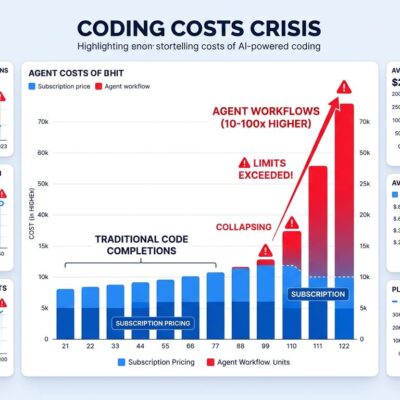
The math is worse. Anthropic is spending $40 billion a year on infrastructure while generating roughly $10 billion in annualized revenue. That’s a $30 billion annual deficit. Amodei said it plainly: “We do not know how frontier AI labs become profitable at the scale we are operating.” Either Claude API prices are going up, or Anthropic needs more funding rounds. Probably both.
The Illusion of AI Independence
Anthropic positioned itself as the independent AI safety company—ex-OpenAI researchers building Claude without Big Tech control. The $200 billion Google commitment exposes that narrative as fiction. Anthropic is now 100 percent dependent on Google for compute infrastructure. If the Google relationship sours, there is no Plan B. No multi-cloud strategy. No alternative at this scale.
This isn’t unique to Anthropic. OpenAI is deeply tied to Microsoft through $13 billion in investments and Azure infrastructure. Every frontier AI lab depends on the Big Three clouds: Google, AWS, or Azure. Training costs for frontier models now exceed $100 million, with projections hitting $10 billion per training run by 2026 and $100 billion data center clusters needed by 2027. Only companies with market caps above $100 billion can afford this. The result is an effective oligopoly controlled by cloud giants. AI independence doesn’t exist at the frontier.
Pentagon Blacklist, Four Days Earlier
The timing matters. On May 1, the Pentagon announced AI deals with eight companies—SpaceX, OpenAI, Google, Microsoft, Nvidia, AWS, Oracle, and Reflection. Anthropic wasn’t on the list. The Department of Defense labeled Anthropic a “supply chain risk,” a designation typically reserved for companies linked to foreign adversaries. The issue: Anthropic insisted on safety guardrails for AI use in warfare. The Pentagon wanted unrestricted access. Anthropic refused and got blacklisted.
Four days later, Anthropic announced the $200 billion Google commitment. That’s not coincidence. When government revenue evaporates, you pivot hard to commercial infrastructure. The Google deal isn’t just about scaling Claude. It’s about securing revenue when the Pentagon door slammed shut. Anthropic is now betting everything on the Google relationship working out.
What Developers Should Expect
If you’re building on Claude’s API, plan for price increases. The economics don’t support current pricing when infrastructure costs are four times revenue. Anthropic will either raise prices, cut costs, or raise more capital. Price hikes are the fastest path.
Vendor lock-in is cascading. Anthropic is locked to Google Cloud. Developers using Claude are locked to Anthropic. That’s two layers of dependency. Enterprise surveys show 81 percent of leaders are concerned about AI vendor dependency, with 47 percent saying a key business function would stop if their primary AI provider went dark. Only 6 percent could switch without disruption.
The strategic move: don’t depend on a single AI provider. Use Claude, GPT, and open models in parallel where possible. But acknowledge reality—at enterprise scale, some lock-in is unavoidable. The real question is whether Anthropic can deliver reliability with a $200 billion infrastructure bet riding on one cloud vendor.
Good for Google, Questionable for Everyone Else
For Google, this is the biggest cloud deal in history. It validates Google Cloud as the AI infrastructure platform and locks in the company behind Claude exclusively. Alphabet shares jumped 2 percent on the news, briefly surpassing Nvidia’s market cap. But there’s concentration risk: 40 percent of Google Cloud’s backlog comes from one customer. If Anthropic fails or can’t pay, Google’s cloud revenue takes a massive hit.
For developers and the industry, consolidation is accelerating. Fewer independent AI options. Cloud giants controlling the AI stack. One analyst put it this way: “What cloud computing achieved in ten years, AI is achieving in eighteen months.” The vendor lock-in that took a decade in cloud infrastructure is happening in a year and a half for AI.
The $200 billion commitment raises a bigger question: is this sustainable economics, or the late stage of a bubble? Anthropic is betting it’s sustainable. Developers are about to find out if that bet pays off—or if Claude API prices double to cover the tab.