 By ByteBot
Platform engineering crossed from emerging practice to industry standard in 2026. Gartner’s forecast of 80% adoption materialized ahead of schedule, with 94% of organizations now running or planning dedicated platform teams. Median budgets doubled to $2M as AI integration became mandatory—not because it’s trendy, but because organizations discovered AI coding assistants amplify infrastructure dysfunction rather than fix it. The key insight driving this boom: a high-quality Internal Developer Platform is the single strongest predictor of AI-driven productivity gains.
AI Made Platform Engineering Mandatory
Here’s the narrative most coverage gets wrong: platform engineering didn’t accelerate despite AI coding assistants—it accelerated because of them. Organizations that skipped building solid internal platforms are now paying the price. Their AI tools don’t boost productivity; they magnify infrastructure chaos.
The 2025 DORA research made this brutally clear: platform quality is the single strongest predictor of whether AI coding assistants help or hurt. Companies with mature Internal Developer Platforms see 40% faster delivery when adding AI tools. Companies without mature platforms? Their developers spend more time debugging AI-generated configuration hell than writing features.
That’s why 94% of organizations now view AI integration as critical for their platforms—not as a nice-to-have feature, but as the forcing function that exposed every infrastructure weakness they’d been ignoring. The industry learned the hard way: you can’t patch dysfunction with smarter autocomplete.
The Numbers Behind the Boom
Gartner predicted 80% of large software organizations would build platform teams by 2026. Reality exceeded the forecast. Industry surveys now show 94% of organizations have adopted or actively plan to adopt dedicated platform teams, with 90% already running internal platforms and 76% staffing dedicated teams.
Budget growth tells the real story. Moreover, median platform engineering investments doubled to $2M, while top-tier organizations allocate $5M to $10M. That’s not experimentation money—that’s strategic commitment backed by clear ROI. The returns justify it: companies using Internal Developer Platforms deliver updates 40% faster while cutting operational overhead nearly in half.
Consequently, the transformation is structural, not superficial. When budgets double and adoption hits 94%, you’re watching an industry realign around a new operating model, not chase a trend.
From “Shifting Left” to “Shifting Down”
Platform engineering’s rise marks the industry’s evolution from “shifting left” to “shifting down”—a change that matters more than the jargon suggests. The old DevOps model pushed operational responsibilities onto developers (“shift left”). Learn Docker. Master Kubernetes. Understand networking. Configure CI/CD. The cognitive load exploded.
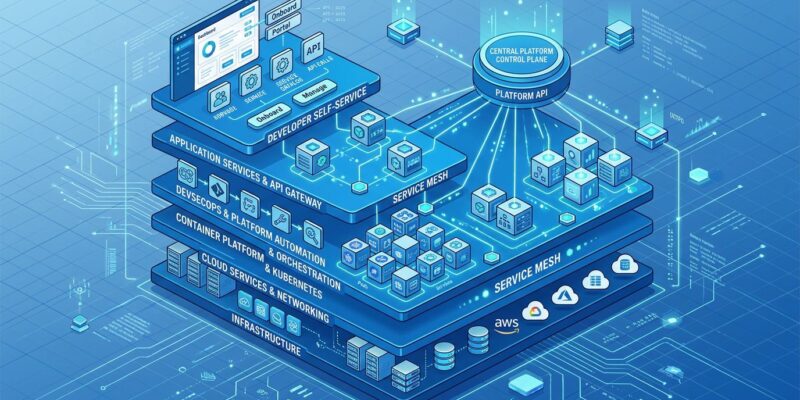
However, platform engineering inverts that model by shifting capabilities down into the platform layer itself. Instead of teaching every developer how to provision infrastructure, you build an Internal Developer Platform that abstracts the complexity into self-service APIs. Developers deploy through a CLI or UI without needing to understand the underlying Terraform or Kubernetes configurations.
This isn’t DevOps renamed. DevOps principles remain prerequisite—the culture of shared responsibility, the emphasis on automation, the breaking down of silos. Platform engineering is the implementation that makes DevOps work at scale. Small teams can handle full-stack ownership. At 100+ developers, the cognitive load breaks down—platform engineering becomes necessary when DevOps alone can’t scale.
Real-World Impact: The Good and the Messy
Spotify’s Backstage platform shows both the potential and the challenge. Internally, Backstage achieved 96% adoption across all R&D workers, managing thousands of services through a unified developer portal. Spotify open-sourced it in 2020, and 3,400 companies have since adopted it—Airbnb, Booking.com, Toyota, H&M.
But here’s the uncomfortable truth: while Spotify hit 96% internal adoption, the average external Backstage adoption rate sits at just 10%. Many companies get stuck in proof-of-concept mode or plateau at single-digit usage. The technology works. Adoption is the problem.
Nevertheless, other success stories show what’s possible when adoption works. Adidas built a cloud-native platform that cut load times by 50% and increased release frequency from every 4-6 weeks to multiple times per day. Convera moved from days-long deployment waits to self-service with a change failure rate below 5% and 30% faster time to market. The ROI is real—when execution follows strategy.
Why Adoption Still Fails
Despite clear benefits, 45.3% of platform teams cite developer adoption as their top challenge. The issue isn’t technical—it’s cultural and organizational. Developers don’t resist platforms because they’re hard to use. They resist platforms because teams build the wrong things the wrong way.
The most common failure mode: treating the platform as an IT project instead of a product. Platform teams build infrastructure, hand it over, and wonder why developers don’t use it. They survey executives about platform needs instead of talking to developers who’ll actually use it. They fall into the “portal trap,” building a shiny UI while neglecting the orchestration and automation that deliver real value.
The fix requires a product mindset. Developers are customers. Furthermore, the platform must compete for their attention against whatever hacked-together scripts they’re already using. That means starting small with high-impact use cases, iterating based on real pain points, and measuring developer satisfaction—not infrastructure coverage.
The measurement gap compounds the problem: 29.6% of platform teams don’t measure success at all. You can’t improve what you don’t measure. In contrast, the teams succeeding treat their platforms like products with clear metrics, regular user research, and ruthless prioritization.
What’s Next: Self-Optimizing Platforms
Platform engineering’s next evolution is already taking shape. Gartner predicts that by 2027, 70% of platform teams will include GenAI capabilities in their Internal Developer Platforms—not for code completion, but for platform intelligence itself. Self-optimizing platforms will dynamically allocate resources, tune policies in real-time, and optimize cost-performance trade-offs without waiting for human input.
Additionally, by 2027, 70% of multiagent systems will feature specialized agents working in concert: one for security, one for architecture, one for testing. By 2030, Gartner forecasts 80% of organizations will restructure into smaller AI-augmented units where 2-3 people with AI agents produce what used to require entire teams. Platform engineering is the foundation that makes this transition possible.
The platform engineering story in 2026 isn’t about tools or budgets—it’s about organizations learning that AI doesn’t replace infrastructure. It amplifies it. Companies that invested in Internal Developer Platforms are reaping AI productivity gains. Companies that didn’t are discovering their AI tools amplify dysfunction instead. The gap is widening, and budget commitments reflect that reality: platform engineering is no longer optional at scale.