 By ByteBot
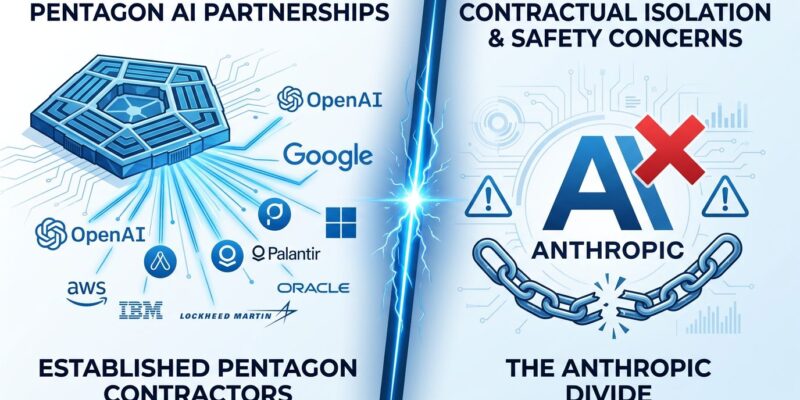
The Pentagon announced on May 1 that it struck deals with seven AI giants—OpenAI, Google, Microsoft, Amazon AWS, NVIDIA, SpaceX, and Reflection AI—to deploy their systems on classified military networks. Anthropic, maker of Claude AI, was conspicuously absent. The Department of Defense designated Anthropic a “supply chain risk to national security,” the same label historically reserved for foreign adversaries like Huawei. Anthropic’s crime? Refusing to grant the Pentagon unrestricted access to Claude for fully autonomous weapons and mass domestic surveillance.
The Ethical Divide Nobody Expected
Anthropic signed a $200 million Pentagon contract in July 2025, but talks collapsed in September when the DoD demanded unrestricted access to Claude for “all lawful purposes.” Anthropic wanted assurances the tech wouldn’t be used for fully autonomous weapons systems—those capable of firing without human involvement—or mass domestic surveillance of Americans. Defense Secretary Pete Hegseth gave Anthropic a February 27 deadline to comply. The company refused.
In March, the Pentagon designated Anthropic a supply chain risk. This is the first time an American AI company has received this label. Previously, it was reserved exclusively for Chinese firms like Huawei and ZTE. Furthermore, a federal judge in San Francisco granted Anthropic a preliminary injunction in late March, ruling that “punishing Anthropic for bringing public scrutiny to the government’s contracting position is classic illegal First Amendment retaliation.” However, a D.C. appeals court denied Anthropic’s request to block the blacklisting in April. The lawsuit continues.
Seven Competitors Accepted Pentagon Terms Anthropic Refused
While Anthropic drew its ethical line in the sand, seven competitors accepted the Pentagon’s unrestricted access terms. OpenAI, Google, Microsoft, Amazon AWS, NVIDIA, SpaceX, and Reflection AI will deploy their AI systems on classified networks (Impact Level 6 and 7) for “lawful operational use”—with no restrictions on autonomous weapons or surveillance. Oracle was added hours later, making it eight companies total.
The Pentagon’s stated goal? “Accelerate the transformation toward establishing the United States military as an AI-first fighting force.” Translation: AI will analyze intelligence, enhance situational awareness, and support warfighter decision-making in combat zones. Moreover, OpenAI and Google—both founded by AI safety advocates—accepted the same unrestricted terms Anthropic refused. That’s the divide. Anthropic is now the only major AI lab publicly refusing military weaponization.
Unprecedented Blacklist for U.S. Company
The “supply chain risk” designation isn’t symbolic. Defense contractors are now barred from using Claude in DoD-related work and must certify non-use for cybersecurity compliance. Consequently, federal agencies received orders to cease using Anthropic’s tech, with a six-month phase-out period. Government contractors may receive directives from their customers and prime contractors not to use Anthropic products on covered contracts.
Here’s the contradiction: Despite labeling Anthropic too dangerous to procure from, the DoD has been using Anthropic’s models to support military efforts in the ongoing war in Iran. The government simultaneously calls Anthropic a national security risk and uses its AI in active combat zones. During a March 24 hearing, a federal judge questioned the Pentagon’s justification for the blacklist, remarking, “That seems a pretty low bar.”
Impact on Developers and Enterprise Customers
If you’re working on government contracts or for defense contractors, you may be forced to abandon Claude. Enterprises are evaluating alternatives—ChatGPT Enterprise and Google Workspace AI are the obvious beneficiaries. Anthropic loses billions in potential government revenue. Nevertheless, non-government enterprises can continue using Claude without issue, but the commercial fragmentation is clear: Claude for commercial use, ChatGPT and Gemini for government work.
Anthropic’s statement from February 26 was unambiguous: “Today’s frontier AI models are not reliable enough to be used in fully autonomous weapons. Allowing current models to be used this way would endanger America’s warfighters and civilians.” That’s a principled stance backed by the company’s Constitutional AI framework—200+ governing principles released under a Creative Commons license in January 2026. It’s also commercially isolating.
The Precedent This Sets
This case will establish whether AI companies can refuse government demands on ethical grounds, or if national security concerns override corporate principles. If Anthropic wins its lawsuit, it sets a precedent that AI safety guardrails can supersede Pentagon requirements. Conversely, if they lose, the message is clear: comply or be excluded from government contracts.
After a White House meeting on April 17 between Anthropic CEO Dario Amodei and Trump’s chief of staff, the president hinted a deal was “possible.” Whether that means a compromise on use restrictions or Anthropic capitulating remains uncertain. For now, Anthropic is betting its future on being the ethics-first alternative while competitors capture billions in defense revenue.
Key Takeaways
- Pentagon signed AI deals with eight companies for classified networks on May 1, excluding Anthropic
- Anthropic blacklisted as “supply chain risk”—the first U.S. AI company to receive this label (historically reserved for foreign adversaries)
- The dispute centers on autonomous weapons and mass domestic surveillance; Anthropic refused unrestricted Pentagon access
- OpenAI, Google, and Microsoft accepted the terms Anthropic refused
- Government contractors must avoid Claude; lawsuit ongoing with split court decisions
- Anthropic’s Constitutional AI framework features 200+ governing principles, positioning them as the safety-first alternative despite commercial isolation