 By ByteBot
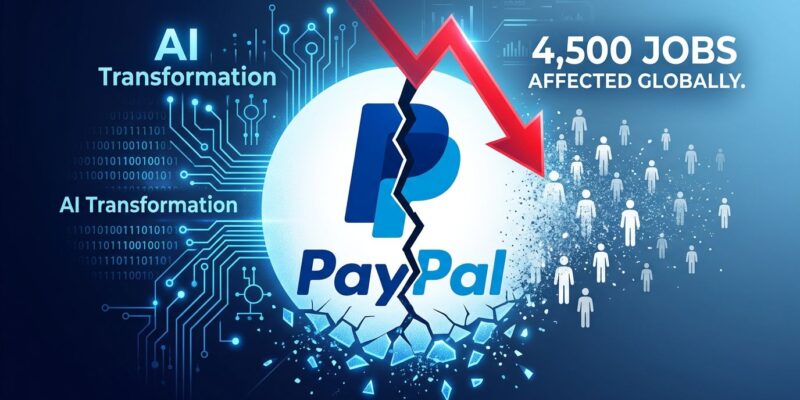
PayPal announced yesterday a $1.5 billion AI transformation initiative during its Q1 2026 earnings call—the first under new CEO Enrique Lores, who took the helm March 1 after six years running HP. The company plans to cut approximately 20% of its workforce (4,500+ jobs) over the next 2-3 years while betting on AI automation to deliver cost savings. Despite beating earnings estimates with $8.4 billion in revenue (up 7% year-over-year), PayPal’s stock dropped 10% in premarket trading May 5. The message from investors: We don’t believe your AI story.
The stock drop is the tell. When a company beats earnings but tanks anyway, the market is signaling something deeper. In PayPal’s case, it’s weak Q2 guidance showing 9% year-over-year EPS decline—hardly the trajectory of a company being transformed by efficiency gains.
The $1.5B AI Bet That Investors Didn’t Buy
PayPal formed a dedicated “AI transformation and simplification” team led by former Walmart technology executive Anshu Bhardwaj, reporting directly to CEO Lores. The mandate: “redesign function by function, process by process” to modernize customer support, technology development, and risk management. Lores pitched it as “becoming a technology company again”, promising “cloud-native” infrastructure and “aggressively adopting AI in development processes.”
The company’s restructuring follows a two-wave approach. Wave one tackles structural realignment—reorganizing into three business segments (checkout solutions/PayPal, consumer financial services/Venmo, payment services/crypto) and eliminating organizational layers. Wave two deploys AI automation across customer support, tech development, and risk operations. Moreover, customer support and technology development were flagged as “near-term opportunities” for AI-driven efficiencies.
Here’s the problem: automating customer support typically degrades satisfaction, not improves it. Furthermore, if AI genuinely made PayPal more efficient, Q2 earnings guidance wouldn’t project a 9% decline. The numbers don’t support the transformation narrative.
Why the Market Isn’t Buying It
PayPal’s Q2 2026 guidance shows EPS declining 9% year-over-year. Full-year 2026 guidance calls for “low-single digit decline to slightly positive” non-GAAP EPS. Transaction margin dollars are expected to show a “slight decline.” These aren’t the metrics of a company being transformed by AI efficiency—they’re the metrics of a company losing competitive ground.
Meanwhile, competitors are thriving. Apple Services posted a record $30.976 billion in Q1 2026. Visa and Mastercard both delivered double-digit revenue growth. Additionally, Stripe continues gaining market share by offering superior developer experience. PayPal’s stock is down over 80% from its 2021 pandemic highs, and the gap keeps widening.
If AI automation delivers real efficiency gains, those gains should show in improving margins and profitability. Instead, PayPal is cutting 4,500 jobs while guiding profitability down. That’s not transformation—it’s cost-cutting dressed up in AI language.
The 2026 Pattern: AI as Cover for Layoffs
PayPal isn’t alone. Over 92,000 tech workers have been laid off in 2026 year-to-date, with nearly every company citing AI as the driver. However, Oxford Economics research reveals only 4.5% of layoffs (roughly 55,000 positions) are actually AI-driven. Standard market and economic conditions drove 245,000 job losses during the same period—nearly four times higher.
A December 2025 survey of 1,000 hiring managers found that 59% admit they emphasize AI in layoff announcements “because it plays better with stakeholders” than admitting financial constraints. Consequently, companies including Meta, Microsoft, Block, Pinterest, CrowdStrike, Oracle, and Amazon all announced “AI transformation” cuts in 2026. The pattern is clear: AI has become corporate cover for economic restructuring.
Chinese courts have started pushing back. In May 2026, a Chinese court ruled that automation alone doesn’t justify layoffs. Meanwhile, Western companies continue using AI as PR spin for cost-cutting that would happen regardless of technological advancement.
What This Means for Tech Workers
If PayPal can frame 20% layoffs as “AI transformation,” every struggling tech company will copy the playbook. The precedent is set: blame AI when cutting headcount, take credit when metrics improve. Actual AI efficiency gains, where they exist, rarely materialize at promised scale. Fortune analysis nailed it: “Companies are choosing the fastest path to efficiency instead of the harder path to reinvention. They are laying off their way to transformation because it’s easier than rewiring how work gets done.”
Tech workers now face dual pressure: prove your value can’t be automated while watching companies use AI as justification for cuts that have nothing to do with actual automation capabilities. Only 9% of companies report AI has actually replaced roles entirely, yet 100% of tech layoff announcements in 2026 cite AI as a contributing factor.
PayPal’s stock drop shows the market sees through this. When investors don’t believe the AI transformation story despite promised $1.5 billion in savings, that’s the signal: this is desperation cost-cutting, not innovation. The new corporate playbook is transparent—and workers are paying the price.