 By ByteBot
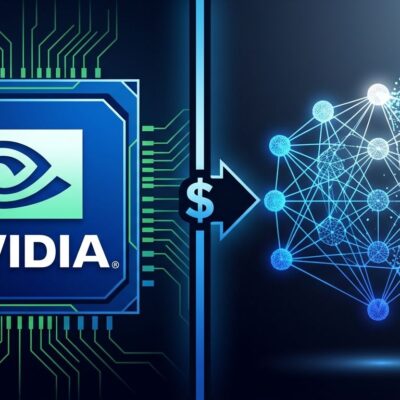
Nvidia just handed $3.5 billion to Taiwanese chipmaker MediaTek — not to build more GPUs, but to make sure every company trying to replace Nvidia’s GPUs still ends up running on Nvidia’s platform. The deal, announced Monday, places MediaTek inside the NVLink Fusion ecosystem: Nvidia’s infrastructure layer that lets hyperscalers design custom AI accelerators while still depending on Nvidia’s interconnect, rack architecture, and software stack. The strategic logic is direct to the point of being brazen: if you can’t stop customers from building their own chips, become the plumbing those chips run on.
The Platform Play Hiding Inside a Bond Deal
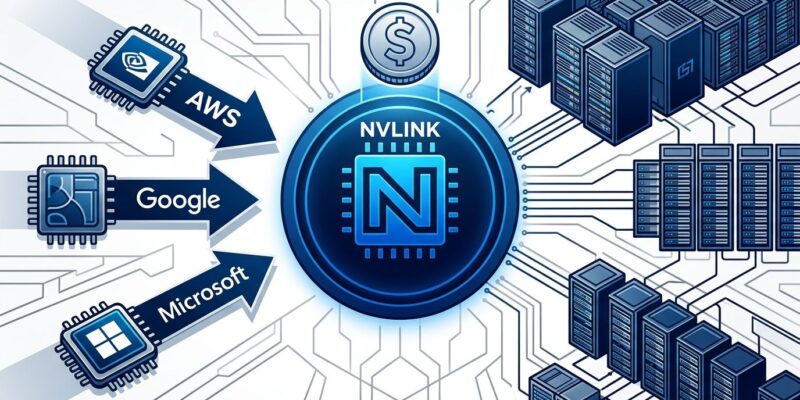
On the surface, this looks like a financial investment. Nvidia purchased $3.5 billion in MediaTek convertible bonds as part of a record $3.9 billion overseas bond offering — Alphabet quietly took the remainder. But the strategic payload is the partnership terms: MediaTek adopts NVLink Fusion and becomes a design partner for hyperscalers building custom AI accelerators. Those accelerators, regardless of who designs the compute die, still plug into Nvidia’s rack-scale MGX architecture and NVLink fabric.
The convertible bond structure matters. Nvidia holds debt — if MediaTek’s custom chip business struggles, Nvidia is a creditor. If it succeeds and hyperscalers rush to MediaTek for custom silicon, those bonds convert to equity. Nvidia captures upside from the very defection it is supposedly enabling. Forbes called it a tollbooth: “If the deal works, every escape from Nvidia’s margins gets built on Nvidia’s plumbing.”
Why Hyperscalers Are Building Their Own Chips
The custom chip race is real and accelerating. Amazon has deployed over one million Trainium processors and is selling capacity to OpenAI. Google’s TPUs are the most mature alternative AI silicon available, now rentable externally. Microsoft’s Maia 200 — built on TSMC 3nm with 140 billion transistors — runs GPT-5.2 production workloads today. Meta has MTIA for inference, OpenAI built Jalapeño for internal use. Custom AI chip shipments are growing at +44.6% year-over-year in 2026, nearly triple the rate of merchant GPUs at +16.1%.
This is what Nvidia is countering. Nvidia still holds 90%+ of the AI training market and 60–75% of inference, but if hyperscalers shift a third of their compute to custom silicon, the revenue impact is significant. Marvell — which already designs chips for Amazon and Microsoft — is projecting $11 billion in AI ASIC revenue for 2026 alone. Nvidia needed a response that did not involve dropping GPU prices.
NVLink Fusion: The Standard Beneath the Custom Silicon
NVLink Fusion is Nvidia’s answer. The platform separates what companies can customize from what they still depend on Nvidia for. Hyperscalers design their own XPU compute die — specialized processing optimized for their workloads. That die uses an NVLink Fusion chiplet to connect to Nvidia’s NVLink fabric. Everything then sits inside Nvidia’s MGX rack-scale architecture, using Nvidia’s networking and system software.
The result: a custom accelerator differentiated from Nvidia’s H-series GPUs — but one that still buys Nvidia’s interconnect, Nvidia’s networking, and Nvidia’s rack systems. As Nvidia VP Dion Harris put it: “Every cloud, every model builder is deploying our platform in some shape, form, or fashion.” The NVLink Fusion ecosystem already includes Marvell, Alchip, Samsung, Astera Labs, and now MediaTek. It is becoming the default standard for semi-custom AI infrastructure before most hyperscalers have finished reading the contract.
The historical parallel analysts are reaching for is Intel’s 30-year x86 dominance. Rival silicon regularly appeared, grabbed sockets, and ultimately strengthened the Intel ecosystem because everything still plugged into Intel’s bus standards. Nvidia is playing that role for AI infrastructure: own the interconnect standard, and you control the platform regardless of who wins the individual chip competition.
The Counterweight: UALink
There is an open alternative. UALink is an open AI interconnect standard backed by AMD, Google, Intel, Broadcom, and Microsoft — companies with strong incentives to prevent NVLink Fusion from becoming the industry default. Analyst Matt Kimball of Moor Insights noted that “heterogeneity is the future of AI,” flagging UALink as a legitimate counterweight. If UALink achieves sufficient ecosystem adoption among hyperscalers, Nvidia’s platform lock weakens considerably.
This outcome is genuinely uncertain. NVLink Fusion has a running start — MediaTek, Marvell, Samsung, and Astera Labs are already committed. But the companies backing UALink are not minor players hedging bets. Google and Microsoft have specific financial and competitive reasons to prevent Nvidia from becoming the infrastructure tollbooth for AI compute. Which standard wins will shape who captures the margins as AI infrastructure scales.
What This Means for Developers
Near term, more chip diversity generally benefits developers. Competing accelerators mean better cloud pricing on AI compute, which is the largest marginal cost for most AI-heavy applications. MediaTek entering the hyperscaler AI silicon market via NVLink Fusion accelerates that competition.
The longer-term concern is subtler: if NVLink Fusion becomes the default infrastructure standard, Nvidia extracts platform rents even from “Nvidia-free” compute. You switch to a cloud provider running MediaTek-designed custom chips, and your infrastructure bill still routes through Nvidia’s ecosystem. That is not immediately a problem — Nvidia provides genuine value in its networking and systems stack — but it is worth tracking. The chip logo on the accelerator is mattering less. What runs between the chips is mattering more.