 By ByteBot
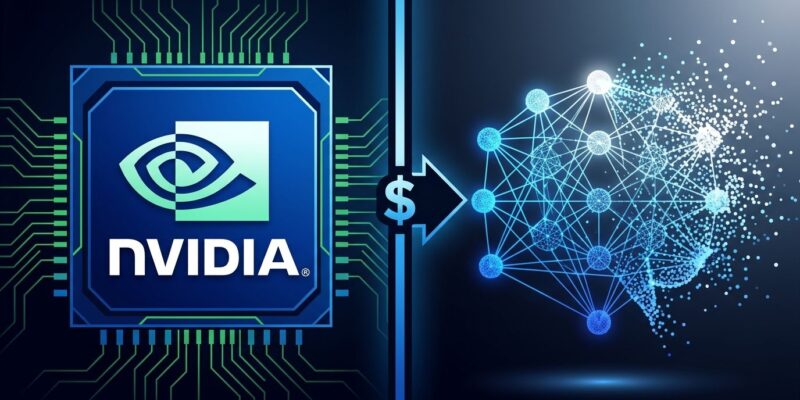
NVIDIA is in early-stage talks to acquire Reflection AI — the $25 billion startup behind Beam, a 501-billion-parameter open-weight model — according to a Financial Times report confirmed by Bloomberg on October 10. NVIDIA had already invested $800 million in Reflection during its October 2025 funding round. Now it may own the whole company. The developer community has one very specific question: what happens to Beam’s Apache 2.0 license if NVIDIA closes this deal?
What Reflection AI Built With Beam
Reflection was founded in 2024 by Misha Laskin and Ioannis Antonoglou, both former Google DeepMind researchers, with an explicit mission to build a Western open-weight alternative to proprietary US labs and Chinese competitors. Beam, announced October 5, is their first frontier model: 501 billion total parameters, 23 billion active per inference pass (sparse mixture-of-experts), trained on 23.8 trillion tokens using 6,144 NVIDIA GB300 GPUs in under four weeks.
The benchmark numbers are serious. Beam scores 80.9 on SWEBench Verified and 80.1 on Terminal Bench v2.1 — competitive for coding and agentic tasks. It matches GLM 5.2 on advanced reasoning while using 3–4x less inference compute, translating directly to lower operating cost per token. Kimi K3 is still ahead on raw capability, but Beam’s efficiency argument is real. Full weights — with technical report, documentation, and complete inference and fine-tuning tooling — are set to release under Apache 2.0 later this October.
Related: Reflection AI Beam: 501B Parameters, 23B Active — Not Released Yet
The Open-Weight License Question
Here is the mechanical reality developers need to understand about Apache 2.0: it is irrevocable. Once Reflection publishes Beam’s weights under that license, nobody — including NVIDIA if they complete an acquisition — can reach back and revoke the rights granted to that release. You can use it commercially, fine-tune it, redistribute it, and build products on it. That permanent license protection is what matters most here.
The race, therefore, is about timing. If Beam’s full weights release in October before any acquisition closes, developers get what Reflection promised. However, if NVIDIA finalizes a deal first and decides future Reflection models ship under different terms — say, restricted to NVIDIA’s NIM inference microservices platform or behind commercial license requirements — that is a materially different situation for Beam v2 and every model version after it. The current release would still be Apache 2.0. Future versions would be NVIDIA’s call.
Talks are described as early-stage with no finalized terms, according to Bloomberg’s October 10 report. Options on the table include full acquisition, a deepened investment stake, or an acqui-hire arrangement — similar to how NVIDIA handled Groq, where the company brought in staff and licensed technology rather than completing a full corporate acquisition.
The Chip Supplier Paradox
NVIDIA’s entire competitive position depends on selling chips to every major AI lab without picking sides. That posture worked as long as NVIDIA was pure infrastructure. Owning Reflection breaks the neutrality. OpenAI is already building a custom inference chip with Broadcom. Meta is developing MTIA accelerators. Anthropic has an explicit multi-supplier strategy designed to prevent single-vendor lock-in. These customers already had reasons to accelerate custom silicon development — an NVIDIA-owned model company gives them one more.
The conflict mirrors Intel’s foundry ambitions. Intel tried running a contract chipmaking business while competing with the same customers in processors. The trust problem proved difficult to solve. NVIDIA’s version is structurally similar: you cannot convincingly position yourself as a neutral chip supplier once you own a model company that competes with your customers. Moreover, NVIDIA paid $800 million to back Reflection at a $25 billion valuation — this is not a small bet on a peripheral startup.
NVIDIA did co-sign the July 2026 industry letter backing open-weight AI alongside Microsoft, Meta, and Google. Owning Reflection would give that position more operational substance. It also creates the incentive to route Beam deployment through NVIDIA’s own NIM infrastructure rather than allowing it to run freely on any hardware stack — which is precisely the concern the open-source community is watching.
What to Watch
Two near-term dates matter. First: when Reflection drops Beam’s weights publicly. The Apache 2.0 license on that release is permanent. Second: any acquisition announcement. Acquisitions of this scale take months to close, so there is a real window where both events happen independently. For teams building on open-weight models, the practical advice is simple: get Beam weights when they drop, before any acquisition changes the license trajectory for future versions.
Key Takeaways
- NVIDIA is in early acquisition talks with Reflection AI ($25B valuation), reported by Bloomberg and the Financial Times on October 10 — no deal is confirmed yet
- Beam weights are due under Apache 2.0 later this October — once released, that license is irrevocable regardless of who owns Reflection
- NVIDIA owning a model company creates a direct conflict with its chip customers (OpenAI, Anthropic, Meta), who are already building alternative hardware to reduce NVIDIA dependency
- Watch the weight release timing — grab Beam under Apache 2.0 when it drops; future model versions would be under NVIDIA’s license control post-acquisition