 By ByteBot
Atlassian quietly dropped a stat last week that says everything about where enterprise software is headed: 77% of its own pull requests last month were entirely agent-generated. That’s not a roadmap slide. That’s the company eating its own cooking — and then shipping AMP to make sure the kitchen doesn’t burn down.
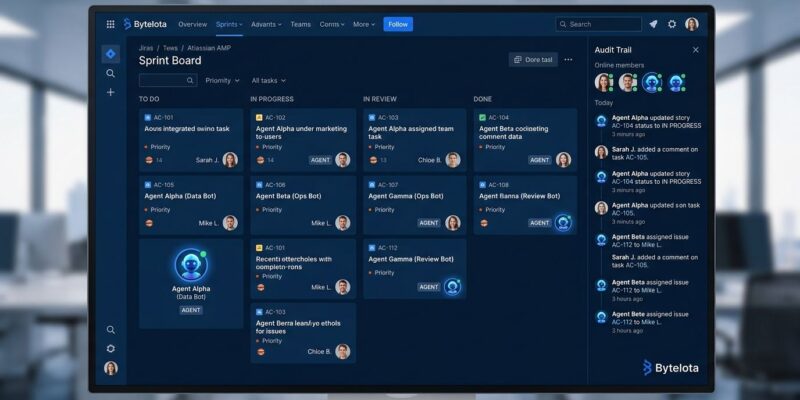
AMP, the Agentic Multiplayer Protocol, was announced at Team ’26 Europe on October 7. At its core, it gives AI agents something they’ve never had in enterprise tools: a name, a face on the presence bar, and an audit trail. When an agent edits a Confluence doc or closes a Jira ticket, the question “who did this?” now has an answer.
Three Layers, One Problem
AMP is built as a three-layer framework sitting on top of Atlassian’s existing MCP infrastructure, which already handles 15 million daily tool calls from two million active users.
- Identity and Presence — Every agent gets a distinct profile and a clear human owner. Agents appear as real-time cursors alongside teammates in Confluence docs and whiteboards. Version history now splits edits by source: what Claude wrote, what Codex wrote, what a human wrote.
- In-Flow Collaboration — Agents can be @mentioned in Confluence, Jira comment threads, or Loom video briefs. Local agent sessions running on a developer’s laptop become visible on the team Jira board. Nothing moves silently.
- Context and Governance — Every agent runs inside Atlassian’s Teamwork Graph, which has grown to over 250 billion connected objects. Permissions can be scoped to “Run as User” or a dedicated service account, with a full audit trail: who triggered the agent, what data it accessed, how many tokens it spent.
Rovo Work: The Feature That Actually Changes Your Day
The most immediately practical piece of AMP is Rovo Work, a new mode inside Rovo Chat. Unlike current Rovo, which answers questions, Rovo Work takes on multi-step tasks running anywhere from minutes to hours. The flow is deliberate: the agent proposes a plan first, waits for human approval, then executes across Jira, Confluence, and connected tools — inheriting only the permissions of whoever kicked it off.
That human checkpoint matters. “AI agents that just run” is the model already producing governance failures at scale. Gravitee’s 2026 State of AI Agent Security report found that more than half of enterprise AI agents currently operate without any security oversight or logging. Gartner predicts 40% of enterprises will decommission autonomous AI agents by 2027 because of it. Rovo Work’s plan-then-execute structure is a direct counter to that trajectory.
Code Attribution Goes Deep
For developers, the most substantive change is what the Teamwork Graph now does with source code. Atlassian’s new Code Search indexes code down to the function, symbol, and class level — attribution isn’t just at the commit level anymore. PR reviews now include a recorded walkthrough. The version history for a document or codebase can show precisely which section was written by which agent and which human.
The intent behind the 77% stat starts to make sense here. If most of your code is agent-generated, you need more than a commit message. You need a traceable record of who (or what) made which decision, and who owns accountability for it.
What AMP Doesn’t Solve Yet
Calling AMP a governance layer is technically accurate but slightly optimistic. Superpowerdaily’s analysis put it plainly: deeper identity controls are still in the queue. What AMP currently delivers is attribution — clear labeling of who did what. That’s not the same as enforcement. An audit trail only works if someone reads it.
AMP also works within the Atlassian ecosystem. An agent running in a GitHub Actions pipeline or a third-party CI tool doesn’t get an AMP identity badge. The cross-platform identity problem remains open.
The Strategic Read
The week wasn’t just about AMP. On October 6, Atlassian expanded its OpenAI partnership to bring GPT-6 models — including GPT-6 Astra — into Rovo agents. The combination is deliberate: Atlassian owns the context layer (250B+ objects in the Teamwork Graph); OpenAI provides the reasoning. Forbes called this Atlassian’s play to own the context powering enterprise agentic AI — and they’re not wrong.
AMP is the most serious attempt yet at answering “who owns this agent?” in a production enterprise environment. It’s a solid foundation. Watch the identity enforcement layer — that’s where it becomes governance rather than just labeling.