 By ByteBot
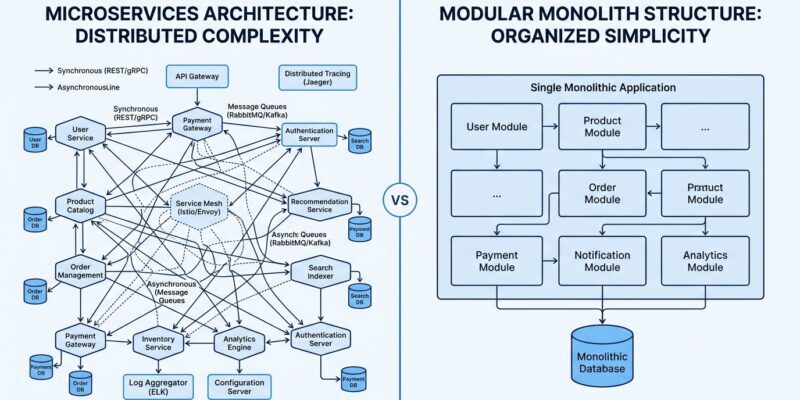
The microservices hype cycle has reversed. In 2026, 42% of organizations that adopted microservices are quietly consolidating services back into modular monoliths—single deployable applications with clear internal boundaries. This isn’t architectural failure; it’s maturity. After years of racing to break apart monoliths (2015-2023), engineering teams are learning an expensive lesson: most companies adopted microservices prematurely, driven by “we might scale” assumptions rather than demonstrated need.
The Hidden Costs Nobody Advertised
Platform engineering teams required to run microservices cost $600,000 to $1.8 million annually for organizations with 50-100 engineers. That’s a minimum of three senior engineers at $200,000 each, plus tooling and infrastructure. Moreover, microservices introduce 25% operational overhead from distributed debugging, deployment coordination, and service mesh complexity.
Worse, teams need 3-6 months just to become productive with Kubernetes tooling—half a year before delivering at full velocity. Organizations with fewer than 50 engineers rarely see net benefits. Consequently, the “we might scale” argument collapses when you factor in these costs. Most startups and mid-size companies waste millions on infrastructure complexity they don’t need, money that could fund product development instead.
Amazon Prime Video: 90% Cost Reduction Moving to Monolith
In 2023, Amazon Prime Video’s video quality analysis team migrated from microservices back to a monolith and achieved a 90% cost reduction. The original architecture used distributed microservices orchestrated by AWS Step Functions, with expensive Tier-1 S3 calls for every second of stream. The bottleneck was clear: intermediate video frames stored in S3 created massive overhead.
The solution? Pack all components into a single process and eliminate S3 intermediate storage entirely. Data transfer moved in-memory, scaling improved, and resilience increased. Therefore, if Amazon—the company that popularized microservices—finds monoliths superior for specific workloads, it validates a critical principle: architecture should match actual needs, not aspirational scale.
The Distributed Monolith Trap
Many teams rushing into microservices end up with distributed monoliths—the worst of both worlds. Services deploy separately but can’t change independently. You get the complexity of microservices (distributed debugging, deployment coordination, cascading failures) without the benefits (independent scaling, team autonomy).
Warning signs are unmistakable: services share databases or tightly coupled data models, schema changes ripple across multiple services, and you must deploy multiple services together for any change. This anti-pattern is the most common outcome of premature microservices adoption. Teams split monoliths along code boundaries instead of business domains, creating distributed systems without isolation benefits.
Modular Monolith: The Sophisticated Default
A modular monolith is a single deployable application with clearly defined internal modules enforced by modern tooling. Spring Modulith 1.4, ArchUnit 1.3, and jMolecules 2026.0 all landed in Q1 2026, signaling the maturity of this approach. Furthermore, modules communicate in-process with well-defined boundaries, offering organization without distributed system complexity.
This isn’t a compromise or stepping stone—it’s often the optimal architecture. You get a single deployment artifact (one rollout), modules enforce boundaries at compile time, in-process communication eliminates network latency, and you can extract modules to microservices later if needed. Clear boundaries provide organizational benefits without operational overhead.
The New Decision Framework
The 2026 consensus is clear: default to modular monolith, extract to microservices only with demonstrated need. Microservices benefits appear at 100+ engineers with mature DevOps, not at startup scale. Organizations need a $2 million+ cloud bill to justify platform engineering investment.
The decision tree is simple. Start with a modular monolith. Extract to microservices when you have proven bottlenecks (metrics, not predictions), 100+ engineers organized into independent teams, regulatory requirements demanding service isolation, or genuinely different tech stacks needed for different domains. Reject the “we might scale” argument without data—that’s the YAGNI (You Aren’t Gonna Need It) principle applied to architecture.
Success is measured by developer velocity—how quickly and confidently teams can ship, fix, and improve software. Architectural purity doesn’t matter if your team can’t deliver. The industry is finally learning this lesson.
Key Takeaways
- Default to modular monoliths unless you have demonstrated need at scale—most teams don’t
- Platform engineering for microservices costs $600K-$1.8M annually, plus 25% operational overhead
- Amazon Prime Video cut costs 90% moving back to monolith—if Amazon does it, question the dogma
- Distributed monolith is the worst outcome: all complexity, no benefits from either pattern
- Extract to microservices only at 100+ engineers with proven bottlenecks and mature DevOps