 By ByteBot
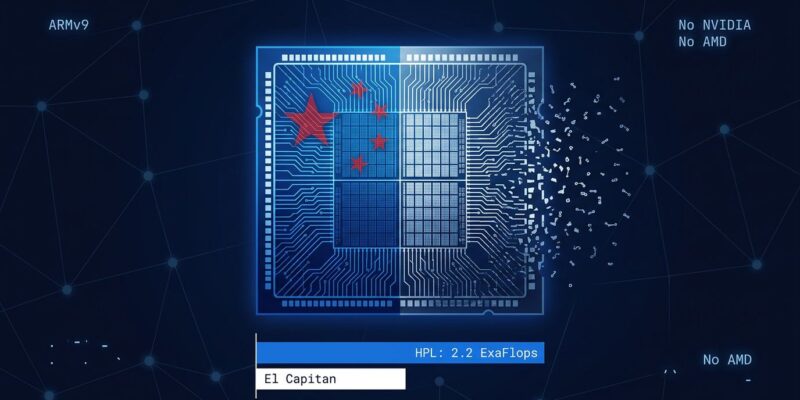
For the first time since 2017, a Chinese supercomputer sits at the top of the TOP500 list — and it got there without a single US chip. LineShine, deployed at China’s National Supercomputing Centre in Shenzhen, scored 2.198 exaflops on the HPL benchmark at ISC 2026 last week, displacing El Capitan by 21 percent. The entire machine runs on 2.45 million Huawei-designed ARMv9 CPU cores. No Nvidia. No AMD. Nothing Washington controls.
A CPU-Only Exascale Machine
LineShine is built around 40,960 Huawei LX2 processors — custom ARMv9 chips with 304 cores each running at 1.55 GHz. Each LX2 packs 32 GB of on-package HBM delivering 4 TB/s of bandwidth, plus 256 GB of DDR5 per socket. The system spans 22,000 nodes across 90 cabinets and draws 42.22 megawatts. It is also the first system to sustain more than 2 exaflops using CPUs alone — no GPU co-processors anywhere in the design.
If that sounds like a narrow technical distinction, it isn’t. LineShine topped the world’s most prestigious supercomputer ranking using hardware entirely outside US licensing jurisdiction. The network fabric is LingQi, a Chinese-developed interconnect. The operating system is KylinOS, a government-backed Linux distribution. The only foreign intellectual property is the ARMv9 instruction set, licensed by British company Arm Holdings — and that is not subject to US export controls.
| Spec | LineShine | El Capitan |
|---|---|---|
| HPL Score | 2.198 ExaFlops | 1.809 ExaFlops |
| HPCG Score | 22.004 PFlops | 17.406 PFlops |
| Architecture | CPU-only (Huawei ARMv9) | GPU-APU (AMD MI300A) |
| Core Count | 2.45M CPU cores | 44,544 MI300A devices |
| Power | 42.22 MW | ~29 MW |
| US Chips | Zero | AMD MI300A |
| Location | Shenzhen, China | Livermore, CA |
The Loophole Washington Left Open
US export controls from 2022 through 2024 focused on Nvidia’s H100, A100, and H200 GPUs, along with AMD equivalents — the chips powering most frontier AI training clusters. CPUs were treated differently, facing far fewer restrictions. Jimmy Goodrich, a technology policy researcher, put it directly: “The US government should have stronger controls on the export and manufacturing of CPUs for the China market. It is a loophole in the current regulations.”
China’s response was to build at scale using what it had access to. The LX2’s ARMv9 cores are manufactured domestically, the design is attributed to Huawei’s semiconductor arm, and the full stack — silicon to OS to interconnect — avoids every US-controlled component. The sanctions intended to constrain China’s compute capacity appear instead to have accelerated its push to build a sovereign one.
China stopped submitting systems to the TOP500 in 2023, shortly after the most aggressive export restrictions landed. Returning now, with a #1 finish, is not a coincidence. HPC analyst Addison Snell observed: “What I’m surprised by is that they submitted it.” The resubmission is as much a political statement as a technical one.
Where LineShine Falls Short
The HPL Linpack benchmark that defines TOP500 rankings measures linear algebra throughput — it is not an AI training benchmark. On HPL-MxP, the mixed-precision metric that better approximates transformer workloads, LineShine ranks fourth, behind three US GPU-based systems. CPUs lack the low-precision circuitry (INT8, FP8, tensor cores) that makes Nvidia hardware effective for large language model training.
The gap grows larger when you include systems that do not bother competing in TOP500. xAI’s Colossus facility in Memphis — running hundreds of thousands of Nvidia H100 and H200 GPUs — would likely rank far higher than any TOP500 entrant on actual AI workloads. It has no reason to enter. Nvidia still powers more than 400 of the world’s 500 fastest systems on the June 2026 list. LineShine does not change that.
What LineShine does change is the assumption that China cannot reach exascale without US chips. That assumption is now false.
What This Means for Developers
For HPC developers, the takeaway is that CPU-only exascale is real and it performs. LineShine also beats El Capitan on HPCG (22 petaflops vs 17.4), which better reflects real scientific application performance. The architecture detailed by Chips and Cheese — dense ARMv9 with on-package HBM and 4 TB/s bandwidth — is worth watching as a design pattern for memory-bound workloads.
For AI infrastructure developers, the relevant data point is the benchmark gap. A CPU-only exascale machine is impressive engineering. It is not a substitute for a GPU cluster when training a 700-billion-parameter model. The chip war now has two fronts: traditional HPC (China just took #1) and AI-accelerated compute (the US still leads by a significant margin). Those fronts are measuring different things.
One more item from ISC 2026: ACM SIGHPC announced it is taking over ownership of the TOP500 list from the ISC Group after 33 years, with future rankings to be published in the ACM Digital Library. The politics of who runs the list may matter more than usual now that it has become a scorecard in a geopolitical contest.