 By ByteBot
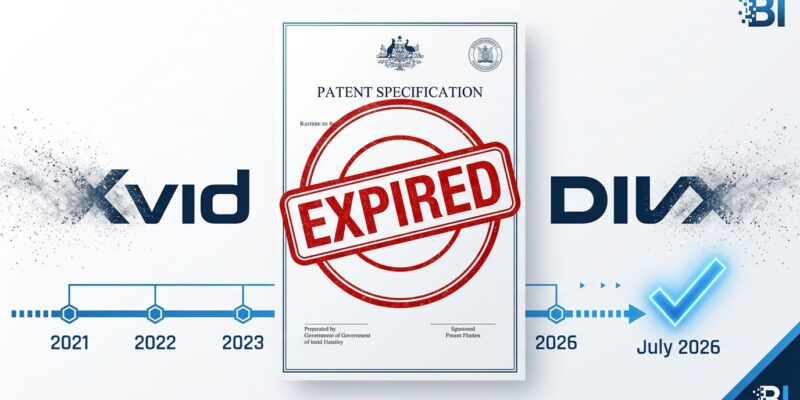
As of July 19, 2026, the last MPEG-4 Visual patent on Earth has expired. A Brazilian patent — BRPI0109962B1, titled “process for storing and processing image information from successive images over time” — was the final holdout in a pool that once stretched across dozens of countries. The VIA Licensing Alliance’s MPEG-4 Visual patent pool is now officially marked “Terminated.” After 25 years, every Xvid encoder, every DivX decoder, every MPEG-4 Part 2 implementation on the planet can be shipped, compiled, and distributed without a licensing dollar owed to anyone — in every country.
What the MPEG-4 Visual Patent Actually Covered
MPEG-4 Part 2 is the video coding standard that powered the early internet video era. Xvid and DivX are its two most famous implementations — Xvid is the open-source fork (literally “DivX” spelled backward, released under GPL in 2001), DivX is the commercial version. If you downloaded movies over BitTorrent between 2001 and 2007, you watched MPEG-4 Part 2 video. Furthermore, the patent pool behind it was managed by MPEG LA — the same organization that later merged into the VIA Licensing Alliance in 2023.
The patents cleared country by country over the past five years. Europe fell in April 2021. The US wrapped up by November 2023. Brazil — with its longer patent term — held on until July 19, 2026. As a result, the patent tracking page on Meta-Wiki that developers had been monitoring for years can finally be marked complete. The Brazilian patent BRPI0109962B1 was the last entry on the roster.
Stop. This Is Not H.264.
Before anything else: MPEG-4 Part 2 is not the codec inside your .mp4 files. That is almost certainly H.264, technically called MPEG-4 Part 10 or AVC. They share a name prefix, they can both live in .mp4 containers, and that is where the similarity ends. H.264 is a completely different standard with a completely different patent pool — one that remains fully active. In contrast with today’s news, the H.264 patent pool managed by VIA Licensing Alliance still lists active licensees and unexpired patents, with the last ones extending to 2027 and beyond in some jurisdictions.
This news does not free H.264. It frees Xvid. If you ship H.264 encode or decode in commercial software without a license today, you still have a problem. The two are regularly confused even by working developers, and every piece of coverage that skips this distinction is doing you a disservice. The .mp4 file format is just a container — what is inside (H.264, MPEG-4 Part 2, AV1) is the thing that matters for patent exposure.
Who Actually Cares About This in 2026
MPEG-4 Part 2 was largely displaced by H.264 in the late 2000s. However, “largely” is doing a lot of work there. Legacy DVR and security camera systems from the early 2010s still output Xvid streams. Industrial and medical embedded devices have long replacement cycles and still store video in MPEG-4 Part 2. Millions of .avi files sit on hard drives and NAS systems that any transcoding or media management tool needs to handle. More concretely: Linux distributions that maintained restricted codec packages for legal reasons can now clean that up. Open source projects that avoided implementing MPEG-4 Part 2 encoding due to Brazilian patent exposure — that exposure is gone. Commercial software vendors who excluded MPEG-4 Part 2 encode from products sold in Brazilian markets can remove the restriction. None of this is earth-shaking, but it is a real and final legal clearing.
For FFmpeg users specifically: the libxvid encoder and the mpeg4 codec are now fully unencumbered. FFmpeg’s legal notes on codec patents have long warned about potential exposure depending on jurisdiction — that note can now be retired for MPEG-4 Part 2. Developers distributing FFmpeg builds or applications that wrap it for MPEG-4 Part 2 encode have one less caveat to manage.
The Patent System Working Exactly as Designed
Here is the part worth sitting with: MPEG-4 Part 2 became fully patent-free in the same year that virtually nobody starts a new project using it. The patents lasted precisely long enough to extract value across the format’s entire commercial lifespan, then expired when H.264 and AV1 had safely replaced it. This is not a coincidence — it is a demonstration of how the patent system functions. Twenty-year terms on codec patents filed around 2001 expire between 2021 and 2026, right on schedule. The Hacker News community’s reaction to the news captured it perfectly: “Encode video and torrent like it’s 2002!” — nostalgia, not urgency. Moreover, this mirrors exactly what happened with MP3: patents cleared in 2017, right as AAC and Opus had finished taking over.
The same clock is ticking on H.264. Most of its patents will be gone by 2027 in many jurisdictions. If you want a codec that is free from the start rather than free at the end, the answer is AV1, designed explicitly by the Alliance for Open Media to stay outside the patent pool model entirely. The freedom arriving for MPEG-4 Part 2 today is a milestone, but it is also a reminder: by the time patent protection expires on a video standard, the industry has almost always moved on. Consider how quickly technical decisions compound — choosing encumbered formats has a long tail.
The milestone is real. MPEG-4 Part 2 is finally, fully, and globally free. It is just about 15 years too late to matter for most of what you are building. For legacy pipelines and open source distributions, the legal clearing is genuine and worth acknowledging. For everything else: this is history arriving on schedule, not a reason to open a new Xvid project.