 By
By On May 3, 2026, a Chinese open-weight model most Western developers had never heard of walked into a live coding challenge against eight frontier models and came out first — beating GPT-5.5, Claude Opus 4.7, and Gemini 3.5 Flash with a 7-1-0 record. Kimi K2.6 from Moonshot AI did it while costing 42 times less per output token than Claude Opus 4.7. That combination — competitive coding performance, MIT license, OpenAI-compatible API — is why developer communities are calling this the DeepSeek R1 moment of 2026.
What Kimi K2.6 Is
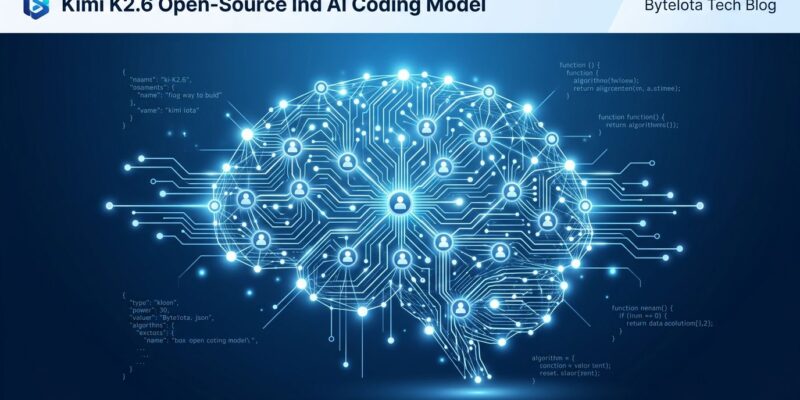
Kimi K2.6 is a 1-trillion-parameter Mixture-of-Experts model from Moonshot AI, a Beijing-based startup founded in 2023. Only 32 billion parameters activate per token — inference runs at the cost of a 32B model while routing across the full trillion-parameter architecture. It ships with a 256K token context window, native multimodal input (text, images, video via a 400M-parameter vision encoder), and weights available on HuggingFace under a Modified MIT license.
The MIT license is not a footnote. It means you can deploy K2.6 commercially, modify it, and self-host without royalties. That is the reason the developer community reacted the way it did.
The Benchmarks, Honestly
The headline benchmark win matters less than understanding where K2.6 actually lands:
| Kimi K2.6 | Claude Opus 4.7 | GPT-5.5 | |
|---|---|---|---|
| SWE-Bench Verified | 80.2% | 87.6% | 88.7% |
| SWE-Bench Pro | 58.6% | 64.3% | ~62% |
| MCP Atlas (tool use) | ~81% | 79.1% | 75.3% |
The gap on SWE-Bench Verified is real — K2.6 trails GPT-5.5 by 8.5 points on raw code correctness. What flips the story is MCP Atlas, which measures tool use and multi-agent coordination: K2.6 leads both GPT-5.5 and Claude Opus 4.7. For developers building agentic workflows, that is the benchmark that maps to production workloads. The May 3 live challenge was a multi-agent, tool-heavy task — K2.6’s wheelhouse.
The Price Gap Is the Real Story
Benchmark scores matter less when the economics are this different:
| Model | Input ($/M tokens) | Output ($/M tokens) |
|---|---|---|
| Kimi K2.6 | $0.20 | $0.60 |
| Gemini 3.5 Flash | $1.50 | $9.00 |
| Claude Opus 4.7 | $5.00 | $25.00 |
| GPT-5.5 | ~$5.00 | ~$20.00 |
The same monthly workload — 100 million input tokens and 10 million output tokens — costs roughly $85 on K2.6 and $2,550 on Claude Opus. That is $29,580 per year. For a startup running coding agents at any meaningful scale, this is the difference between viable and expensive. Context caching cuts K2.6’s input cost to $0.15 per million tokens — a 75% reduction for repeated-context workflows.
Agent Swarm: Built for Long-Horizon Work
K2.6 is not just a chat model that happens to cost less. Moonshot AI built it specifically for multi-agent, long-horizon tasks. The Agent Swarm capability runs 300 parallel sub-agents simultaneously — triple K2.5’s limit — executing up to 4,000 coordinated steps and sustaining autonomous runs for 12 hours. Real-world use cases from beta testers include complete codebase refactors, 5-day autonomous infrastructure agent runs, and full-stack application generation from a single brief.
This is what separates K2.6 from “cheap alternative” framing. It is purpose-built for the workflows where cost compounds: long context, many tool calls, parallel execution.
Drop-In Replacement for OpenAI
K2.6 is fully compatible with the OpenAI SDK. Change the base URL and model ID, keep everything else:
from openai import OpenAI

client = OpenAI(
    api_key="your-moonshot-api-key",
    base_url="https://api.moonshot.ai/v1"
)

response = client.chat.completions.create(
    model="kimi-k2.6",
    messages=[{"role": "user", "content": "Refactor this function..."}],
    temperature=0.3
)
Tool calling, streaming, and function signatures all work identically. The model is also available on Azure AI Foundry for enterprise deployments, NVIDIA NIM, and via the official Kimi API documentation for integration guides.
Where It Falls Short
Honest assessment for teams making real deployment decisions:
- Model version pinning is broken. The Moonshot API currently returns “kimi-for-coding” as the model identifier regardless of which K2.6 version is active. For CI/CD pipelines requiring reproducible builds, this is a blocker until Moonshot fixes it.
- Thinking mode drops under load. Under high demand, K2.6 silently switches from Thinking to Instant mode. If your workflow depends on consistent reasoning depth, test this before committing.
- Complex orchestration has a gap. One benchmark scored K2.6 at 68/100 vs Claude Opus 4.7’s 91/100 on multi-agent lease handling and live SSE streaming — the kind of contention that does not appear in standard benchmarks but absolutely appears in production.
The practical rule: K2.6 handles 80% of standard coding tasks — code generation, unit tests, refactors, UI prototyping — at a fraction of the cost. For the remaining 20% involving ambiguous specs, deep multi-file reasoning, or sustained multi-agent contention, keep Claude Opus or GPT-5.5 in the stack.
How to Get It
- Moonshot API — platform.kimi.ai — $0.20/$0.60 per million tokens
- HuggingFace — moonshotai/Kimi-K2.6 — Free weights, self-host on your own hardware
- Azure AI Foundry — Enterprise deployment, SLA-backed, pay-per-token via Azure billing
- Ollama —
ollama pull kimi-k2.6— Local inference on consumer hardware
The open-source coding model benchmark has been moving fast. K2.6 is currently the strongest open-weight option available. Whether it displaces Claude Opus in your stack depends on your workload profile — but at these prices, it is worth testing before assuming it cannot.