 By ByteBot
Anthropic just made the EU AI Act your problem, even if you have never served a single European user. On August 11, the company announced it is watermarking all Claude outputs globally — consumer app, developer API, Claude Code, and enterprise deployments via AWS, Google Cloud, and Microsoft Foundry. The trigger is EU AI Act Article 50, which became enforceable on August 2. Brussels wrote the rule. Anthropic decided everyone follows it.
What Article 50 Actually Requires
Article 50 of the EU AI Act is the transparency chapter. It became enforceable on August 2, 2026, and covers four areas: chatbots and direct human interaction, generative AI output (text, images, audio, video), emotion recognition systems, and deepfakes. The core mandate for generative AI is that outputs must be marked in a machine-readable format detectable as artificially created.
There is an editorial carve-out worth knowing: AI-generated text for public-interest topics does not require labeling if a human editor does substantive review and holds editorial responsibility for the publication. Cursory approval does not count — the review must be genuine. Obvious AI interactions (like a dedicated AI IDE) are also exempt where a reasonably well-informed person would recognize AI involvement.
The Anthropic Announcement: What Is Actually Being Marked
Anthropic is using two techniques depending on content type.
For text, it is token-bias watermarking. At each generation step, the model nudges its choice among statistically near-equivalent tokens using a secret key. This creates a detectable statistical signature across longer passages without changing meaning, readability, or quality. The watermark persists through copy-paste and light editing.
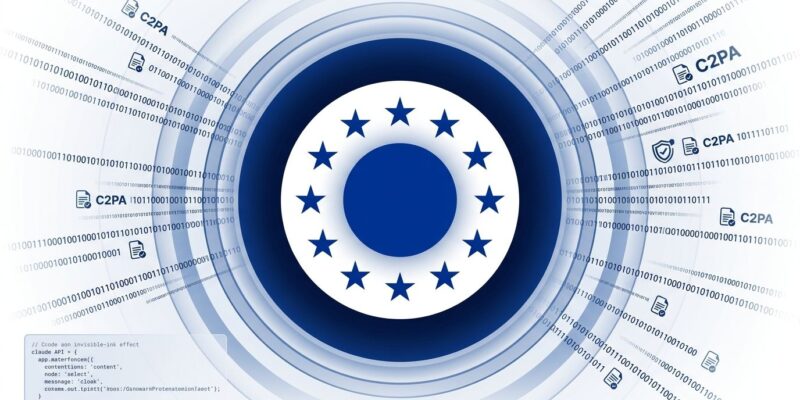
For image files (.png, .jpg, .svg), Anthropic attaches signed C2PA provenance metadata — a cryptographically signed record of the file’s origin embedded in its metadata, similar to EXIF data but tamper-evident. C2PA is now ISO/IEC 22144, used by Adobe, OpenAI, Google, and thousands of other members.
Coverage at launch: Claude Sonnet 4.6, Claude Haiku 4.5, and all Claude models released after August 2. All Claude access points are included, which means your AWS Bedrock or Google Cloud Vertex integration is covered too.
Provider vs. Deployer: Your Actual Obligations
Here is where developers often miss the plot. Anthropic handles the provider obligation under Article 50 — marking outputs at the model level. But if you build products on top of Claude, you are a deployer under the Act, and that is a separate legal category with separate duties.
- Chatbots: If your product has any conversational AI component, you must inform users at first interaction that they are talking to an AI. This was live August 2 with no grace period.
- AI-generated public-interest text: If your platform publishes Claude-generated content on topics like news, health, or finance, you need disclosure — unless your editorial team is doing real, substantive review.
- Deepfakes and synthetic media: Even with C2PA metadata already embedded by Anthropic, you as deployer are responsible for ensuring end-user disclosure.
If your product operates in the EU or processes EU users’ data, these obligations apply. California SB 942, operative as of August 2 as well, adds a parallel set of requirements for companies with over one million monthly California users — covering images, video, and audio (not text), and requiring a free public detection tool.
The Limitations That Actually Matter
Do not build compliance assumptions around what the watermark cannot do.
Code is largely unwatermarkable. The token-bias technique needs interchangeable alternatives to embed a signal. Rigid syntax — matched identifiers, required keywords, constrained structure — leaves few such choices. A single prettier formatting pass likely strips what signal exists.
Short-form content does not register. Commit messages, PR titles, one-line fixes, and brief annotations fall below detectable thresholds. The watermark needs statistical signal across a passage.
It can be stripped. Format conversion, re-encoding, screenshots, or re-uploading to a social media platform removes it. Asking a different model to rewrite Claude’s output eliminates the signal entirely.
Absence does not prove non-AI origin. Older model outputs and heavily edited text may carry no detectable mark. Do not treat “no watermark detected” as confirmation that content is human-written.
The Detection Gap
Anthropic confirmed a text detection API is in development — one you can use yourself. It has not shipped yet. Until it does, you cannot verify from outside Anthropic’s systems whether a given piece of text carries the mark. General AI detectors identify broad stylistic patterns, not Claude’s specific watermark signature. If you are building compliance tooling, plan for the detection API but do not build around it until it is available.
What to Do Now
- Audit your chatbot disclosure. If any Claude-powered product lets users interact conversationally, add “you are talking to an AI” at session start. This was required as of August 2.
- Map your content publication flows. Where does your product publish Claude-generated text publicly? If it covers news, health, legal, or finance topics, you need a disclosure mechanism — or genuine editorial review.
- Do not rely on the watermark for code audits. Token-bias watermarking does not hold up in code. Use other audit mechanisms for AI code traceability if that matters for your compliance posture.
- Watch for Anthropic’s detection API. When it ships, integrate it into your compliance tooling. Until then, treat the mark as present in prose output but unverifiable from your side.
The EU AI Act watermarking rules create a two-tier compliance picture: Anthropic marks the output, you disclose its presence to users. Both are required. Only the first one happens automatically.