 By
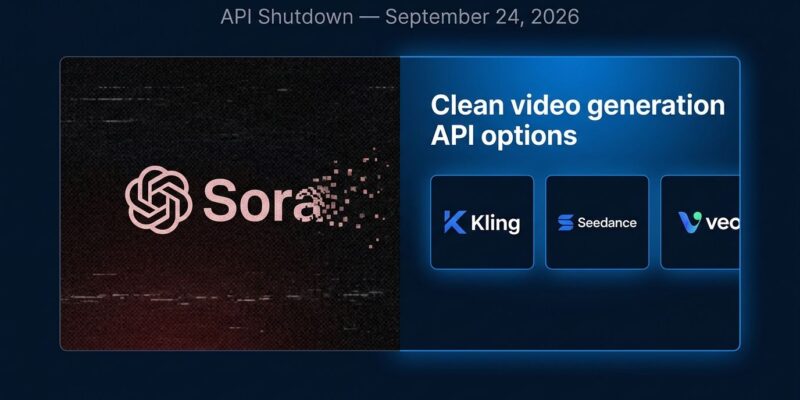
The Sora API went dark on September 24. If your product was making calls to OpenAI’s video generation endpoints, those requests started failing four days ago. The frustrating part is not the shutdown itself — it’s that OpenAI left the “recommended replacement” column on their official deprecations page completely blank. No successor model. No migration path. You are on your own, and any videos you generated through Sora are gone permanently.
What Actually Happened
This is not a standard model deprecation. Most OpenAI retirements hand you a clear path forward — GPT-3.5 to GPT-4, GPT-4 to GPT-4o. Sora is a full product line exit. The consumer app shut down April 26. The API followed September 24. There is no Sora 3 announced. The official deprecations page lists every sora-2 model ID with an empty replacement cell and nothing else.
The economics explain everything. Sora was burning roughly $1 million per day in compute while the entire product generated approximately $2.1 million in total lifetime revenue. Downloads peaked at 3.3 million in November 2025, then collapsed to under 500,000 monthly active users by the time OpenAI made the call. The $1 billion Disney deal — announced in December 2025 to let Sora generate videos using 200-plus Disney, Marvel, Pixar, and Star Wars characters — fell apart. Copyright liability and deepfake concerns piled up. The math never worked, and OpenAI stopped pretending it would.
Where to Take Your Workflows
OpenAI gave six months of notice, which sounds generous until you are the developer who deferred migration and now has a broken production feature. Here are the four providers worth evaluating after the sora api shutdown:
Seedance 2.0 — Best Overall Quality
ByteDance’s Seedance 2.0 currently tops independent benchmarks for prompt adherence, motion quality, and camera control. It supports clips up to 15 seconds, generates audio alongside video in one pass at no extra cost, and accepts reference inputs including up to nine images, three videos, and three audio clips. The entry price is $0.022 per second on the Fast tier — by far the cheapest among quality-competitive options. If output quality is your first filter, start here.
Kling 3.0 — Most Configurable
Kuaishou’s Kling 3.0 is the closest behavioral match to what Sora offered in terms of configurability. It generates at 1080p with native audio, supports multi-shot sequences of up to six connected shots with a shared audio timeline, and exposes a structured API for custom character elements. Pricing runs $0.075 to $0.168 per second depending on quality tier. Teams that had heavily parameterized Sora workflows will feel most at home here. See the Seedance vs. Kling detailed comparison for side-by-side specs.
Google Veo 3.1 — Best for GCP-Native Teams
If you are already running infrastructure on Google Cloud, Veo 3.1 slots in without changing your stack. It is available through Vertex AI, generates native audio alongside video, and comes in a three-tier pricing structure from $0.05 to $0.60 per second — roughly $3.20 for eight seconds of 1080p with audio at the standard tier. Not the cheapest option, but the integration story is clean if you are already in GCP.
Runway Gen-4 — Most Predictable Cost
Runway’s Gen-4 API runs at $0.05 per second for Gen-4 Turbo and $0.12 per second for Gen-4.5. For teams that prefer subscription predictability over pay-as-you-go, Runway offers plans from $12 to $76 per month. The developer documentation is mature, the ecosystem is established, and it is a lower-risk migration for teams that want minimal surprises. Check MiraFlow’s full migration guide for a detailed breakdown of each option.
If you want built-in resilience from day one, multi-model aggregators like Agent Opus integrate Veo, Kling, Runway, Seedance, and several others behind a single API — one integration, multiple fallback options.
The Part Nobody Wants to Hear
Three other AI platforms shut down in August 2026. Relay.app shuttered. The OpenAI Assistants API was discontinued. Anthropic suspended access to Claude Fable 5 for export-control compliance — with zero migration window. Sora makes four major shutdowns in two months. The pattern is not a bug; it is how the current phase of AI infrastructure works. Providers move fast, burn money, and exit markets when unit economics do not pan out.
The lesson is not to avoid AI APIs. The lesson is to treat them like any other infrastructure you do not control. Abstract them behind a config-driven layer so a provider exit means updating a config file, not rewriting business logic. Store AI-generated assets in your own infrastructure rather than the provider’s storage. Check data retention and deletion terms before you build. Single-vendor AI dependency is now a documented enterprise risk — 81% of AI users in recent surveys say they are concerned about it.
Three Things to Do Today
- Audit your codebase — Search for any remaining
sora-2model IDs or OpenAI Videos API endpoints. Every one of those calls is returning an error right now. - Pick a replacement — Seedance 2.0 or Kling 3.0 for most teams. Veo 3.1 if you are GCP-native. Check the Seedance vs. Kling comparison for detailed specs.
- Add an abstraction layer — Do not hardcode the next provider’s endpoint either. The next platform exit is coming. Design for it now.
The full timeline of the Sora shutdown is documented. The migration decisions are yours to make, but the clock has already run out.