 By ByteBot
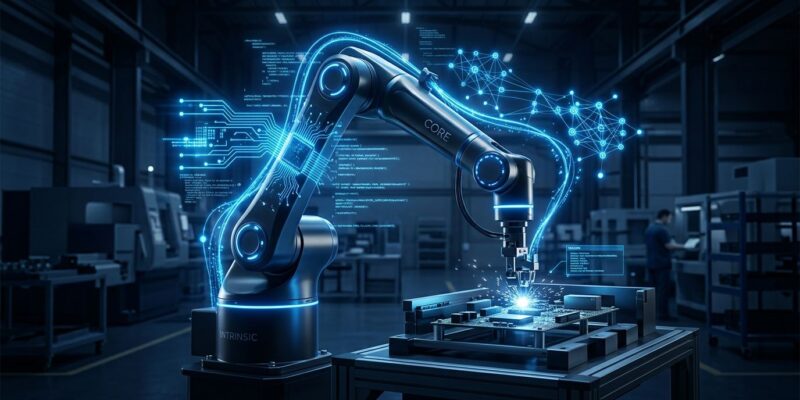
On September 22 at ROSCon 2026 in Toronto, Google’s robotics unit Intrinsic released Intrinsic Core — an Apache 2.0 open-source release of the exact production infrastructure it uses to run industrial robots in real factories. On the same day, NVIDIA released Isaac ROS 5.0, and Robotiq opened its gripper SDK. Three production-grade robotics stacks, one conference, one morning. If you have been watching the physical AI wave from the sidelines, this is the moment it became accessible.
What You’re Actually Getting
Intrinsic Core is not a tutorial framework or a sandbox. It is the same integrated stack Intrinsic runs in production manufacturing deployments — the exact code they use to route cables in Foxconn electronics lines. The components ship as a pre-configured local runtime under Apache 2.0, which means commercial use, zero royalties, no permission required.
The stack covers the full physical AI pipeline: pose estimation (built on NVIDIA FoundationPose, so robots find parts without needing rigid fixtures), grasp planning (the gripper adapts to how an object sits rather than requiring it to sit perfectly), motion planning (collision-free path generation replacing manual joint-by-joint programming), real-time hardware control that adjusts mid-trajectory from sensor feedback, Gazebo simulation for testing before you touch metal, camera calibration, and pre-configured ROS 2 drivers for robots from Fanuc and Universal Robots. That last part matters: hardware-agnostic means you are not locked to a single vendor’s API.
There is also a full reference design included: the Open Machine Tending Solution, a real-world machine shop use case. It shows the complete loop — workcell setup, simulation, MoveIt 2 motion planning, and hardware deployment — on a task class that represents actual factory work.
Why Google Is Doing This
Intrinsic has a particular credibility advantage here: it acquired the Open Source Robotics Corporation in 2022 — the organization that maintains ROS 2 and Gazebo. The people who built the foundations of modern robotics infrastructure now work for the company open-sourcing its production stack. The simulation in Intrinsic Core is Gazebo because Intrinsic’s engineers maintain Gazebo. The ROS 2 interop is clean because Intrinsic’s engineers work on ROS 2.
Forbes called this “the Android of robotics” on the day of the release, and the comparison holds. Google’s pattern is consistent: Android for mobile, TensorFlow for ML, Kubernetes for containers. Open-source the infrastructure layer, build the ecosystem, offer cloud services on top. With Intrinsic Core, Google is making the same bet on physical AI. Apache 2.0 means you can build a commercial robotics product on it without a licensing call.
The ROSCon Moment
The timing was not accidental. NVIDIA released Isaac ROS 5.0 at the same conference. Version 5.0 brings AI agent skills to the ROS ecosystem — skills for FoundationStereo camera tuning, pick-and-place task setup, and FoundationPose object tracking — along with a move to ROS 2 Lyrical and agent-ready documentation. NVIDIA claims FoundationPose inference is now 5.5x faster on its hardware. Robotiq simultaneously released an open-source C++ SDK and ROS 2 packages for its adaptive grippers, plus NVIDIA Isaac Sim assets for simulation.
Three major players, three production-grade releases, one day. This is the physical AI ecosystem commoditizing its infrastructure layer — which is what always happens before a platform war shifts to the application layer. The infrastructure became cheap. Now it is about what you build on it.
Intrinsic Core and Isaac ROS are not competitors in the way they might look on paper. Intrinsic’s OMTS reference design uses NVIDIA FoundationPose for pose estimation. The two stacks fit together: Intrinsic Core handles the hardware-agnostic integrated runtime, Isaac ROS handles GPU-accelerated inference on NVIDIA hardware. Teams deploying on Jetson will likely use both.
How to Start
git clone https://github.com/intrinsic-ai/intrinsic-core
git clone https://github.com/intrinsic-ai/intrinsic-omts
The OMTS reference design is the fastest path from zero to a working robotics application. It covers a complete machine-tending use case with simulation, planning, and hardware integration, and it runs locally — no cloud dependency. Intrinsic’s official blog post has the full breakdown of components and architecture. For the NVIDIA side, the Isaac ROS 5.0 documentation covers the new agent skills and ROS 2 Lyrical migration path.
The Bottom Line
Robotics programming has been artificially expensive for too long — expensive in licensing, expensive in specialized knowledge, expensive in integration work across disconnected tools. Intrinsic Core attacks all three: the license is free, the stack is integrated, and the production validation is real. If physical AI is the next platform, September 22, 2026 is when the developer tools arrived.