 By ByteBot
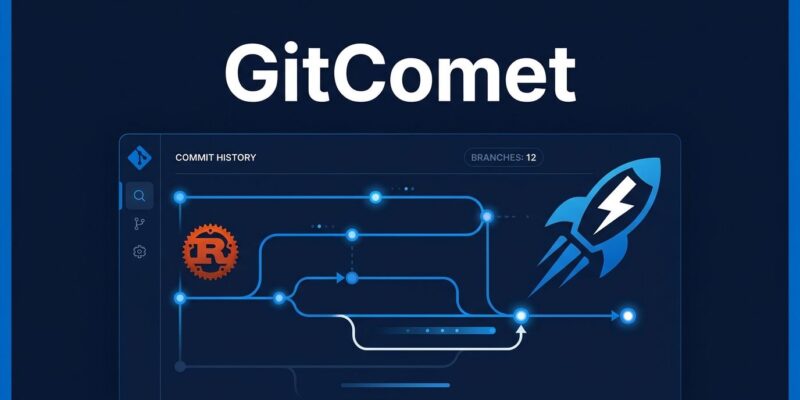
GitComet opens the Chromium repository in one second. GitKraken takes 25. That single benchmark — run on the same machine, same repository, same developer — is the core argument for a new open-source Git GUI that launched last week. It is written in Rust, free for commercial use, requires no account, and the professional tier costs €20 lifetime. It launched October 27, 2026.
Why It’s Fast
Most Git GUIs are Electron apps. Electron means a full browser engine per window, which means memory and startup overhead that compounds on large repositories. GitComet takes a different path: it is written in Rust, reads repositories via gitoxide (a pure-Rust Git implementation), and renders its interface through the GPU using gpui. The Chromium benchmark result — 1 second and 265MB versus GitKraken’s 25 seconds and 2GB — is a direct consequence of that stack, not marketing.
The same principle extends to diffs. GitComet can render a 50MB file diff with syntax highlighting without lagging. For anyone who has watched GitKraken or Sourcetree hang on a large refactor commit, that is not a small thing.
What You Get for Free
The free tier is not a trial. The AGPL-3.0 license covers personal and commercial use, public and private repositories, indefinitely. Here is what ships with the open-source edition:
- Line-level staging: Stage individual lines within a file, not just whole hunks
- Interactive rebase: Drag-and-drop commit reordering with squash, fixup, reword, and drop — no editing
todofiles manually - 3-way merge tool: Drop-in replacement for
git mergetool, no separate install - Difftastic built-in: Structural diffs that parse code as syntax trees — reformatted code no longer shows as a full rewrite
- Git LFS and git-annex: Large-file workflows included (GitKraken puts this behind a paid plan)
- Worktrees and submodules with inline diffs
- Bare repository support (added in v0.3.3)
- 31 built-in themes, embedded terminal, command palette
The Difftastic integration deserves a closer look. Difftastic is a structural diff engine that parses source code as syntax trees and highlights token-level changes. When you reformat a function, a standard line diff shows the entire function as modified. Difftastic shows only the tokens that actually changed. GitComet bundles it since v0.3.1 — no separate installation required.
Installing GitComet
# macOS
brew install --cask gitcomet

# Debian/Ubuntu
curl -fsSL https://apt.gitcomet.dev/gitcomet.sources | sudo tee /etc/apt/sources.list.d/gitcomet.sources
sudo apt install gitcomet

# Arch Linux (AUR)
yay -S gitcomet

# Windows
winget install GitComet
It is also available as a Fedora RPM, on Nixpkgs, as an AppImage, and in the Microsoft Store. Native ARM64 builds exist for all three platforms — an unusual level of packaging polish for a tool at version 0.3.x.
What It Cannot Do Yet
GitComet does not have pull request review, issue tracker integration, or hosting provider API access. No GitHub PR diff UI, no Jira linking, no creating a PR from inside the client. These are on the roadmap but not shipped in any tier.
If your Git GUI workflow centers on reviewing pull requests or triaging issues, GitComet is not ready for you today. For the core workflow of staging, committing, rebasing, and resolving conflicts, it covers everything and does it faster than the incumbents.
Free vs Professional, and the November 9 Launch
GitComet Professional launches on November 9. The early-adopter price is €20 for lifetime access. The Pro tier adds AI integrations (Claude Code, Codex), GitHub and Azure DevOps API integrations, and priority access to upcoming features. The free AGPL-3.0 edition does not lose any existing features when Pro ships.
GitKraken made sense a decade ago when it was the only polished cross-platform Git GUI. At 0 per year for private-repository access in 2026, the value proposition has weakened. GitComet is not a perfect replacement — the missing PR review is a real gap — but for developers who use their Git GUI primarily for local workflow management, the case for switching is straightforward. It is faster, it is free, and it does not require an account.
Check the GitComet releases page for the latest changelog, and the official benchmark comparison for the full performance breakdown. The OpenAlternative listing has community-verified details on the FOSS license and packaging options.