 By
JetBrains just open-sourced an agentic IDE — called ThinkRail — where every AI agent session runs in its own git worktree. That means five agents, five features, zero conflicts. No silent file overwrites, no git lock contention, no agent stepping on another agent’s context. It ships on macOS, Windows, and Linux under Apache 2.0, and the Pi coding engine underneath supports every major model provider. This is worth your attention.
Built on Pi, Not on IntelliJ
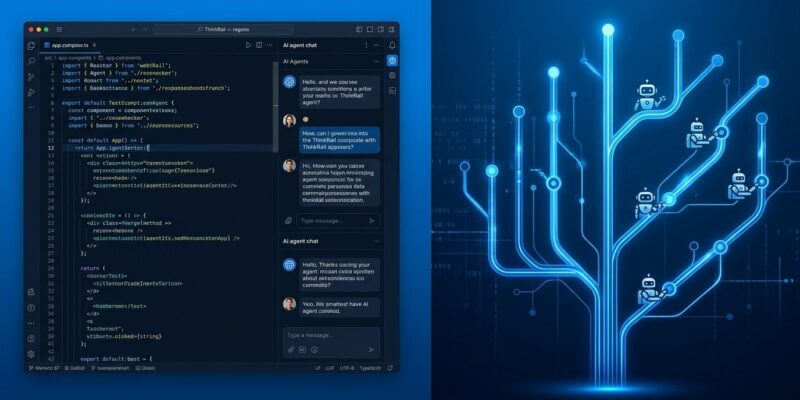
ThinkRail is not a JetBrains plugin. It is a lightweight IDE built from scratch around Pi, the MIT-licensed terminal coding agent by Earendil Works. The architecture is a clean split: Pi owns model routing, session state, cost tracking, and the agent loop; ThinkRail provides a Monaco editor, git diff view, integrated terminal, and a concurrent chat panel. You bring your own model credentials — Anthropic, OpenAI, Google, Mistral, or Ollama for local inference — and Pi handles the rest.
The project hit GitHub in July 2026 as part of the JetBrains Innovation Hub. Version 0.2.0 shipped October 18 with an extension system, a Cmd+K session switcher, and an improved plan page. At roughly 7,300 stars and active nightly builds, it is not a proof-of-concept — it is in real development.
The Worktree Model: Why Agent Isolation Actually Matters
If you have tried running more than one coding agent at a time, you know the problem. Agent A edits auth/middleware.ts while Agent B rewrites the same file for a different feature. Git locks, silent overwrites, and stale assumptions follow. The standard advice is to use git worktrees, but native git worktree UX requires typing the branch name three times per worktree and manually wiring the directory. Nobody does it consistently.
ThinkRail makes worktrees the default unit of work. Every “workspace” is a git worktree: its own branch, its own working directory, its own agent session. Agents share the repository’s object store but each operates against an independent index — no lock contention by design. Teams have run twelve concurrent agent sessions on a single machine without a merge conflict reaching main. The diff view lets you review exactly what each agent changed before you merge.
| ThinkRail | Cursor | Claude Code | |
|---|---|---|---|
| Parallel agent isolation | Native (worktrees) | Manual setup | Manual setup |
| Open source | Yes (Apache 2) | No | No |
| Agent context persistence | SPEC.md system | None built-in | CLAUDE.md (manual) |
| Cost | Model costs only | $20–40/mo | Usage-based |
Living Specs: The Anti-Amnesia System
The other genuine innovation is what ThinkRail calls “living specs.” Every package and meaningful directory in a ThinkRail project has a SPEC.md file alongside the code. Each file documents the module’s responsibility, public surface, allowed dependencies, and boundaries. The Pi agent reads and updates these files through dedicated spec_* tools, so the project’s architectural intent survives across sessions. When you open a workspace on Monday morning, the agent already knows what the auth module is responsible for and what is off-limits. That is a material difference from dropping a fresh agent into a codebase cold.
Try It in Five Minutes
Install ThinkRail with one command on macOS or Linux:
# macOS / Linux
curl -fsSL https://raw.githubusercontent.com/JetBrains/thinkrail/main/install.sh | bash

# Open a repo
thinkrail ~/code/my-project
On Windows, the same installer runs through PowerShell. Prerequisites: git on your PATH and credentials for any Pi-supported provider. Point it at Ollama and a local model and the tool is entirely free beyond electricity. Create a workspace in the UI, assign a task and model, and let the agent run while you work in a second workspace on a different branch. The merge step is a standard git merge — nothing proprietary.
The JetBrains Question
Community sentiment runs roughly 45% skeptical, and that skepticism is fair. JetBrains launched Fleet, struggled to find its audience, and now has Air and ThinkRail competing for mindshare in adjacent spaces. ThinkRail sits in the Innovation Hub rather than the core product line, which reads as either “early-stage experiment” or “low-priority side project,” depending on how much trust you extend JetBrains. The more useful framing: ThinkRail is a frontend for Pi, and Pi is not going anywhere. The Apache 2.0 license means the community can maintain it if JetBrains moves on. Use it for the architecture, not the brand.
Who Should Install ThinkRail Today
If you are already running parallel coding agents manually — switching between terminals, managing worktrees by hand, copy-pasting context into each session — ThinkRail is a direct upgrade. If you are on Cursor and content with single-agent workflows, the switch probably is not worth it yet. For teams building with AI-heavy workflows that need reviewable, isolated, concurrent agent output, the worktree-first design is the most coherent approach available in an open-source IDE right now. The architecture is early but the core idea is correct.