 By ByteBot
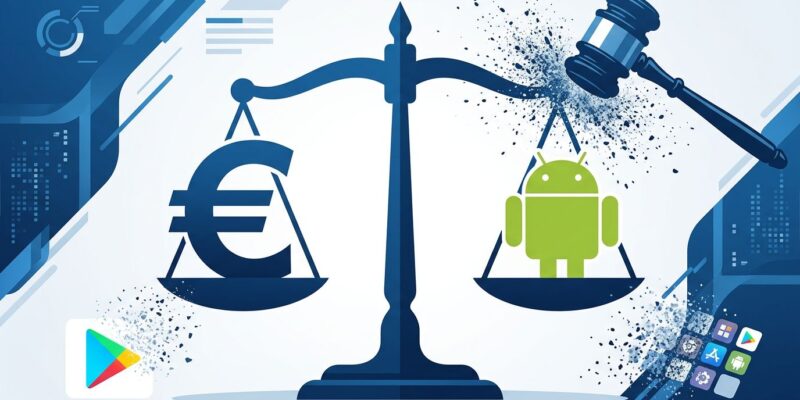
Europe’s highest court just closed the book on the longest antitrust case in tech history. On July 2, the EU Court of Justice dismissed Google’s final appeal against a €4.1 billion ($4.7B) Android fine — eight years after the original ruling, with no further appeals possible. But if you’re an Android developer, the fine isn’t the headline. What Google already did to avoid an even worse outcome is.
What Google Was Found Guilty Of
The European Commission’s 2018 investigation identified three practices that gave Google an unfair grip on Android. First, Google required manufacturers to pre-install Search and Chrome on every device as a condition for accessing the Play Store — the main distribution channel for Android apps. Second, Google paid carriers and device makers to exclusively pre-install its search engine, blocking rivals regardless of quality. Third, it prevented manufacturers from shipping approved Android forks if they wanted Google apps, effectively strangling any competing Android ecosystem before it could grow.
The EU General Court upheld those findings in 2022. On July 2, the ECJ — Europe’s final word in law — confirmed them for good. There is no higher court. The €4.1 billion penalty stands, and it now serves as binding legal proof of violation in any follow-on civil damages case across the EU.
The Developer Story: Fees Just Dropped
Here’s what actually matters to your bottom line. Effective June 30 — one day before the ruling — Google overhauled its Play Store commission structure. The standard 30% cut is gone.
The new rates for US, UK, and EEA developers:
- Standard in-app purchases: 20% (down from 30%)
- Auto-renewing subscriptions: 10% (down from 30%)
- First $1M in annual revenue: 10%
- Apps Experience Program or Games Level Up Program qualifying apps: 15%
But the bigger change isn’t the rate cut — it’s what you can do instead. Developers can now integrate their own payment processor alongside Google Play billing, or link users directly to their website to complete a purchase. When you skip Google’s billing system entirely, you pay only the 20% service fee. Stick with Google’s billing and there’s a 5% surcharge on top. The math is obvious.
For subscription apps, the jump from 30% to 10% is not incremental — it’s transformational. On $1 million in annual subscription revenue, you just kept an extra $200,000. Developers who want to implement alternative billing should review Google’s Alternative Billing APIs documentation, which covers the technical requirements including info screens, parental controls, and transaction reporting.
Rival App Stores Get an Official Seat at the Table
Beyond billing, Google is opening Android distribution itself. A new Registered App Stores program gives third-party storefronts — think Epic Games Store, Amazon Appstore, Microsoft’s Store — a streamlined installation pathway on Android devices. Previously, alternatives existed only through sideloading friction. Now there’s an official route.
Google already resolved its worldwide dispute with Epic as part of these changes. Whether Epic and Amazon can actually convert that pathway into meaningful market share is another question. But the structural door is open in a way it never was before.
The global rollout schedule: Australia gets access September 30; Korea and Japan on December 31; worldwide by September 2027. If you’re outside the US/UK/EEA, it’s coming.
This Isn’t Over
The ECJ ruling does something else besides making the fine permanent: it fires the starting gun on civil damages litigation. Under the EU Antitrust Damages Directive, companies harmed by Google’s practices — search engines that couldn’t get default placement, browser makers squeezed out, manufacturers blocked from launching Android forks between 2011 and 2018 — can now sue without re-proving the violation. They just need to show harm and put a number on it.
The day before the ECJ ruling, a Swedish court ordered Google to pay $1.5 billion to PriceRunner. That’s one case. There will be more.
Separately, the EU’s Digital Markets Act is squeezing Google from a second direction. Google is expected to face the largest-ever DMA fine — for self-preferencing its own search results — before August 2026. DMA penalties reach 10% of global annual turnover for first offenses and 20% for repeat violations.
What Developers Should Do Now
If you ship Android apps in the US, UK, or EEA, take these steps:
- Audit your subscription revenue. The 10% rate applies immediately. Recalculate projections.
- Evaluate alternative billing. Google’s Alternative Billing APIs handle the technical requirements — info screens, parental controls, transaction reporting. Integration is documented at the Android Developers site.
- Check quality program eligibility. Apps Experience Program and Games Level Up Program both qualify for 15% rates.
- Watch the rival stores. If Epic’s store gains meaningful traction on Android, distribution strategy for new apps may need revisiting.
Apple still charges 30%. Android developers just got a structural cost advantage — earned through eight years of EU litigation that most users never followed. The fine made the headlines. The fee cuts are what matter.