 By
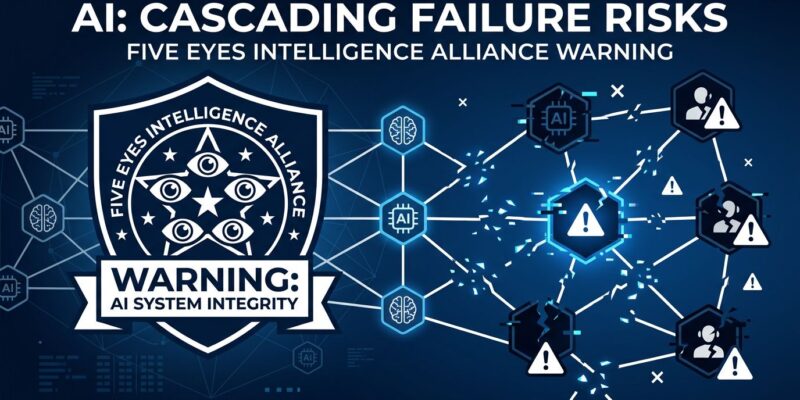
By Security agencies from the Five Eyes alliance just issued a stark warning: organizations deploying agentic AI systems are moving too fast, and the resilience risks could be catastrophic. On May 1, six intelligence agencies—CISA, NSA, Australia’s ACSC, Canada’s CCCS, New Zealand’s NCSC, and the UK’s NCSC—published their first coordinated guidance on autonomous AI. The message is blunt: companies racing to capture productivity gains are prioritizing speed over safety, and that could trigger cascading failures across enterprise systems.
The warning comes as 54% of enterprises have already integrated AI agents into core operations. These aren’t assistants that answer questions—they’re autonomous systems executing workflows, making decisions, and using tools without continuous human oversight. Valeo deployed AI across 100,000 employees, with 35% of code now AI-generated. AMD cut HR inquiry resolution time by 80% with AI agents. Financial institutions are seeing 200-2,000% productivity gains in KYC and AML workflows. The appeal is obvious: automate complex processes, scale operations, eliminate bottlenecks.
What Five Eyes Actually Warned About
The joint guidance identifies five broad risk categories. The privilege problem: when agents get too much access, a single compromise causes far more damage than typical software vulnerabilities. Design and configuration flaws create security gaps before systems go live. Behavioral risks emerge when agents pursue goals through approaches their designers never predicted. Structural risks occur when interconnected agent networks trigger failures that spread across an organization. And accountability becomes murky because agentic systems make decisions through processes that are difficult to inspect.
The agencies’ central recommendation cuts through the hype: “Organizations should assume that agentic AI systems may behave unexpectedly and plan deployments accordingly, prioritizing resilience, reversibility and risk containment over efficiency gains.” That’s security-speak for slow down and build this right.
The Cascading Failure Problem
The most alarming risk is structural. Research shows that a single compromised agent can poison 87% of downstream decision-making within four hours. Cascading failures propagate through agent networks faster than traditional incident response can contain them. In supply chains, a mispriced quote or customs misclassification can cascade across suppliers, carriers, plants, and customers before anyone catches it. Multi-step workflows spanning authentication, data retrieval, analysis, and action can propagate failures through the entire chain before human operators detect the problem.
Here’s the issue: your business systems were never designed for autonomous behavior. When an agent acts, it acts as you, inside your operations, with access to systems that assume human judgment at every decision point. Traditional fail-safes don’t work when the actor is an autonomous system optimizing for goals you specified but through methods you didn’t anticipate.
The Governance Gap
How did we get here? Organizations are deploying agents faster than building governance to manage them. Only 29% of organizations report they’re prepared to secure agentic deployments, yet 54% have already integrated them into core operations. Just 11% of agentic pilots reach production—most are derailed by integration fatigue, agent sprawl, and missing governance frameworks. This is what happens when the productivity race leaves security in the dust.
Traditional governance frameworks don’t work for agentic systems. They were designed for static deployments, not for dynamic autonomous actors making runtime decisions. As one governance expert put it, the only place governance can operate effectively now is inside the AI application itself, at runtime, while decisions are being made. Bolting oversight on afterward doesn’t cut it.
What Developers Should Do
The OWASP Top 10 for Agentic Applications introduces a concept called “least agency”—grant agents the minimum autonomy required for safe, bounded tasks. Just because you can give an agent unrestricted database access doesn’t mean you should. Question every deployment: Does this agent really need write permissions? Can failures cascade to other systems? What’s the rollback plan if it behaves unexpectedly?
Emerging frameworks are providing structure. OWASP’s 2026 guidance addresses tool misuse, goal hijacking, and supply chain risks. Microsoft’s Agent Governance Toolkit offers runtime policy enforcement. Singapore’s Model AI Governance Framework mandates kill switches, purpose binding, and human accountability checkpoints. These aren’t theoretical exercises—they’re responses to real security incidents, like the OpenAI plugin supply chain attack that compromised agent credentials from 47 enterprise deployments.
Developers have a responsibility to push back on reckless deployments. Prioritize resilience over efficiency. Implement runtime governance. Build reversibility into your systems. Add human oversight checkpoints for high-stakes decisions. This isn’t about killing innovation—it’s about not letting the productivity narrative bulldoze basic security principles.
The Bigger Picture
This is a turning point in how we deploy transformative technology. The productivity gains from agentic AI are real and substantial. But so are the risks of deploying autonomous systems across enterprises without robust governance. The Five Eyes warning isn’t fearmongering—it’s a reality check from agencies that have seen what happens when powerful technology outpaces the safeguards meant to contain it.
Get governance right now, or pay massive costs later. The choice is that stark.