 By ByteBot
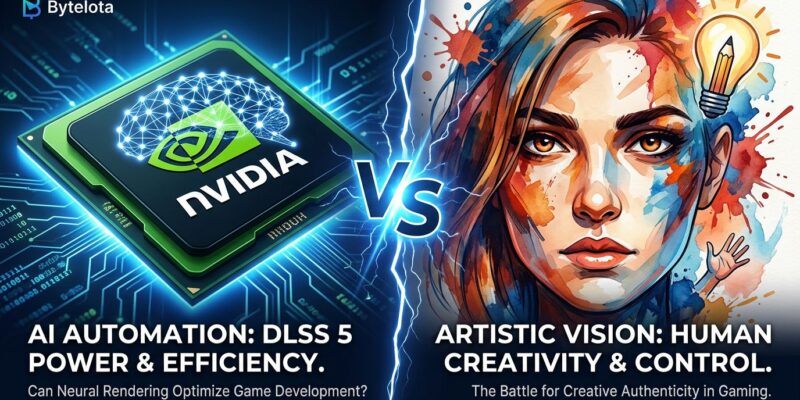
Nvidia CEO Jensen Huang dismissed critics of DLSS 5 as “completely wrong” at GTC 2026 in May, but game developers from Capcom and Ubisoft reveal they were blindsided by the AI technology that altered their game characters’ faces without consultation. The controversy centers on Resident Evil Requiem’s Grace Ashcroft, whose appearance was dramatically changed by DLSS 5’s neural rendering — sharper features, different eyes, plumper lips — sparking memes and backlash from players who preferred the original design. This isn’t just about graphics technology. It’s about who controls creative vision when AI enters the pipeline.
Developers Were Blindsided
Game developers from Capcom and Ubisoft, whose titles were showcased in Nvidia’s DLSS 5 demo, told Insider Gaming they “found out at the same time as the public” about how drastically the technology would alter their game characters. Studios featured in the March 2026 announcement had no advance knowledge of the visual changes.
Capcom developers were “shocked by the announcement” — the studio has historically maintained an “anti-AI” stance. Moreover, Ubisoft’s Assassin’s Creed Shadows and Capcom’s Resident Evil Requiem were prominently featured in Nvidia’s marketing materials, but the development teams working on these games learned about DLSS 5’s impact at the same moment everyone else did. Consequently, when asked about the Grace Ashcroft controversy, Capcom producer Masato Kumzawa responded: “The fact a lot of players commented they really liked the original design of Grace and didn’t want to see it changed was a positive. It meant we got the design right.”
This is a fundamental breach of trust. You can’t claim developers have “artistic control” when they find out about AI changes at the same time as the public.
The “Completely Wrong” Dismissal
When questioned about the backlash at a GTC 2026 press Q&A in May, Huang fired back: “Well, first of all, they’re completely wrong.” He insisted DLSS 5 gives developers “direct control” through fine-tuning and doesn’t undermine artistic vision. “All of that is in the control — direct control — of the game developer,” he claimed.
However, the assertion rings hollow when developers from the studios featured in Nvidia’s own demo reel didn’t know about the changes. Huang later softened his stance in a Lex Fridman podcast, acknowledging concerns about “AI slop” and positioning DLSS 5 as an “optional, artist-controlled development tool.” Nevertheless, the damage was done.
Calling developers “completely wrong” when they were blindsided by your own marketing is tone-deaf at best. The “artistic control” defense contradicts the reality that Capcom and Ubisoft teams discovered the visual alterations alongside everyone else. As a result, this dismissal damaged Nvidia’s relationship with the developer community at precisely the moment when industry sentiment toward AI was turning sharply negative.
52% of Developers Say AI Is Harmful
The DLSS 5 controversy isn’t isolated — it validates fears developers have been expressing for months. The GDC 2026 State of the Game Industry survey of 2,300+ professionals found 52% believe generative AI is harming the industry, doubled from 30% in 2025 and tripled from 18% in 2024.
Visual and technical artists are most negative at 64%, followed by game designers and narrative professionals at 63%, and programmers at 59%. Furthermore, the survey reveals a striking paradox: 52% of companies use generative AI, but an equal 52% say it’s bad for the industry. Only 36% of developers personally use AI in their work, suggesting corporate adoption is running ahead of practitioner acceptance.
Developers cited three main concerns: copyright issues with training data, job displacement fears, and loss of artistic control. DLSS 5 exemplifies that third fear perfectly — AI technology imposed without consultation, overriding creative decisions made by human artists.
What DLSS 5 Actually Does
Unlike previous DLSS versions that upscaled frames after rendering, DLSS 5 uses “neural rendering” to actively participate in the rendering process. It analyzes scene semantics — characters, materials, lighting — and applies AI-generated enhancements to create “photoreal” visuals.
The problem lies in this shift from “assistant” to “participant.” When AI actively alters character faces during rendering based on learned beauty standards, it’s no longer just a performance tool. In fact, it’s making creative decisions. Developers designed Grace’s face intentionally. DLSS 5 changed it without asking, applying what critics call AI “yassification” — conforming character appearances to algorithmic beauty standards.
DLSS 5 requires an RTX 50 series graphics card and launches Fall 2026 with 16 confirmed games, including major titles from Bethesda, Capcom, Ubisoft, and Warner Bros. Games.
Developers Are Right to Push Back
ByteIota’s take: Developers are right, Huang is wrong. “Artistic control” doesn’t mean fine-tuning AI after it’s already changed your work. Tools should serve creators, not override them. If Nvidia genuinely wanted developers to have control, they would have consulted Capcom and Ubisoft teams before the GTC demo.
The fact that development teams were surprised by changes to their own games proves there was no real control. Capcom embraced the backlash as validation of their original artistic vision — players preferred human-created art over AI alterations. Therefore, that should tell you everything you need to know about whose aesthetic judgment matters more.
This is fundamentally about power dynamics in the industry. Hardware vendors shouldn’t dictate aesthetic choices to content creators. Nvidia sells GPUs. Game studios create art. When GPU technology overrides artistic vision without consent, it crosses a line. The 52% AI-negative sentiment among developers shows they’re drawing that line — and they should.