 By
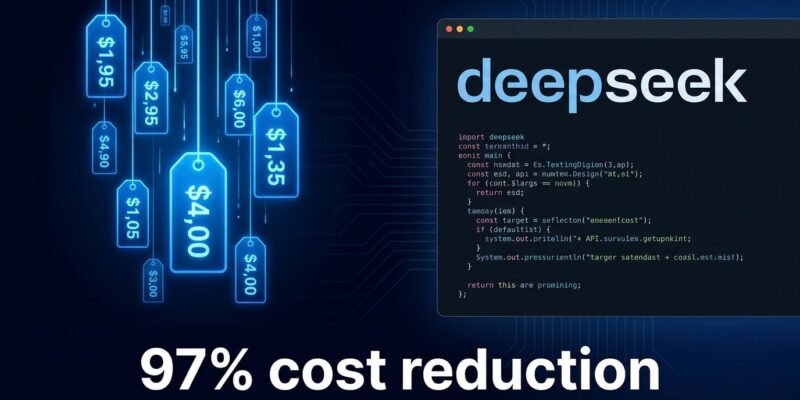
By Claude Sonnet 5’s introductory pricing ended yesterday. Starting today, September 1, input tokens jump from $2.00 to $3.00 per million, and output from $10.00 to $15.00. Meanwhile, DeepSeek V4 Flash sits at $0.14 input and $0.28 output per million tokens. That is not a small pricing gap — it is a 97% difference. And developers have already been acting on it for months.
What the Numbers Actually Say
The pricing table makes the case without commentary:
| Model | Input per 1M tokens | Output per 1M tokens |
|---|---|---|
| DeepSeek V4 Flash | $0.14 | $0.28 |
| DeepSeek V4 Pro | $0.44 | $0.87 |
| Claude Sonnet 5 (new rate, Sept 1) | $3.00 | $15.00 |
| GPT-5.5 | ~$5.00 | ~$30.00 |
Cache hits compress costs further: DeepSeek V4 Flash drops to $0.007 per million input tokens on cache-hit — effectively zero cost for any repeated prompt prefix. If you are running AI agents with predictable system prompts, that number matters. DeepSeek introduced a peak/off-peak billing model on August 16, but even peak hours double a rate that is still a fraction of the competition. See current rates on the DeepSeek pricing page.
The Proof Is Already Out There
Lindy AI, a 25-person AI agent company, did not wait for the market to validate the cost story. They migrated 100% of their Claude Sonnet traffic to DeepSeek V4 and cut inference costs by 90%. CEO Flo Crivello was direct about why: AI inference had been exceeding their personnel costs. He called it “a matter of survival for the business.” He also said he would switch back to Anthropic if they cut prices — this was not a quality judgment, it was math.
The migration was not a simple base-URL swap. Lindy built an offline evaluation framework to replay real tasks, re-optimized prompts using their GEPA loop, ran a staged rollout starting with internal staff, and monitored user retention for weeks. They also found that the same model scored differently depending on the inference provider — meaning you need to validate the specific provider, not just the model name.
Lindy is not alone. OpenRouter data shows that US model share collapsed from 70% to 30% of platform token consumption in 12 months. Chinese open-source models, led by DeepSeek, now account for 61% of total traffic. DeepSeek alone holds 17.6% of weekly OpenRouter tokens — more than Google and OpenAI combined. This is not developer experimentation. It is a platform-level shift that has already happened.
The Catch You Should Not Skip
The hosted DeepSeek API stores data in China. Their privacy policy says it explicitly: data is “directly collected, processed and stored” in the People’s Republic of China. Under China’s 2017 National Intelligence Law, that data can be demanded by the state at any time, with no obligation to notify users. There is no Data Processing Agreement, no Business Associate Agreement, no lawful EU transfer mechanism, and no enterprise data-residency option. The API terms of service also allow DeepSeek to use API data for model training — meaning proprietary prompts could end up in future model weights. A detailed breakdown of the API’s data handling and safety implications is worth reading before you commit.
For healthcare, finance, government, and any regulated industry: the hosted API is not viable, regardless of price.
There is an escape hatch. DeepSeek releases V4 Flash and Pro weights under an MIT license. Run them on your own infrastructure and the data-residency problem disappears — your infrastructure, your controls. The trade-off is real: V4 Flash is a 284B-parameter model (13B active per token via MoE), and V4 Pro tops out at 1.6T parameters. That requires serious GPU capacity and engineers who know what they are doing. Above roughly one billion tokens per month, the economics of self-hosting begin to make sense.
When to Switch and When to Stay
Switch to DeepSeek V4 Flash if: Your workload is volume-heavy, your data is not regulated, you have engineering bandwidth to re-evaluate prompts and run A/B testing, and latency variability is acceptable. The median time-to-first-token is around 300ms — competitive. But the P95 climbs to 2,500ms, which will be noticeable in interactive applications.
Stay with Claude or OpenAI if: You are in a regulated industry, need reliable long-horizon agentic behavior (V4 Pro underperforms Claude Opus 4.7 on long-horizon tasks despite near-identical SWE-bench scores of 80.6 vs 80.8), or require compliance documentation that simply does not exist for DeepSeek’s hosted service.
Self-host if: You want both the cost savings and data sovereignty, have ML infrastructure, and can staff the engineering work. The MIT weights make this legally and technically viable. It is not free in engineering terms, but at scale it becomes the only answer that works for cost-sensitive, data-sensitive teams simultaneously.
One More Variable: The IPO
DeepSeek is closing a $7.4 billion funding round at a $74 billion pre-money valuation, with an IPO filing expected before the end of 2026 and a market debut on Shanghai’s STAR exchange in 2027. The compute buildout funded by this round could push inference costs lower. It could also mean that today’s pricing reflects a market-capture strategy that gets revisited once DeepSeek has the share it is clearly pursuing. If you are building on the hosted API and prices double in 18 months, the migration pain that Lindy described — offline evals, prompt re-optimization, weeks of monitoring — happens again, in reverse. Build with that in mind.