 By
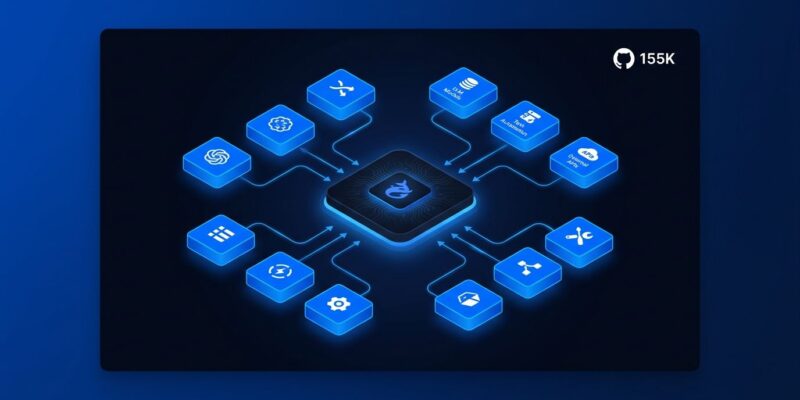
By DeepSeek shipped a developer preview of an open-source agent runtime called Harness (dsh) on August 13. Within 48 hours it had 100,000 GitHub stars. Within five days, 155,000. The star count is a headline, but the architecture is the actual story: every component — the model adapter, the tool registry, the agent loop, the session store — is a swappable plugin. No vendor lock-in wired into your code. No rewrite required to change models.
Everything Is a Plugin — What That Actually Means
In LangChain or the OpenAI Agents SDK, your model choice, tool definitions, and agent loop are baked into Python code. Swapping from GPT to Claude means editing files, updating imports, retesting. In dsh, those same choices live in a declarative config file. The runtime — built on the Cordis meta-framework — loads each component as an isolated plugin that can be swapped or unloaded without restarting the agent.
Model adapters, tool registries, sandboxes, session state handlers, MCP clients, event dispatchers, and the UI are all plugins. There is no privileged core to patch. Extend dsh by mounting a plugin alongside the others, and registrations are effects that unwind cleanly when their plugin unloads. The community figured this out fast: plugins for long-term memory, context compression, and proactive scheduling appeared within 24 hours of the release.
Getting Started Takes One Command
No Git clone, no pnpm, no Docker.
npx @deepseek-ai/dsh webThat opens the browser interface at http://127.0.0.1:3080. Enter a DeepSeek API key, pick a model under Settings → Models, send a task, and watch the agent work. The low-friction install is deliberate — the team wants developers in a running agent before they hit any configuration complexity.
MCP support ships as an official plugin: @deepseek-ai/dsh-mcp-client connects dsh to the full ecosystem of MCP tool servers. Add a filesystem server, a GitHub server, or a database server via a single config entry. Per-tool allow/ask/deny permission rules are built in. The limitation worth knowing: only MCP Tools are bridged — Resources and Prompts are not.
The Token Cost Angle
DeepSeek V4 Flash costs $0.14 per million tokens on a cache miss and $0.0028 on a cache hit — roughly 98% cheaper. dsh keeps your system prompt, tool definitions, and conversation prefix stable across turns, which maximizes prefix cache reuse automatically. The community Pi plugin pushed this to 99.93% cache hit rates in testing, bringing average task cost to around $0.028. For context: token usage can vary 7x across different agent harnesses for identical tasks. Harness choice is a cost decision, not just an architectural one.
Read the Warning Before You Ship
The documentation says this in all caps: “THERE WILL BE COMPATIBILITY-BREAKING CHANGES.” rc.7 to rc.8 was 536 commits in two days. rc.8 to 0.1.1-rc.1 was another 172 commits two days after that. This is not a stable API to build production workloads on. Other caveats: Node.js only (no Python SDK yet), GitHub issues are disabled (use Discussions and Discord), and the built-in sandbox is not Docker or Kubernetes-level isolation — you will need to engineer your own execution boundaries for anything consequential.
The InfoQ architecture deep-dive is worth reading before you commit to building on it. The design is genuinely elegant, but “developer preview” means the plugin APIs will move.
Where This Fits
dsh is the most architecturally interesting agent runtime to ship in 2026. The star velocity reflects real developer excitement about unbundling the agent stack — not hype about a model. If you want to experiment with a modular, config-driven agent runtime today without vendor lock-in, dsh is the right sandbox. If you need stability for production, wait for v1.
The plugin hub already has community tools worth browsing. The MIT license means you can fork and own every layer if needed. The question is not whether dsh matters — it is whether your team wants to ride the v0 wave or let it stabilize first.