 By ByteBot
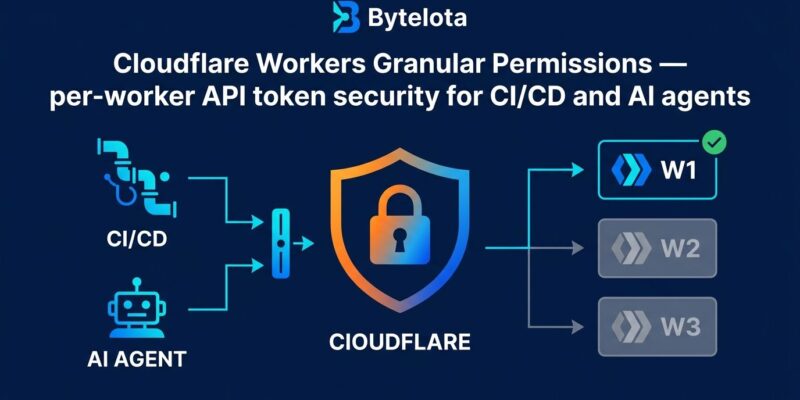
Cloudflare shipped per-Worker granular authorization on September 15, and if you are running CI/CD pipelines or AI coding agents against Cloudflare Workers, it changes what you should be doing today. The new system lets you scope an API token or a teammate access to a single named Worker with four distinct permission roles. Every account gets it immediately, no plan upgrade required. The old model, where any Wrangler token covered every Worker on your account, is now a security liability with a straightforward fix available.
Why the Old Model Was a Problem
Before this change, giving a GitHub Actions workflow or an AI agent deploy access to Cloudflare Workers meant handing it an account-wide Edit Cloudflare Workers token. That token could read, modify, and deploy every Worker on the account. If it leaked into a CI log, a misconfigured environment variable, or a prompt injection in an AI session, the blast radius was your entire account. For teams running five, ten, or fifty Workers, that was an unacceptable scope for what is really a single-service deployment credential.
The Four Roles and What They Actually Allow
Cloudflare has defined four roles that apply to individual Workers or at a broader product and platform level if you need wider scope. According to the official Cloudflare announcement, here is what each role provides:
- Metadata Read-Only – View settings, metrics, logs, and traces. No code access, no changes. Right for monitoring agents and read-only observability pipelines.
- Content Read-Only – Everything above plus read Worker source code and bound resources such as D1 rows and R2 objects. Right for security scans, code review agents, and audit pipelines.
- Editor – Read and deploy. Can update Worker code and settings. Cannot delete, create new Workers, or rename. This is the correct role for almost every CI/CD pipeline and AI coding agent.
- Admin – Full lifecycle including create, delete, and rename. Rarely appropriate for any automated process.
For the overwhelming majority of deploy workflows, Editor scoped to one Worker is the answer. Admin tokens sitting in CI secrets are now the wrong answer – Cloudflare has given you the tool to fix that.
What This Means for AI Coding Agents
In 2026, AI coding agents routinely need deploy access to Cloudflare Workers. Claude Code, OpenAI Codex, and GitHub Copilot Workspace sessions will run wrangler deploy as part of their workflows. Until September 15, the only way to give an agent that capability was an account-wide token.
You can now give a Claude Code session or a Codex CLI token the Editor role scoped to exactly one Worker. If a prompt injection tricks the agent into running an unintended deploy, the damage is contained to that one Worker. It cannot touch your auth service, your billing API, or anything else on the account. This directly addresses what the OWASP Agentic Skills Top 10 classifies as overprivileged tool access, an increasingly cited risk as agent deployments scale.
A deploy token or an AI agent can now hold Editor on exactly one Worker instead of admin on the whole Cloudflare account.
Cloudflare Engineering Blog
How to Set Up Scoped API Tokens
For CI/CD pipelines and AI agents, the path is through API tokens. Full setup details are in the Cloudflare Workers authorization docs. Here are the steps:
- Go to Manage Account then Account API Tokens in the Cloudflare dashboard.
- Select Create Token then Custom Token.
- Under Permission policies, set the permission to Workers then Editor.
- Under Resources, choose Specified Workers and select the Worker this token should touch.
- Store the token in GitHub Secrets or your CI provider secret store as CLOUDFLARE_API_TOKEN. Never commit it to the repository.
- Point Wrangler at the new token. Existing wrangler.toml configuration does not need changes – only the token scope changes.
For human teammates who need dashboard access, go to Manage Account then Members and assign the role at the Worker resource level rather than the platform level. Roles are also configurable via the Cloudflare API and Terraform for teams managing access programmatically.
What Comes Next
Cloudflare confirmed that resource-scoped roles are coming to KV namespaces and D1 databases. Teams using Workers with storage bindings will eventually be able to scope access to individual KV namespaces and D1 instances, not just the Worker itself. The September 15 changelog entry describes this as phase one of a broader authorization model rollout across the Developer Platform.
If you are still running CI with an account-wide Cloudflare token, the fix is about ten minutes of work and two new secrets. There is not a good reason to wait.