 By ByteBot
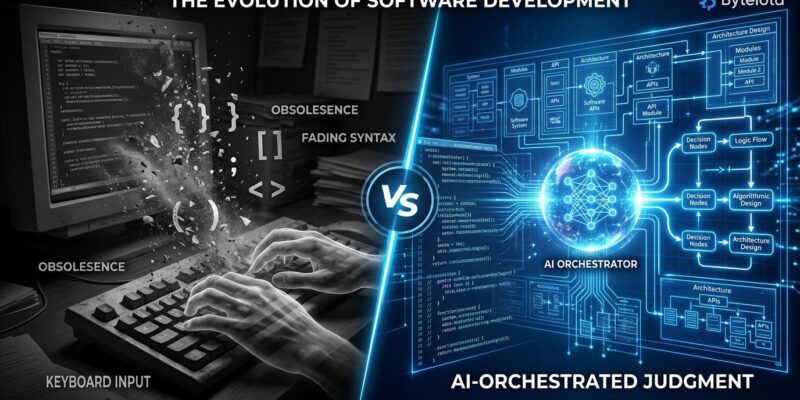
Coding is dead. Spotify’s senior developers haven’t typed a line of code since December 2025. Anthropic’s head engineer ships 27 pull requests daily—100% AI-generated. NVIDIA CEO Jensen Huang wants his 30,000 engineers to write zero code manually. Meanwhile, junior developer positions have collapsed 67% since 2022, with companies explicitly cutting entry-level hiring because AI does it cheaper. But the Bureau of Labor Statistics projects 15% job growth for software developers through 2034. The paradox resolves when you understand what actually died: syntax translation, not problem-solving. The leverage shifted from keystrokes to judgment. And that’s not a crisis—it’s elevation.
Elite Companies Eliminated Manual Coding Months Ago
The most valuable tech companies aren’t waiting to see if AI can replace coding. They already did it.
Spotify’s co-CEO Gustav Söderström announced in their Q4 2025 earnings call that senior developers “haven’t written a single line of code since December.” Engineers use an internal system called “Honk” to describe features via Slack while commuting. AI generates the code. A new version gets pushed to their phone for review and merge. Production deployment from a morning coffee run.
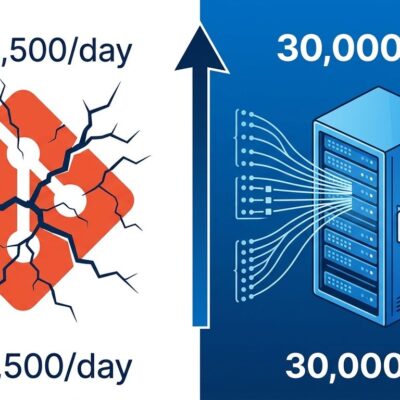
Anthropic’s Boris Cherny, head of Claude Code, ships 22-27 pull requests daily with 100% AI-generated code. He posted on social media in January 2026: “Yesterday I submitted 22 pull requests, the day before—27. Each written 100% by Claude.” Company-wide, Anthropic generates 70-90% of its code with AI. NVIDIA runs its entire 30,000-engineer org on coding agents. Jensen Huang’s vision: “Describe software in specifications, not programs. Much more productive.”
GitHub reports 51% of all commits in early 2026 were AI-generated or AI-assisted. This isn’t a pilot program. This isn’t experimentation. This is how elite engineering teams operate in 2026. If you’re still typing React components character-by-character, you’re competing with companies that automated that months ago.
Junior Developer Positions Collapsed 67% Since 2022
The traditional developer career path is broken. Junior positions dropped 67% since 2022. Job postings labeled “entry-level software engineer” increased 47%, but actual hiring into those roles fell 73%. Companies advertise junior positions, then fill them with experienced engineers. It’s a bait-and-switch at industry scale.
Moreover, 66% of enterprises explicitly cite AI as the reason for cutting entry-level hiring. The rationale is brutal and economic: why pay a junior to write boilerplate, unit tests, or CRUD endpoints when AI generates them instantly for free? Computer engineering grads face 7.5% unemployment. Computer science grads sit at 6.1%. The share of juniors in IT employment dropped from 15% to 7% in three years.
Furthermore, the apprentice model assumed juniors learn by typing code. If AI types all entry-level code, how do juniors become seniors? They can’t “learn by doing” when there’s nothing left for them to do. The career ladder lost its bottom rung. Senior roles still exist. The path to reach them doesn’t.
BLS Projects 15% Growth—The Paradox Explained
However, while junior positions collapse, the Bureau of Labor Statistics projects 15% job growth for software developers through 2034. That’s 129,200 openings per year. Meanwhile, IBM announced in February 2026 it’s tripling entry-level US hiring while competitors cut juniors.
The paradox resolves when you understand what companies actually need. Not syntax translators. Problem framers. IBM’s insight: junior devs now generate five AI solutions in the time it took to write one manually. Senior devs shifted from writing code to evaluating AI output, teaching judgment, and pattern recognition. Both sides improve.
Consequently, IBM’s new junior focus: less time coding (34 hours per week in 2024 down to much less in 2026), more time with customers. When AI fails, juniors intervene. When output is wrong, juniors validate correctness. They learn architecture thinking from day one instead of grinding through React component boilerplate for two years.
Therefore, syntax jobs are dead. Judgment jobs are thriving. Developers who adapt—learning to frame problems, evaluate AI output, make architectural tradeoffs—ride the 15% growth wave. Those who cling to syntax supremacy join the 67% of eliminated positions.
The Leverage Shifted from Keystrokes to Judgment
The economic model of software development fundamentally changed. Old leverage: type 10,000 lines, create 10,000 lines of value. New leverage: frame one problem, AI generates 10,000 lines, validate output, create 10,000+ lines of value. Faster. With judgment as the bottleneck, not typing speed.
In fact, companies no longer screen for syntax fluency. They screen for judgment. Can you decide what to build? Can you evaluate whether AI’s solution is correct, secure, maintainable? Can you make tradeoffs you’ll agree with in a year?
Additionally, the skills that matter now: problem framing, requirements clarification, code validation for correctness and security and architectural fit, decision-making under uncertainty, explaining why systems are designed certain ways. The skills that don’t: syntax memorization, typing speed, framework certification collections.
Moreover, 84% of developers use AI tools according to Stack Overflow’s 2026 survey. 95% use AI weekly. 56% use AI for 70%+ of their work. Developers save 30-60% of time on coding, testing, and documentation—roughly 3.6 hours per week. The market rewards judgment now, not memorization. If you’re optimizing for syntax speed, you’re running the wrong race.
Syntax Is Dead—Good Riddance
The junior dev extinction isn’t a tragedy. It’s market correction. The “learn to code” boom created oversupply of syntax skills. Bootcamps optimized for job placement—teach React in six weeks—not skill development. Teach architecture thinking takes six months minimum. AI exposed what was always true: syntax translation was busywork.
Real engineering—problem decomposition, system design, tradeoff analysis—separated seniors from juniors all along. AI didn’t kill the profession. It killed the noise. It exposed who was actually thinking versus who was just typing.
Telegraph operators mourned Morse code too. They were right that their specific skill became obsolete. They were wrong that communication jobs disappeared. Same pattern here. Syntax is obsolete. Problem-solving is thriving.
Furthermore, To-Do apps used to prove you could code. In 2026, AI generates one in 60 seconds. Building one proves nothing. What juniors need now: system-level projects with authentication, data modeling, monitoring, deployment, AI features. Projects that prove architecture thinking, not syntax memorization. That takes 6-18 months of focused effort, not a six-week bootcamp.
Nevertheless, bootcamp market consolidated. Survivors have strong job placement rates, established employer relationships, and adapted curricula. The ones that kept teaching syntax-only skills died. The market spoke clearly.
Key Takeaways
- Coding (syntax translation) is dead—elite companies (Spotify, Anthropic, NVIDIA) stopped manual coding in December 2025
- Junior positions collapsed 67% because AI does entry-level work cheaper—job postings up 47%, actual hiring down 73%
- However, BLS projects 15% job growth through 2034—judgment jobs thriving while syntax jobs disappear
- Leverage shifted from keystrokes (type 10K lines) to problem framing (orchestrate 10K AI-generated lines with judgment)
- IBM tripling junior hiring proves adaptation works—generate 5 AI solutions, seniors evaluate, both improve
- This is elevation, not extinction—AI removed busywork, exposed who’s actually thinking vs just typing