 By ByteBot
React Server Components became the “industry standard” in 2026 after React 19 made them production-stable. Frameworks like Next.js defaulted to server-first architecture, and Vercel’s marketing promised 67% faster initial renders with 40-62% smaller JavaScript bundles. However, the gap nobody discusses: 45% of React developers tried RSC, yet only 33% report positive experiences. The pendulum swung hard toward server-side rendering, and for highly interactive applications, it swung too far.
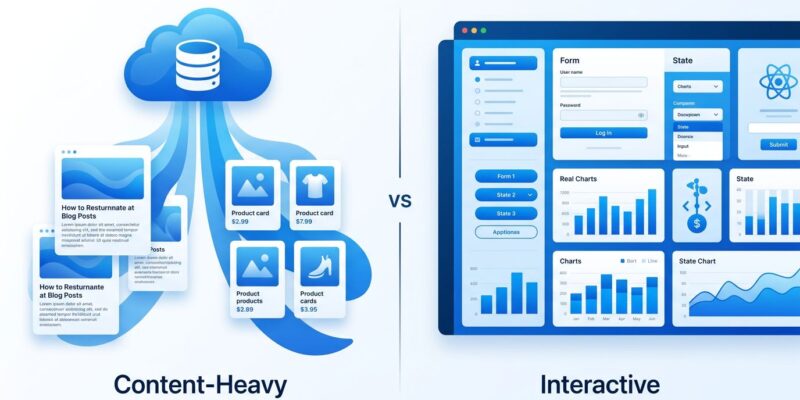
This is the divide the React community won’t acknowledge. RSC delivers real benefits for content-heavy sites—blogs, documentation, e-commerce product pages—where server rendering makes sense. But for dashboards, admin tools, and stateful applications where interactivity dominates? The complexity tax outweighs the performance gains. The industry’s “server-first by default” narrative ignores a fundamental truth: one architecture doesn’t fit all React apps.
When RSC Actually Wins
React Server Components solve real problems for content-heavy applications. The performance data isn’t hype—it’s backed by production case studies. Sites migrating to RSC see 40-62% bundle size reductions and initial renders 67% faster than traditional client-side approaches. Server components render exclusively on the server with zero client JavaScript overhead, making them ideal for static or semi-static content.
Moreover, the wins are measurable. Vercel’s e-commerce case study documented 70% TTFB reduction and 40% server cost savings. React 19.2 Server Components achieve 0.8-second First Contentful Paint, and Interaction to Next Paint improved from 250ms to 175ms in production deployments—a 30% responsiveness gain. For ByteIota’s blog posts, product catalogs, or documentation sites, these gains are real and significant.
Furthermore, the key insight: RSC shines when your content-to-interaction ratio is high. Blog posts, marketing pages, product listings—these are natural fits. The architecture eliminates client-server waterfalls by fetching data directly in server components, and heavy dependencies like markdown parsers or syntax highlighters stay on the server entirely. If your app is 70% content and 30% interaction, RSC is worth the complexity.
When RSC Breaks Things
For highly interactive applications—dashboards, admin panels, real-time collaboration tools—RSC introduces friction without proportional benefits. The architecture requires a 128KB minimum client-side JavaScript payload for even trivial interactive features. That’s 3.2 times larger than Svelte 5.0’s equivalent bundle for the same functionality. Consequently, when everything in your app needs state, effects, and event handlers, you inherit server infrastructure requirements for zero performance gain.
Library compatibility breaks hard. Popular React libraries like Ant Design, Mantine, and React Admin assume client-side rendering and don’t work with Server Components. Developers hit the “use client” cascade—importing React Query makes the entire component tree client-side, eliminating RSC benefits entirely. One GitHub discussion captured the frustration: “For B2B SaaS applications, the App Router DX is a big step down from the Pages Router. The biggest loss was simplicity.”
The adoption gap tells the story. Only 33% of developers who tried RSC report positive experiences, mirroring Platform Engineering’s failure pattern—80% adoption but fewer than 30% achieve measurable value. In fact, if your app is 90% interactive like most admin dashboards, RSC adds complexity without benefit. Everything becomes a Client Component anyway, so you’re stuck with server hosting costs and framework lock-in for gains that don’t materialize.
The Complexity Tax
RSC’s developer experience challenges are real and measurable. The server/client boundary mental model confuses developers—adding an `onClick` handler to a Server Component does nothing because you forgot the “use client” directive. The cascade effect means importing a single client-side library can turn your entire component tree into Client Components, eliminating the architecture’s core benefit.
Development friction shows up in tooling. Developers report restarting the dev server every 20 minutes because it crashes or progressively slows down. Next.js’s aggressive default caching causes stale data unless you explicitly opt out with `{ cache: ‘no-store’ }` or revalidation strategies. In addition, only 22% report “high satisfaction” with RSC platforms, matching the pattern where infrastructure adoption doesn’t translate to developer productivity.
The question becomes: Is 40% faster initial load worth doubling development time and team frustration? For small teams or rapid prototyping, the RSC learning curve outweighs performance benefits. The complexity compounds when you add React Context (doesn’t work across server/client boundaries), third-party scripts (need manual “use client” wrapping), and TypeScript (confusing type errors at the boundary). As a result, it’s death by a thousand papercuts.
What Developers Should Do
Evaluate RSC based on your app’s characteristics, not industry hype. Ask: Is your app content-heavy or interaction-heavy? Content-heavy sites (blogs, documentation, e-commerce product pages) should use RSC—the performance gains are real. Interaction-heavy apps (dashboards, admin tools, data visualization) should stick to client-side React or consider lighter alternatives like Svelte 5.0 as analyzed in this contrarian perspective.
Check library compatibility before committing. If your stack depends on Ant Design, Mantine, or React Admin, RSC won’t work without major rewrites. Verify your critical dependencies support Server Components—the ecosystem is catching up, but gaps remain. Additionally, consider team context: junior developers struggle with the server/client mental model, and the learning curve slows velocity for small teams.
Remember that RSC requires server infrastructure. You need Node.js or Edge runtimes (Vercel, Cloudflare Workers, AWS Lambda), not static hosting. Server-side rendering increases hosting costs compared to static sites. Therefore, if your app sits behind authentication where SEO doesn’t matter, the server-first benefits vanish while complexity and costs remain.
The best architecture is the one that fits your problem. Content-heavy? Use RSC. Interactive-heavy? Use client-side React or Svelte. Mixed use cases like e-commerce with product pages and interactive carts? Selective hybrid approaches work—server components for structure and content, client components for interactive features. For deeper understanding of architectural decisions, Josh Comeau’s guide to React Server Components provides excellent context. Don’t cargo-cult architectural patterns because frameworks push them as defaults.