 By ByteBot
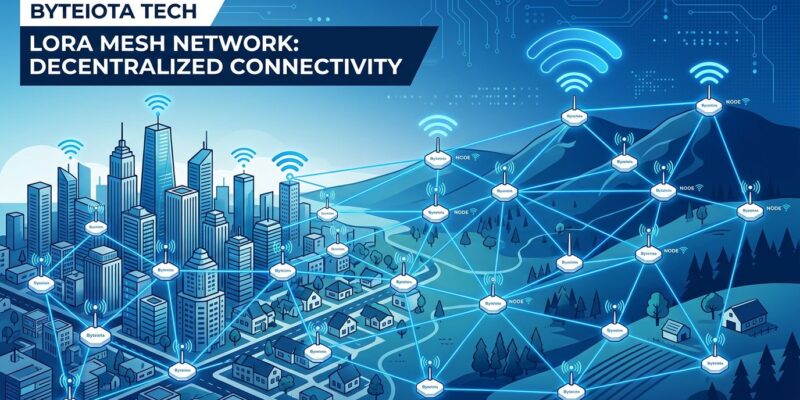
Meshtastic hit #5 on Hacker News today with 384 points. This open-source project turns $20-50 LoRa radios into decentralized mesh networks that work without cell service or internet. No ham license required, encrypted by default, with 1-3 km urban range or 20+ km line-of-sight. Developers are deploying it for IoT sensors, privacy messaging, and emergency comms.
Real-World Range Expectations
Marketing touts the 331 km world record. Field testing in 2026 tells a different story. Dense urban environments deliver 0.5-2 km reliable range. Typical cities hit 1-3 km. Suburban rooftops reach 2-8 km. Rural line-of-sight opens up to 10-20+ km, with properly placed hilltop relays hitting 10-50 km.
The limiting factor isn’t transmit power – it’s line-of-sight and Fresnel clearance. In urban and forested areas, obstructions kill range faster than weak signals. The golden rule: height × antenna quality × line-of-sight. Doubling antenna height improves range up to 40%. Upgrading from stock 2 dBi antennas to 5-8 dBi aftermarket options makes measurable gains. Urban noise floors also reduce signal-to-noise ratio even with strong antennas and clear sightlines.
Hardware Recommendations by Use Case
First-time users should grab a Heltec V3 for $20-30. ESP32-based with WiFi, Bluetooth, 0.96″ OLED, and SX1262 LoRa chip. No GPS or battery holder, but it’s the cheapest entry point for fixed installations or MQTT gateways.
For home base stations, the LILYGO T-Beam ($40-50) is the classic choice. Built-in GPS, 18650 battery holder, WiFi for MQTT, and OLED display. The T-Beam Supreme upgrades to ESP32-S3 with 8MB PSRAM and adds a BME280 sensor for temperature, humidity, and pressure telemetry.
Mobile users prioritizing battery life want the Heltec T114 with nRF52840. Just 11 µA deep sleep current. No WiFi, only Bluetooth, but extraordinarily efficient for portable deployments.
Critical: Never power on your radio without an antenna attached. This damages the radio chip – a common and expensive mistake.
Microcontroller choice matters. ESP32 boards have WiFi and Bluetooth (ideal for gateways and MQTT) but consume more power. nRF52 chips are far more efficient with easier UF2 bootloader updates (drag-and-drop firmware) but lack WiFi. RP2040 boards are cost-effective DIY options with community support.
Developer Applications: MQTT and IoT Integration
Meshtastic’s narrative skews toward prepper scenarios, but that undersells developer potential. The MQTT integration is compelling: sensor nodes transmit data over LoRa mesh to a WiFi-equipped gateway, which bridges to an MQTT broker. Standard IoT pipelines follow: NodeRED processing, InfluxDB storage, Grafana visualization. The T-Beam Supreme’s BME280 sensor becomes an instant weather station.
Home Assistant integration works natively over MQTT for device tracking, environmental monitoring, and automation triggers. Remote monitoring applications include greenhouse temperature tracking, wildlife observation without cell coverage, and field research data collection where power and networking aren’t feasible. Privacy-focused messaging runs encrypted and decentralized with no cell carrier or cloud service intermediary.
Node Configuration: CLIENT vs ROUTER
New users make a critical mistake: setting everything to ROUTER mode because more rebroadcasting sounds better. It’s not. CLIENT is the default and should stay default for most devices. Clients intelligently rebroadcast by waiting to see if neighbors relay first, reducing packet collision.
ROUTER mode always rebroadcasts immediately. Useful for well-placed, permanently powered nodes in strategic locations, but flooding the network with routers causes packet collision, reduces message delivery, and decreases effective range by consuming hops. REPEATER mode disables all broadcast traffic (no telemetry), relaying only other nodes’ packets – for remote hilltop installations with no local users.
Recommended architecture: CLIENT nodes with a small number of strategically placed ROUTERS. For high-traffic scenarios, CLIENT_MUTE sends and receives without adding network congestion.
Getting Started
Pick hardware: Heltec V3 for budget/gateway builds, T-Beam for home bases with GPS and MQTT, Heltec T114 for mobile low-power deployments. Firmware flashing is straightforward via web flasher or UF2 drag-and-drop for nRF52/RP2040 boards.
Connect via Bluetooth, WiFi, or USB. Set your region (US: 915 MHz, EU: 868 MHz), leave role on CLIENT, start with default LoRa parameters. Test before permanent installation – walk around with a mobile node, check actual range, identify dead zones. Once you know coverage gaps, plan fixed router placement intelligently.
The community is volunteer-driven. Official docs at meshtastic.org, regional networks like MSPMesh, NodakMesh, and BuffaLoRa provide local support. Meshtastic won’t replace your cell phone, but for IoT sensors in remote locations, privacy-focused communication, or independent infrastructure, it’s compelling at a reasonable price.