 By ByteBot
OpenAI launched ChatGPT Images 2.0 yesterday (April 21), introducing the first image generation model that reasons before creating. The update brings 2K resolution and superior text rendering, but at a 60% price increase that puts it head-to-head with Google’s cheaper Nano Banana 2. Hacker News erupted with 660 points and 528 comments debating whether “thinking” is genuine innovation or marketing spin for higher prices.
The launch matters because it extends reasoning capabilities from text (ChatGPT o1) to images, making AI image generation viable for professional design work. Moreover, text rendering—previously AI’s biggest weakness—finally works reliably enough for menus, posters, and infographics.
What “Thinking” Mode Actually Does
ChatGPT Images 2.0 integrates OpenAI’s O-series reasoning capabilities. The model now plans layouts, verifies typography, checks object placement, and even searches the web before generating an image. Consequently, this mirrors ChatGPT o1’s evolution from instant responses to deliberate chain-of-thought reasoning.
Two modes ship with the update. Instant mode gives all users (free and paid) base quality improvements without reasoning. In contrast, thinking mode—reserved for Plus, Pro, Business, and Enterprise tiers—adds the reasoning phase, web search during planning, and up to 8 consistent multi-image outputs. Furthermore, the reasoning step reduces iterative re-prompting by getting composition and text placement right on the first attempt.
However, the reasoning process is a black box. OpenAI doesn’t reveal what the model “thinks” or how it plans. Developers on Hacker News questioned whether this is genuine reasoning or just extra compute time dressed up as innovation. Without transparency, it’s impossible to verify if the model truly plans or simply tries multiple approaches internally.
Text Rendering Finally Works
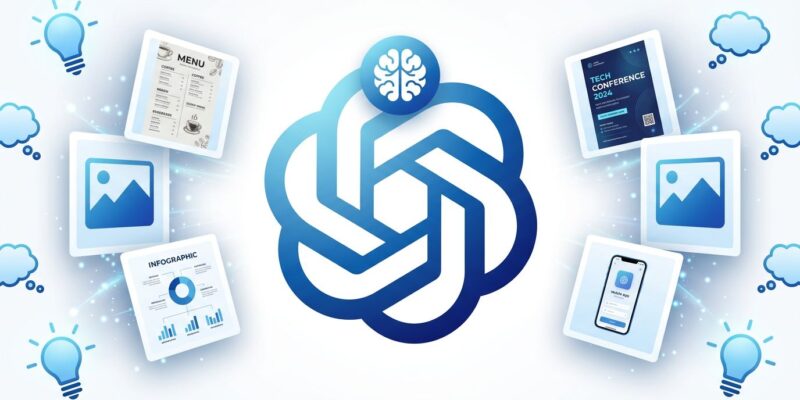
ChatGPT Images 2.0 solves AI image generation’s biggest blocker—text rendering. Previous models produced warped letters, gibberish, and unreadable fonts that made professional use impossible. Nevertheless, Images 2.0 generates readable typography in complex designs: restaurant menus ready for print, event posters with accurate dates, scientific diagrams with labeled components, and product grids with readable SKUs.
The breakthrough extends to multilingual content. The model handles Japanese manga pages, Korean hospitality brochures, South Asian book covers, and multilingual typography posters with clean rendering across Japanese, Korean, Chinese, Hindi, and Bengali text. As a result, this opens AI image generation to localization pipelines that previously required human designers.
Marketing teams can now prototype campaign art with actual copy instead of placeholder text. Additionally, design agencies can generate infographics, posters, and editorial spreads without post-production text fixes. Product teams can mock interface concepts with real UI text. For these use cases, Images 2.0 delivers what previous models promised but never achieved.
The Price of Better Quality: 60% More Expensive
OpenAI’s API pricing jumped significantly. The gpt-image-2 model costs $8 per million input tokens and $30 per million output tokens. For a standard 1024×1024 high-quality image, that’s roughly $0.21 per image—60% more expensive than GPT Image 1’s ~$0.13.
The pricing tiers create a 35X range from low to high quality. Low resolution (1024×1024) costs $0.006 per image. Medium resolution costs $0.053. High resolution hits $0.211. Meanwhile, developers on Hacker News balked at the differential, questioning whether quality improvements justify a 35X cost spread for the same base resolution.
Google’s Nano Banana 2, launched in February 2026, generates images at $0.067 per image—68% cheaper than ChatGPT’s high-resolution tier. Nano Banana 2 also generates faster (3-5 seconds) and holds the highest benchmark Elo score at 1,360. The trade-off: Nano Banana 2’s text rendering is worse, and it lacks reasoning mode. Ultimately, developers must decide: Is superior text rendering worth 3X the cost?
Three-Way Competition: OpenAI, Google, Midjourney
ChatGPT Images 2.0 is OpenAI’s response to Google’s two-month head start. Nano Banana 2 launched in February 2026 and quickly dominated on speed, cost, and benchmark scores. Therefore, OpenAI differentiated on reasoning and text rendering rather than competing on price.
The market now splits three ways. ChatGPT Images 2.0 wins on text rendering and offers unique reasoning capabilities. Nano Banana 2 wins on speed (3-5 seconds), cost ($0.067 per image), and overall benchmarks (Elo 1,360). Midjourney V7 wins on artistic quality—composition, lighting, and aesthetics—but offers no official API and locks users into $10-120/month subscriptions.
Decision criteria for developers are clear. Need text rendering or reasoning? ChatGPT Images 2.0. Need speed and cost optimization? Nano Banana 2. Need artistic quality for creative work? Midjourney. In fact, no single winner exists—choose based on project priorities.
OpenAI is shutting down the DALL-E 2 and DALL-E 3 API on May 12, 2026, forcing existing users to migrate. This creates urgency but also resentment over the 60% price jump coinciding with forced migration.
Copyright Concerns Create Developer Risk
OpenAI hasn’t disclosed what images trained GPT Image 2. This opacity creates legal uncertainty for developers using the model commercially. For instance, the ongoing New York Times lawsuit against OpenAI was allowed to proceed by a federal judge. Studio Ghibli hasn’t sued yet, but copyright experts say they have grounds.
ChatGPT can reproduce Studio Ghibli’s distinctive animation style with uncanny accuracy. It’s unknown whether OpenAI trained directly on Ghibli film frames or learned the aesthetic from fan art derivatives. Hayao Miyazaki, Ghibli’s co-founder, previously called AI-generated animation “utterly disgusting” and “an insult to life itself.” Legal expert Rob Rosenberg argues Ghibli could claim OpenAI harms their trademark goodwill and causes consumer confusion.
Courts are still deciding whether training AI models on copyrighted works falls under fair use protections. If OpenAI loses these cases, developers using ChatGPT Images 2.0 for commercial projects may face downstream legal exposure. Consequently, copyright-conscious companies should assess risk tolerance before adopting. Safer alternatives may emerge as models trained exclusively on licensed data enter the market.
The lack of training data transparency is the real problem. Developers can’t make informed decisions about legal risk when OpenAI treats training sources as a black box. Nevertheless, this isn’t unique to OpenAI—most AI image models refuse to disclose training data—but it creates a risky environment for commercial use.
Key Takeaways
- OpenAI launched ChatGPT Images 2.0 on April 21 with “thinking” mode—the first image generation model that reasons before creating
- Text rendering breakthrough makes AI image generation viable for professional design work (menus, posters, infographics, multilingual content)
- API pricing increased 60% over GPT Image 1, costing $0.21 per high-quality 1024×1024 image vs Nano Banana 2’s $0.067 (68% cheaper)
- Three-way market split: ChatGPT for text rendering/reasoning, Nano Banana 2 for speed/cost, Midjourney for artistic quality
- Undisclosed training data creates copyright uncertainty—developers using Images 2.0 commercially should assess legal risk tolerance
- DALL-E 2/3 API shutdown on May 12 forces migration to the more expensive gpt-image-2 model