 By
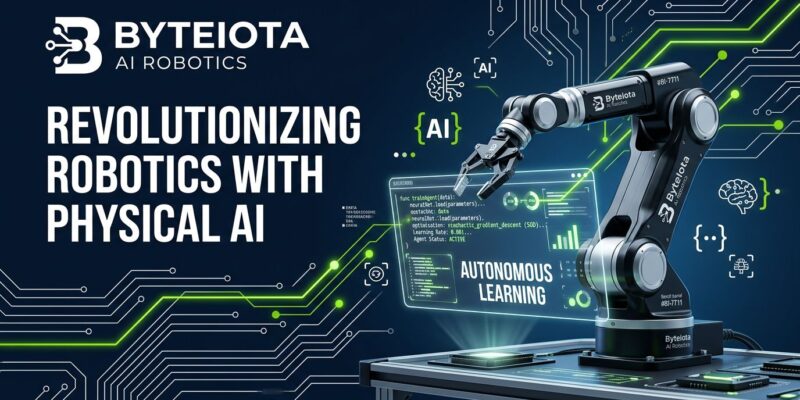
By AI coding agents have spent two years getting very good at software: web apps, REST APIs, CI pipelines, database migrations. That’s a solved problem. Today, NVIDIA drew a bigger circle. The Agent Toolkit’s physical AI skills — dropped June 1, 2026 — let Claude Code, Cursor, and Codex do robotics, vision AI, and autonomous vehicle development using the same workflow developers already use for writing code. Same agent, different domain. No new tooling required.
What Shipped
NVIDIA open-sourced a collection of SKILL.md-based knowledge packages that map its physical AI stack to coding agents. Six domains are covered from day one:
- Cosmos — World foundation models for physical world reasoning and simulation data generation
- Omniverse — Digital twin and simulation libraries
- Isaac — Robotics simulation and robot learning (built on ROS 2)
- Metropolis / DeepStream — Vision AI pipelines for cameras, video, and sensor data
- Alpamayo — Autonomous driving tools
- Jetson — Edge AI deployment and optimization
All skills are available today at github.com/NVIDIA/skills under a permissive license.
How SKILL.md Works
The mechanism is straightforward, and if you have used AGENTS.md or Cursor’s rules files, you already understand the pattern. A SKILL.md file is a structured knowledge package: it contains domain-specific rules, reference documentation pointers, and API guardrails. Drop the skill directory into your project’s skills folder, and your coding agent auto-discovers it when you start a task.
Before generating any code, the agent reads the SKILL.md and consults the bundled reference documents. This prevents the usual AI hallucination problem with niche libraries — the agent isn’t guessing at CUDA-X APIs or DeepStream pipeline syntax. It’s working from NVIDIA-verified documentation. The same SKILL.md file works across Claude Code, Codex, and Cursor without modification.
# Clone the DeepStream coding agent skill
git clone https://github.com/NVIDIA-AI-IOT/DeepStream_Coding_Agent

# Copy skill into Claude Code's skills directory
cp -r skills/deepstream-dev ~/.claude/skills/

# Prompt Claude Code
# "Create a multi-camera people-counting pipeline with REST API and Kafka output"
The DeepStream Demo Is Worth Your Attention
Of the six domains, DeepStream is the most immediately useful for a broad developer audience — anyone doing computer vision, security cameras, retail analytics, or industrial inspection. The DeepStream Coding Agent skill lets you describe a vision AI pipeline in plain language and receive architecturally sound, SDK-idiomatic code in return.
The outputs aren’t toys. One prompt generates a complete production-grade microservice: multi-camera ingestion, GPU-accelerated decode, ONNX model inference (auto-converted to TensorRT on first run), REST API endpoints, Kafka integration, and health monitoring. Before this skill existed, building that stack from scratch required days of reading DeepStream documentation and debugging GStreamer pipelines.
Physical Agents Need Harder Security
Software agents that go wrong produce bad code. Physical AI agents that go wrong move robot arms. NVIDIA ships OpenShell alongside the Agent Toolkit specifically to address this gap.
OpenShell is an out-of-process security runtime: kernel-level enforcement via Landlock LSM and Seccomp BPF, deny-by-default policy model, declarative YAML rules that hot-reload without restarting the agent. Enforcement runs outside the agent process — meaning even a compromised agent cannot override its constraints. Every outbound connection is evaluated at the binary, destination, method, and path level. Source and docs at github.com/NVIDIA/OpenShell.
Who This Is Actually For Today
Be honest with yourself before cloning the repo. The DeepStream and Jetson skills are ready for developers building vision AI systems today. The Isaac robotics skills are best suited for teams already working in ROS 2 — this isn’t an on-ramp for web developers who want to pivot to robotics overnight. Cosmos and Alpamayo require domain fluency in world modeling and AV development.
The most realistic near-term audience: developers building computer vision products (surveillance, manufacturing QA, retail analytics) who already use Claude Code or Cursor. For that group, the DeepStream skill collapses weeks of ramp-up into an afternoon. Industry backing suggests this is already running at scale — Foxconn, Siemens, Universal Robots, and TSMC are day-one partners according to NVIDIA’s announcement.
How to Start Right Now
The path of least resistance is the DeepStream Coding Agent. Clone NVIDIA-AI-IOT/DeepStream_Coding_Agent, drop the skill directory into your Claude Code or Cursor skills folder, and describe the vision pipeline you want. The SKILL.md convention was already showing up in web tooling (Next.js AGENTS.md, Cursor rules). NVIDIA just extended the pattern to hardware. If that standardizes the way domain-specific agent knowledge gets packaged and distributed, the implications reach well beyond robotics.