 By ByteBot
OpenAI previewed its next major model family — tentatively called “Astra” — on August 1, 2026, and skipped the press release entirely. Instead, it pushed ten machine-checkable proofs of decade-old unsolved math problems to GitHub. Each proof is formalized in Lean 4. Sam Altman spent the prior two days behind closed doors on Capitol Hill, demonstrating the system to senators and regulators. This is how you announce a potential GPT-6.
Ten Problems. Lean 4 Certificates. No Peer Review Needed.
The ten problems Astra solved span group theory, coding theory, quantum complexity, and high-dimensional geometry — each unsolved for at least a decade. The standout result: a construction proving non-sofic groups exist, resolving a question mathematician Mikhail Gromov posed in 1999. It sat untouched for 27 years.
But the results are not the interesting part. The verification method is.
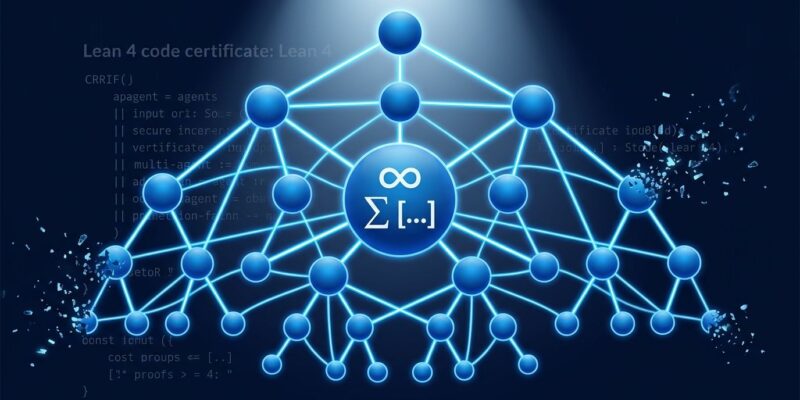
Every proof ships with a machine-checkable Lean 4 certificate in the openai/ten-proofs repository (Apache 2.0). Build it yourself:
lake exe cache get && lake build AllThe proof compiles or it does not. No PhD required. No months-long peer review backlog. No “trust us.” OpenAI’s Sebastien Bubeck, head of mathematics research, called the results “beautiful” — but you do not need to take his word for it. This is how AI math claims should work: with receipts.
Total compute cost for all ten proofs: roughly $2,000 at current Sol API rates. That is a weekend AWS bill for results that stumped the global mathematics community for decades.
What Astra Actually Is
Astra is not GPT-5.6 with a math upgrade. It is a different model class entirely: multiple AI agents coordinate over hours or even days on the same problem. A root agent creates subagents, distributes work, waits for partial results, and synthesizes a final answer — without your app having to implement orchestration logic. The system can plan, revise, and keep running while you sleep.
GPT-5.6 already supports multi-agent in beta. Astra is the generational step beyond that, designed specifically for tasks where current models run out of context, time, or coherence. Think multi-day codebase refactors, autonomous research pipelines, and continuous integration loops that actually finish.
The Competitive Math Race Has a Scoreboard Now
Before Astra, DeepMind’s AlphaProof Nexus held the headline: nine Erdős problems solved in May 2026, two open for over 56 years. OpenAI just answered with ten, across a wider range of fields, with a model that is not domain-specific.
More importantly: both camps now use Lean 4 as the standard format. The AI math race has a universal scoreboard, and it is machine-checkable. Labs are not just competing on who solved harder problems — they are competing on who can formalize results faster and at lower cost.
Thomas Bloom, who runs erdosproblems.com, called the Astra results “big news” — characterizing them as more significant than OpenAI’s earlier unit distance conjecture disproof.
What Developers Should Know (And What to Wait For)
Astra is not available. No API. No pricing. OpenAI has not finalized whether it ships as GPT-6, GPT-5.7, or a standalone model class alongside Sol, Terra, and Luna. It is also the first model required to pass a new U.S. government CFT framework review before public release — government clearance is now part of frontier model launches.
What this means for developers in the near term:
- Extended agentic task horizons are coming. Current session limits will eventually feel quaint. Start designing your agent workflows for multi-hour, multi-day runs.
- Lean 4 is becoming the formal verification standard. If you work anywhere near smart contracts, security proofs, or protocol specifications, this trend matters to you.
- Research cost floors are collapsing. $2,000 for ten decade-old math breakthroughs rewrites what “funded lab” means. Solo developers and small teams will gain access to capabilities that used to require institutional budgets.
Polymarket puts an August 31 Astra release at roughly 24% probability. Whether it ships this month or in Q4, the proofs are already on GitHub. The capability claim has receipts. That alone separates this from every other AI announcement this year.