 By ByteBot
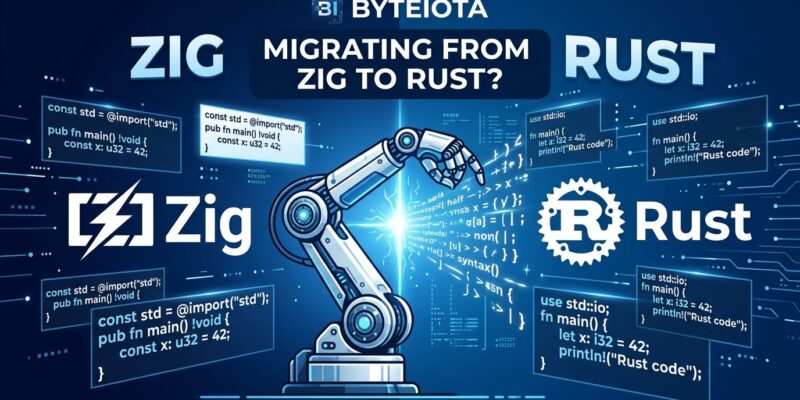
Anthropic acquired Bun in December 2025 and is now rewriting the entire 300,000-line codebase from Zig to Rust using AI agents. The story went viral on Hacker News today, drawing 592 upvotes and 421 comments that split the developer community between “impressive” and “terrifying.” This is the first major test case of AI agents replacing human developers for large-scale codebase migration—and the outcome will shape the future of software engineering careers.
The Acquisition That Changed Everything
When Anthropic made its first-ever acquisition in December 2025, it chose Bun—the JavaScript runtime that’s 4× faster than Node.js at startup and 2.4× better at HTTP throughput. The timing wasn’t coincidental. Just one month earlier, Claude Code hit $1 billion in run-rate revenue. As one analysis put it: “When your billion-dollar product depends on an open-source project you don’t control, that’s a strategic vulnerability.”
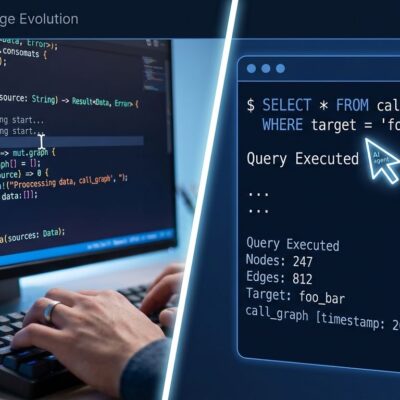
Now Anthropic is using AI agents to port Bun’s 300,000 lines of Zig code to Rust. The workflow is surprisingly automated: @robobun creates pull requests, @coderabbitai and @claude review them, and human developers make the final merge decisions. The process follows roughly 300 porting rules documented in docs/PORTING.md, with what developers are calling an “infinite token budget” approach.
Why Zig to Rust Matters
Bun originally chose Zig for speed and simplicity. Zig offers manual memory management with explicit allocators—no borrow checker, no hidden allocations, just “programmer-owned simplicity.” It’s faster to write and more flexible, but it trusts developers to manage memory lifetimes correctly.
Rust takes the opposite approach. Its borrow checker enforces memory safety at compile time, catching bugs automatically that Zig leaves to humans. The learning curve is steeper, but the payoff is fewer memory leaks, fewer use-after-free errors, and a mature ecosystem with better tooling.
For Anthropic, the switch makes strategic sense. Rust aligns better with their AI safety culture—automated safety checks over trust-the-programmer flexibility. Moreover, Rust also has far more training data for large language models, meaning AI agents work better with Rust code than Zig. There’s an irony here: Anthropic promotes AI development but acquired a project built in Zig, a language that explicitly rejects AI-generated code contributions. This rewrite sidesteps that conflict entirely.
The AI Code Quality Problem
Here’s the uncomfortable question: can AI translate 300,000 lines of low-level systems code while maintaining quality, security, and maintainability? The research suggests no.
Studies show AI-generated pull requests contain 1.7× more issues overall compared to human PRs. Readability is 3× worse—the single largest difference across the dataset. AI optimizes for “working code,” not “human comprehension.” The result is long functions, inconsistent naming, minimal comments, and nested complexity that compiles fine but makes maintenance a nightmare.
Security is worse. Georgia Tech researchers identified over 70 critical software vulnerabilities likely due to AI coding since August 2025, with a significant increase in the past two months. Furthermore, the pattern is consistent: coding agents optimize for making code run, not making code safe. They remove validation checks, relax database policies, or disable authentication flows to resolve runtime errors.
Then there’s architectural blindness. AI agents don’t consider the “big picture” of system design. Specifically, they’re often unaware of the full codebase context, especially in large, complex architectures. This causes breaking changes in files that reference the modified code—changes that compile successfully but break production.
Developer Reactions: Divided on the Future
The Hacker News thread reveals the split. Critics argue that “non-deterministic code generation undermines understanding” and that developers lose mental models of what they’re maintaining. One Bun developer clarified that the port is experimental, noting “302 comments about code that does not work” and emphasizing they “haven’t committed to rewriting” the entire codebase.
However, defenders counter that the compiler provides excellent feedback loops and that having working tests prevents the worst outcomes. This is, after all, an experiment on Anthropic’s own codebase—if anyone has the resources to try this, it’s them.
The debate centers on what developers are calling “vibe-porting”—crude, loose translation versus proper rewrite. The code might compile and pass tests, but is it maintainable long-term? When the builder and the checker share the same assumptions, you get agreement, not assurance.
Anthropic has infinite tokens, but does it have infinite QA budget? Working code is not the same as good code.
The Junior Developer Crisis Accelerates
If AI can rewrite entire codebases, what happens to developers? The data is already troubling. Entry-level software job postings have declined notably in 2024-2025. Only 7% of new hires at major tech companies are recent graduates, down from 9.3% in 2023. Additionally, tech internship postings are down 30% since 2023, with internships declining 11% year-over-year.
Junior developers doing isolated, well-specified tasks at companies with strong AI adoption will face the hardest job market. These are exactly the kinds of tasks AI handles best—and the kinds of tasks that traditionally trained new developers.
Nevertheless, the overall outlook remains positive. The U.S. Bureau of Labor Statistics projects 17% growth in software developer jobs from 2023 to 2033, much faster than average. Software engineer job postings on Indeed are up 11% annually. But the growth is concentrated at senior levels—system design, architecture, problem-solving—while routine coding work gets automated away.
The reframe matters: you won’t be replaced by AI. You’ll be replaced by a developer who uses AI effectively. By 2027, roughly 80% of software engineers will need to upskill. Consequently, the skills that matter are shifting from line-by-line coding to overseeing AI-powered code-writing agents, from implementing features to designing systems.
What Comes Next for AI-Driven Development
Bun’s rewrite is an experiment, not a proven strategy. But the economics are compelling. Anthropic can throw infinite tokens at this problem—no salary negotiations, no hiring timelines, no team coordination overhead. If this works, expect other companies to copy the approach for legacy codebase migrations.
The industry will watch closely. Will the code be maintainable? Will security vulnerabilities surface months later? Will the 3× readability penalty matter when turnover happens and new developers need to understand the codebase?
This is the canary in the coal mine for software engineering careers. The question isn’t whether AI can do this—it’s whether companies should. And if Anthropic declares success, the answer from the rest of the industry will be swift: yes.
Developers need to move up the value chain, fast. Learn to architect systems, not just implement them. Learn to oversee AI agents, not compete with them. Ultimately, the future belongs to developers who use AI effectively—not those waiting for AI to leave them alone.