 By ByteBot
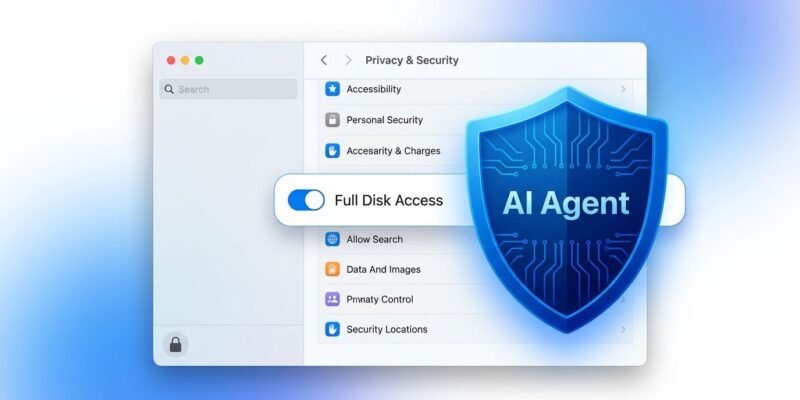
A journalist’s AI agent referenced 187,000 private messages he says he never authorized it to see. Meta disputed the claim. Apple did not wait for the argument to settle. On October 2, Apple issued a developer notice announcing it will tighten macOS Full Disk Access controls — and it named AI agents as the reason. If you are shipping a macOS desktop agent, your permission architecture is now on a clock.
What Apple Said
The notice was blunt. “Some developers are using Full Disk Access in ways that could put users at risk,” Apple wrote in a developer notice covered by TechCrunch, “exposing everything on their systems — including files, mail, messages, and even browsing history — without users’ full knowledge and understanding.” Users who want to grant Full Disk Access will soon need to take “very explicit user action,” a higher bar than the current single toggle in System Settings.
Apple went further: “As AI agents become increasingly capable and autonomous, the risks associated with this level of access will grow substantially.” That sentence is not about the past. It is a statement about the direction of travel — and a signal that this announcement is the first, not the last.
What Apple did not provide: a macOS version, a shipping date, or a technical specification for what “very explicit user action” means. This is intent, not shipping code. Treat it as a runway, not a deadline — but start using it.
The Incident That Started It
Technology journalist Jason Aten reported that Meta’s Muse AI agent — running on his Mac — referenced a private Messages thread he had with a podcast cohost. Muse offered to research a topic from that conversation and surface it as a draft article. Aten said he had not granted Muse access to his messages. Meta disputed the account via MacRumors: three separate permission steps stand between Muse and a user’s Messages database, and Meta says none of those steps can be bypassed by a bug.
The dispute is somewhat beside the point. If Meta is right, users are granting sweeping permissions during onboarding without understanding what they have authorized. If Aten is right, something bypassed what should have been a locked gate. Either scenario is exactly the kind of incident that forces a platform response — and Apple responded.
Why Full Disk Access and AI Agents Are a Bad Combination
Full Disk Access was designed for tools with narrow, bounded tasks: backup software that copies your entire drive, AV scanners that need to read every file. With those tools, the permission scope and the task scope match. You understand what the software will do with access.
AI agents destroy that alignment. An agent granted Full Disk Access has every file, every message thread, and every browser history entry available for every session — even when the user’s actual task is “help me draft a reply.” The agent’s reach is not bounded by the task. And because agents chain tools — read a file, pass context to the model, act on content, write outputs — a single permission grant becomes authorization for a chain of behaviors the user never anticipated.
This is not a bug. It is an architectural mismatch between a permission system designed for 2014 software patterns and agents that operate like autonomous services.
What macOS Developers Should Do Now
Apple has not set a deadline. That does not mean you have unlimited time.
- Audit your Full Disk Access request. Do you need full disk access, or do you need access to a specific directory? Most agents request FDA because it is the path of least resistance — it is rarely the minimum necessary permission.
- Replace FDA with granular entitlements. If your agent needs Messages, request the Messages entitlement. If it needs Photos, request Photos access. If it needs the Desktop folder, scope to that. Match your permission request to your actual data requirements.
- Build transparent onboarding. Before asking for any permission, show users exactly what data the agent will access, why it needs it, and what actions may follow. Permission screens that explain consequences will perform better under Apple’s new UX direction — and they build user trust that blanket FDA requests cannot.
The next macOS major release is the most likely enforcement window — roughly a year of runway. Use it to redesign now rather than scramble after WWDC 2027.
The Broader Shift
Apple has spent a decade tightening iOS permissions — location, background execution, push notifications, camera, microphone. macOS was always the permissive counterpart, the platform where power users knew what they were granting. AI agents are changing that calculus, as 9to5Mac notes. When software can chain autonomous actions across your entire file system, the old trust model breaks down.
Microsoft ran into the same wall. Copilot+ Recall — which takes continuous screenshots of your desktop — was delayed before launch over privacy concerns. The underlying problem is the same: AI features that require broad access cannot be explained in a standard permission dialog, and users cannot meaningfully consent to behavior they cannot predict.
Apple is extending iOS-style privacy discipline to macOS because the alternative is autonomous agents that users cannot understand or control. The vague announcement is frustrating — developers deserve a technical specification and a timeline. But the direction is correct, and waiting for specifics before you audit your permission model is the wrong bet.