 By ByteBot
AMD put a pocket-sized mini-PC on Micro Center shelves this week that runs 200-billion-parameter models without a cloud subscription, a GPU cluster, or CUDA. The Ryzen AI Halo costs $3,999, ships in Windows 11 Pro and Linux variants, and fits in a bag. Within days of going on sale, Perplexity shipped a full production agent stack — orchestrator, scheduler, 27B model, sandbox — to run on it entirely on-device. If you have been waiting for local AI agent development to stop feeling like a weekend project, it just did.
What the Halo Actually Is
The Ryzen AI Halo is AMD’s direct answer to the NVIDIA DGX Spark in the emerging “agent computer” category. It runs the Ryzen AI Max+ 395 APU — 16 Zen 5 cores, a Radeon 8060S integrated GPU with 40 compute units, and a dedicated XDNA 2 NPU rated at 50 TOPS. The critical number is 128GB of LPDDR5X-8000 unified memory: because AMD pools CPU and GPU memory into a single flat address space, every gigabyte is accessible as VRAM. That is what makes running massive models possible without a discrete GPU.
It runs cool — peaks at 83W from the wall, APU tops at 53°C under sustained load — and comes with a 2TB PCIe 4 SSD, 10GbE LAN, Wi-Fi 7, and four USB-C ports. Both OS variants cost the same: $3,999. AMD is selling it exclusively through Micro Center in the US for now, in-store pickup only.
The XDNA 2 NPU deserves a separate mention. It draws about 20W independently, which means you can run a background model on the NPU — for completions, quick queries, or classification — while the iGPU handles your main inference workload. Neither the NVIDIA DGX Spark nor the Mac Studio can split inference across two compute units this way.
Perplexity Is Already Running Agent Stacks on It
The fastest signal that the Halo is production-grade is who built for it first. On September 24, Perplexity expanded Portable Computer to Windows PCs on Ryzen AI Max hardware. The bundle ships the full local agent stack: PPLX 27B (Perplexity’s own post-trained Qwen model), agent orchestrator, planner, scheduler, durable task queue, sandbox, and a content classifier. Connectors for Outlook, OneDrive, Google Drive, Gmail, Slack, and GitHub are included.
The key detail: local inference does not consume Computer credits. Cloud escalation requires explicit user permission. That changes the economics of running agents against private data — no tokens burned, no rate limits hit, no logs leaving the machine. The minimum hardware requirement is 24GB of GPU-accessible memory, which the Halo exceeds comfortably. Installation requires about 20GB of storage. Available to Pro and Max subscribers now.
How It Stacks Up Against the DGX Spark
The NVIDIA DGX Spark costs $4,699 and also ships with 128GB of unified memory. The $700 price gap deserves scrutiny before you dismiss the AMD option.
| Spec | AMD Halo ($3,999) | NVIDIA DGX Spark ($4,699) |
|---|---|---|
| Memory | 128GB unified | 128GB unified |
| Token decode speed | 256 GB/s bandwidth | 273 GB/s bandwidth |
| Long-context prefill | Baseline | ~5x faster |
| Image generation | ~4x slower | Baseline |
| Windows support | Yes (native) | No (Linux only) |
| NPU dual-role | Yes (XDNA 2) | No |
| CPU cores | 16 Zen 5 (x86) | Lower general compute |
| Thermals | 83W peak, 53°C | Runs hot to touch |
On token decode speed, the two boxes are nearly identical — a 7% memory bandwidth difference that is imperceptible in single-user inference. NVIDIA pulls ahead on long-context prefill: for large models, the Spark is roughly 5x faster at prompt processing. If your use case involves RAG over long documents or agentic loops with 32K+ token contexts, that matters. Image generation also favors NVIDIA by about 4x.
AMD wins on the rest: $700 cheaper, native Windows 11, 16 Zen 5 cores that make it a capable general-purpose workstation, the NPU dual-role capability, and better thermals. If you are building multi-user vLLM serving or plan to cluster nodes, the Spark makes more sense. For a solo developer or small team running one model at a time, the Halo is the stronger buy.
The Economics of Cutting the API
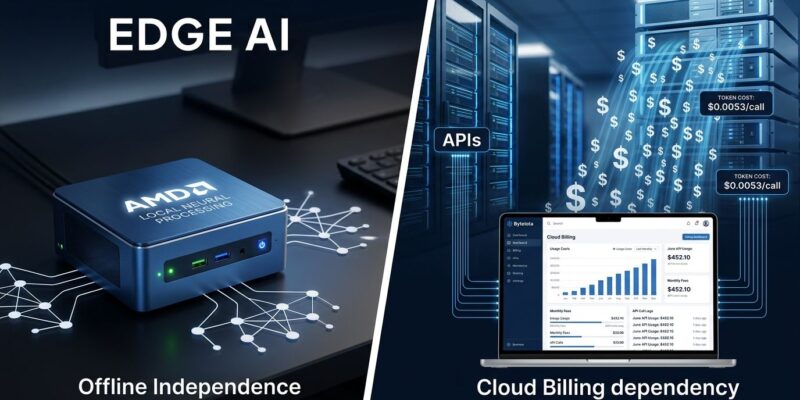
Here is the math that makes this hardware worth taking seriously. Cloud inference at Claude Sonnet pricing runs roughly $20 per million tokens. Running agent pipelines, code review automation, or document processing at 5 million tokens a day costs about $22,500 a month. A $3,999 Halo amortized over 24 months, plus electricity, runs roughly $247 a month for unlimited local inference. The break-even is approximately 2 million tokens per day — reachable for teams with active agentic workflows.
Privacy matters equally for many workloads. Running inference locally means no data leaves the machine, no API logs exist, and no terms of service restrict what the model can be used for. For anything touching customer data, legal documents, or proprietary code, that changes the compliance picture entirely.
What Actually Runs on It
ROCm 7.2 is the first AMD software release where Ollama, llama.cpp, LM Studio, and vLLM reach CUDA-comparable behavior on AMD hardware without hand-patching. In practice: ollama run llama3 on a Ryzen AI Max system works as smoothly as on an RTX 4090. Confirmed configurations include 122B-class models running at usable inference speeds on 128GB unified memory.
For llama.cpp specifically: the Vulkan backend works on both Windows and Linux with the broadest compatibility; the ROCm/HIP backend is Linux-only but faster on supported hardware. The XDNA 2 NPU has dedicated support through Lemonade Server. The upcoming Ryzen AI Max PRO 495 variant — expected through OEM partners in Q4 2026 — will support 192GB unified memory, enough to load 300B-parameter models at 4-bit quantization. Independent benchmarks at that scale have not been published yet, so treat AMD’s 300B marketing claim as a weight-loading statement, not a proven inference-speed result.
Bottom Line
The Ryzen AI Halo is the first AMD hardware that makes building and running local AI agents a real option for individual developers — not just teams with GPU budgets. It runs cool, handles mainstream workloads as a daily driver, supports Windows natively, and now has at least one production agent platform committed to it. At $3,999, it undercuts the DGX Spark by $700 while losing only in scenarios that matter at scale: long-context prefill and multi-user serving.
If you are building agents that process private data, running automated pipelines with high token volume, or want to stop watching API costs compound, the Halo is worth a trip to Micro Center.